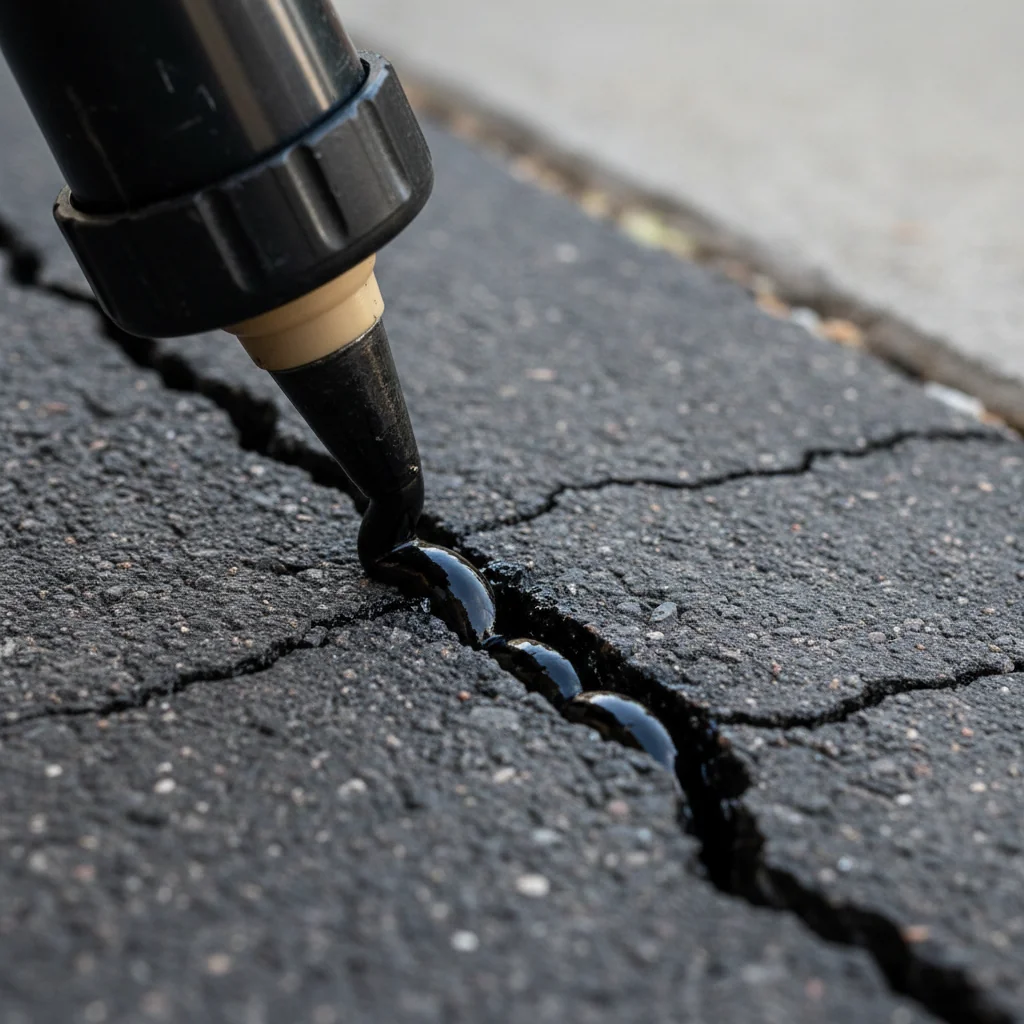
Asphalt driveway repair costs $1 to $3 per linear foot for crack filling and $0.20 to $0.50 per square foot for sealcoating. A typical 600-square-foot driveway with moderate cracking runs $200 to $500 for a professional repair. That's a fraction of the $1,800 to $4,200 you'd spend on a full replacement.
The catch is knowing which type of repair your driveway actually needs. A hairline crack and an alligator-cracked surface require completely different approaches. Pick the wrong one and you waste your money.
Below: every repair method, what each one costs, how to tell whether your driveway needs a patch job or a full tear-out, and which repairs you can handle yourself on a Saturday.
Asphalt Driveway Repair Costs at a Glance
Here's what you'll pay for the most common asphalt driveway repairs in 2026:
| Repair Type | Cost Range | Best For |
|---|---|---|
| Crack filling | $1 - $3/linear ft | Cracks under 1/2 inch wide |
| Crack sealing | $2 - $5/linear ft | Cracks 1/2 to 1 inch wide |
| Pothole patching | $50 - $200 each | Isolated potholes and depressions |
| Sealcoating | $0.20 - $0.50/sqft | Surface protection every 2-3 years |
| Resurfacing (overlay) | $2 - $5/sqft | Widespread surface damage, solid base |
| Full replacement | $3 - $7/sqft | Base failure, alligator cracking |
Prices include labor and materials. Actual costs vary by region, with higher rates in the Northeast and West Coast.
For a standard 600-square-foot two-car driveway: crack filling for 50 feet of cracks runs $50 to $150. Sealcoating the whole surface costs $120 to $300. Full resurfacing jumps to $1,200 to $3,000. These numbers assume you hire a contractor. DIY cuts costs by 40 to 60 percent for most repair types.
Crack Filling and Crack Sealing
Cracks are the most common asphalt driveway problem. They're also the most urgent to fix. Water seeps into cracks and freezes in winter. The ice expands, widening the crack every cycle. One winter turns a hairline into a quarter-inch gap. Two winters turn that gap into a pothole.
When to Use Crack Filler
Best for cracks under 1/2 inch wide. Crack filler is a liquid or paste product that you pour or squeeze into narrow cracks. It bonds to the sides of the crack and creates a flexible seal. Most hardware stores carry it in pour-bottles or caulk-style tubes for $5 to $15 per container, and one container covers roughly 20 to 50 linear feet depending on crack width.
The simplest DIY asphalt repair. Clean the crack with a wire brush or leaf blower, apply the filler, let it cure 24 hours. Done. The whole process takes less than an hour for a typical driveway. Professional crack filling runs $1 to $3 per linear foot, so a driveway with 50 feet of cracking costs $50 to $150.
When to Use Crack Sealant
Best for cracks 1/2 inch to 1 inch wide. Crack sealant is a hot-applied rubberized material that stays flexible after curing. Contractors heat it to 350-400°F and pour it into the crack using a specialized applicator. The rubber compound expands and contracts with temperature changes instead of cracking again.
Crack sealing costs $2 to $5 per linear foot professionally. You can buy cold-pour versions at hardware stores for DIY application, though they don't perform quite as well as hot-applied sealant. For cracks wider than 1 inch, you'll need to fill the bottom with sand or backer rod first, then apply sealant on top.
Patching Potholes and Depressions
Potholes form when water penetrates the asphalt surface and weakens the base material underneath. Traffic loads then collapse the weakened spot. They start small. They grow fast once the edges begin crumbling.
Cold Patch (DIY Method)
Cost: $15 to $30 per bag (covers 1-2 small potholes)
Cold patch is a pre-mixed asphalt product sold in 50-pound bags at hardware stores. You shovel it into the pothole, tamp it down, and drive over it to compact it further. Cold patch is a temporary fix that typically lasts 1 to 2 years before it loosens and needs reapplication. It works in any weather, though, which makes it useful as an emergency repair during winter.
For the best results: clean all loose debris from the pothole, cut the edges vertically with a chisel so the patch has clean walls to bond against, fill the hole in 2-inch layers (tamping each layer), and overfill slightly since it will compact down. A tamping tool or the back of a shovel works for small patches. For larger ones, rent a plate compactor for $75 to $125 per day.
Hot Mix Patch (Professional Method)
Cost: $50 to $200 per pothole
Professional patching uses hot mix asphalt, the same material used for new driveways. Contractors cut out the damaged area in a clean rectangle (saw-cut edges bond better than ragged ones), remove the failed base material, compact fresh gravel, and apply hot mix in layers. The result is a permanent repair that lasts as long as the surrounding driveway.
Hot mix patching costs more per spot, but you only pay once. If you have five or more potholes, most contractors will give volume pricing in the range of $20 to $50 per patch. The minimum service call fee is typically $150 to $250 regardless of how many patches you need, so it makes sense to batch multiple repairs into one visit.
Sealcoating: The Preventive Maintenance Step
Sealcoating is the single best thing you can do to extend your asphalt driveway's life. It applies a thin protective layer over the entire surface that blocks UV rays, water, oil drips, and brake fluid from penetrating the asphalt.
An unsealed asphalt driveway oxidizes in sunlight, turning from black to gray over 2 to 4 years. That gray color isn't just cosmetic. It means the asphalt binder is drying out and becoming brittle, which leads to cracking. Regular sealcoating keeps the binder flexible and can double the lifespan of your driveway.
What Sealcoating Costs
| Driveway Size | DIY Cost | Professional Cost |
|---|---|---|
| Small (300 sqft) | $30 - $60 | $60 - $150 |
| Standard (600 sqft) | $60 - $100 | $120 - $300 |
| Large (1,000 sqft) | $100 - $160 | $200 - $500 |
DIY costs include sealer ($15-$20 per 5-gallon bucket, covers ~300 sqft) plus supplies. Professional costs include cleaning, crack repair, and two coats.
DIY Sealcoating Process
One of the more satisfying DIY projects you can do on a house. Your faded gray driveway turns jet black in an afternoon. Here's the process:
- Clean the surface. Sweep all debris, pull weeds from cracks, and use a degreaser on oil stains. Sealant won't bond to dirty asphalt. A pressure washer speeds this up dramatically.
- Fill all cracks first. Apply crack filler to anything wider than a pencil lead and let it cure overnight. Sealcoat won't bridge cracks.
- Edge the driveway. Apply painter's tape along your garage door seal, walkway edges, and any concrete borders you want to protect.
- Apply the first coat. Pour sealer in a ribbon across the width of the driveway and spread it with a squeegee or brush applicator. Work in sections, moving toward your exit. Keep the coat thin and even.
- Wait 4 to 8 hours, then apply the second coat. Two thin coats outperform one thick coat. The first coat fills the asphalt pores. The second coat creates the protective surface.
- Stay off it for 24 to 48 hours. Full cure takes 24 hours for foot traffic, 48 hours for vehicles. Plan around this, especially if your driveway is your only parking spot.
How Often to Reseal an Asphalt Driveway
Most professionals recommend sealcoating every 2 to 3 years. In mild climates with little freeze-thaw cycling, every 4 to 5 years is fine. Over-sealing (every year) actually causes problems. Too many layers build up, crack in sheets, then flake off in chunks. If your last sealcoat still looks dark and uniform, leave it alone.
The cost to reseal an asphalt driveway over its lifetime adds up, but the math is straightforward: spending $120 to $300 every three years is far cheaper than a $2,000 to $4,000 replacement that happens 10 years sooner because you skipped maintenance.
Resurfacing vs. Replacement: When Each Makes Sense
The most expensive decision you'll face with an aging asphalt driveway. Resurfacing costs $2 to $5 per square foot. Full replacement costs $3 to $7 per square foot. On a 600-square-foot driveway, that gap is $600 to $1,200. Knowing when each option makes sense saves real money.
Resurfacing (Overlay)
Cost: $1,200 to $3,000 for a standard driveway
Resurfacing means applying a new 1.5- to 2-inch layer of hot mix asphalt over your existing driveway. The old surface becomes the base. It works when the underlying base is still solid but the surface has extensive cracking, fading, minor depressions, or some combination of all four.
Good candidates for resurfacing:
- Surface cracking that's widespread but shallow (doesn't extend through the full asphalt depth)
- Faded, oxidized surface that's too far gone for sealcoating
- Minor depressions or low spots (up to about 1 inch deep)
- Cosmetic damage from oil stains or tire marks that sealcoating can't cover
Resurfacing won't fix base problems. If your driveway has areas that flex or bounce when you drive over them, the base underneath has failed. An overlay on top of a bad base will crack within 1 to 2 years.
Full Replacement
Cost: $1,800 to $4,200 for a standard driveway
Full replacement tears out the old asphalt and base, re-grades the site, installs new compacted gravel base, and lays fresh asphalt. The only option when the base has failed. For more detail on new installation costs, see our asphalt driveway cost guide.
How to Tell If Your Driveway Needs Repair or Replacement
The type of cracking tells you almost everything about whether your driveway can be saved.
Cracks You Can Repair
Linear cracks run in relatively straight lines, usually following the direction of traffic or appearing along the edges. They're caused by the asphalt contracting in cold weather or by minor settling. These are surface-level problems. Fill them, seal them, and move on.
Block cracking creates a pattern of large rectangular segments, typically 1 to 3 feet across. The asphalt binder has dried out from age or lack of sealcoating. If the blocks are still sitting flat and the base feels solid underneath, sealcoating after crack filling can extend the driveway's life by several more years. Blocks that shift or rock when you step on them point toward replacement.
Cracking That Means Replacement
Alligator cracking is the red flag. It looks like the scales on an alligator's back: a dense network of interconnected cracks forming irregular polygons, usually 1 to 6 inches across. The base has failed. Water saturated the gravel or soil underneath, and the asphalt no longer has structural support.
No amount of crack filling or sealcoating fixes alligator cracking. You can patch individual spots as a short-term measure, but the underlying problem will spread. When you see alligator cracking covering more than 25 to 30 percent of your driveway, plan for full replacement.
DIY vs. Hiring a Contractor
Some asphalt repairs are genuinely easy DIY projects. Others require equipment and materials that aren't practical for homeowners.
| Repair Type | DIY Difficulty | DIY Savings | Recommendation |
|---|---|---|---|
| Crack filling | Easy | 60 - 80% | DIY. Buy a pour bottle and do it yourself. |
| Cold patching | Easy | 50 - 70% | DIY for 1-2 potholes. Hire for more. |
| Sealcoating | Moderate | 50 - 60% | DIY if you're comfortable with a squeegee. |
| Hot crack sealing | Hard | N/A | Hire. Requires heated equipment. |
| Resurfacing | Not feasible | N/A | Hire. Requires paving equipment. |
| Replacement | Not feasible | N/A | Hire. Major excavation and paving job. |
For the DIY-friendly repairs, the investment is minimal. A crack filler bottle ($8 to $15), a bag of cold patch ($15 to $30), a 5-gallon bucket of driveway sealer ($15 to $20), and maybe a tamping tool ($20). Total materials cost for a full DIY maintenance session: $40 to $85. A contractor charges $200 to $400 for the same work.
How to Save Money on Asphalt Driveway Repair
Fix cracks the same season they appear. A $10 bottle of crack filler in May prevents a $50 pothole by November. Water is the enemy. Every crack that stays open through a winter gets worse.
Bundle repairs into one contractor visit. Most paving contractors charge a minimum service fee of $150 to $250. If you need crack sealing and a pothole patched, doing them together means you only pay that minimum once. Some contractors offer annual maintenance packages that include sealcoating, crack filling, and minor patching for a flat fee.
Get multiple quotes but be specific. Tell each contractor exactly what you need: "50 linear feet of crack sealing and 2 potholes patched" gets you comparable quotes. "My driveway needs work" gets you three wildly different proposals. Ask for hot-pour crack sealing specifically if your cracks are wider than half an inch.
Schedule in late summer or early fall. Paving companies are busiest in spring when homeowners notice winter damage. By August and September, their schedules loosen up and you're more likely to get competitive pricing. The weather is still warm enough for proper curing.
Don't over-maintain. Sealcoating every year is wasteful. Filling hairline cracks you can barely see is unnecessary. Focus your budget on cracks wider than a pencil lead and any area where water pools after rain.
Asphalt Repair and Paving: Choosing a Contractor
The asphalt repair and paving industry has more than its share of fly-by-night operators. Scam artists patrol neighborhoods with leftover material from commercial jobs, knock on doors, and offer "great deals" on driveway sealing. Their work peels off within months.
What to look for when hiring:
- Local business with a physical address. Companies that work out of a truck with no office have no accountability.
- Written estimate with specific quantities. The quote should list linear feet of cracking, square footage for sealcoating, and number of patches. Vague quotes lead to vague results.
- Photos of recent local work. Ask for addresses of driveways they've repaired in the last 6 months so you can drive by and see the quality.
- No payment until the work is inspected. Reputable contractors don't demand full payment upfront. A deposit of 10 to 25 percent is reasonable for larger jobs.
Expect to pay a premium over the lowest bid. The cheapest quote often means the thinnest sealcoat layer or cold-pour crack filler instead of hot-applied sealant. Neither lasts. A quality contractor using proper materials at $0.40 per square foot for sealcoating will outperform a bargain operator at $0.20 per square foot every time.
The Bottom Line
Most asphalt driveway repairs are cheap. Crack filling runs $1 to $3 per linear foot. Sealcoating costs $0.20 to $0.50 per square foot. Both are easy enough to do yourself on a Saturday afternoon. Do them on schedule and your driveway lasts 20 to 25 years. Skip them and you're looking at a $2,000 to $4,000 replacement a decade early.
The one thing to watch for is alligator cracking. When you see that interconnected web pattern spreading across your driveway, stop spending money on surface repairs. The base has failed, and the only real fix is replacement. Hairline cracks, faded sealcoat, isolated potholes, minor depressions: all fixable at a fraction of replacement cost.