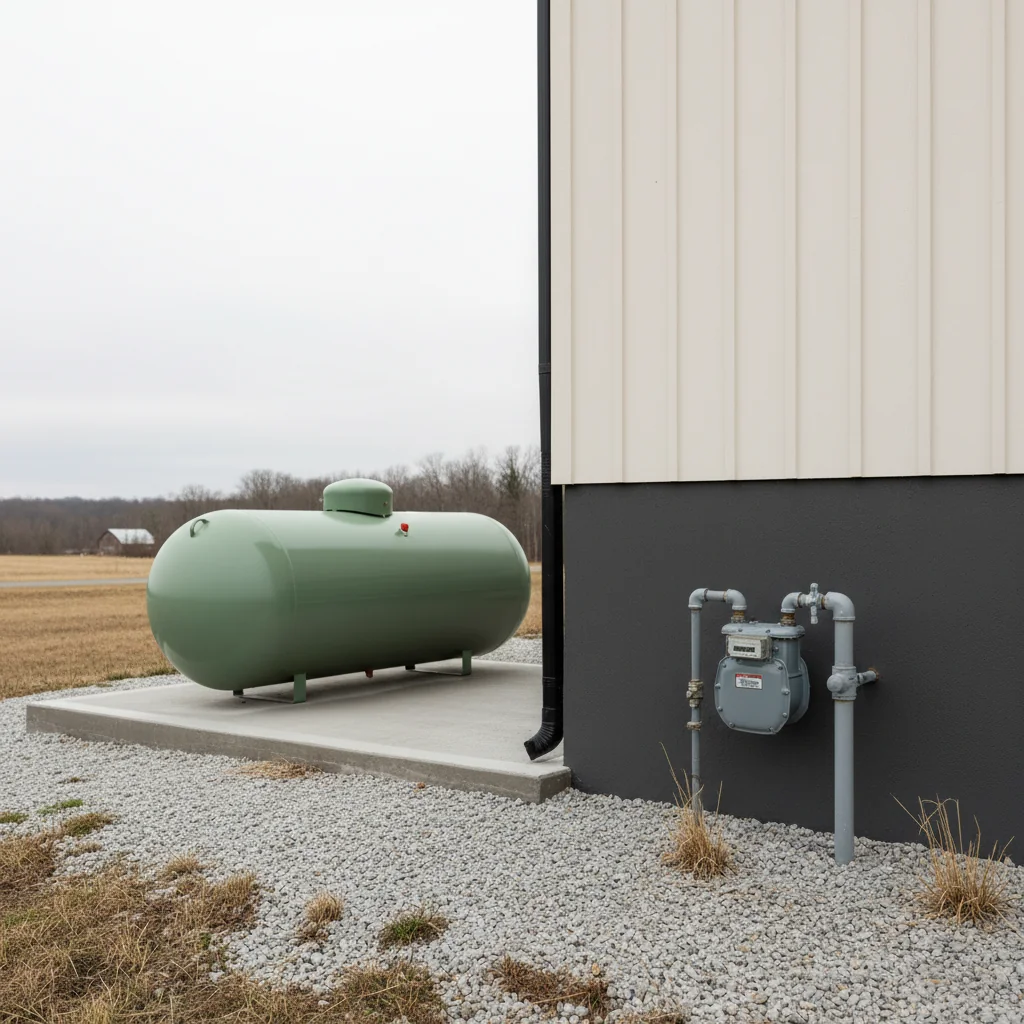
Propane and natural gas are both popular heating fuels, but they are not interchangeable — and the cost difference between them can be substantial. If you are building a new home, converting from one fuel to another, or simply trying to understand your heating bills, this head-to-head comparison covers everything you need to know about propane vs natural gas heating costs in 2026.
To see how the fuels compare where you live, the heating cost by state table lists the annual cost of each one in all 50 states.
The short answer: natural gas is almost always cheaper than propane for home heating. At national average prices for the 2025–26 heating season, natural gas costs about $16 per million BTU delivered, while propane costs about $30 — roughly twice as much. But availability often dictates the choice: if your home does not have access to a natural gas line, propane may be your best gas-fired option.
BTU Content: Propane vs Natural Gas
To compare these fuels fairly, you need to understand the energy content of each:
| Property | Propane | Natural Gas |
|---|---|---|
| BTU per unit | 91,500 BTU/gallon | 100,000 BTU/therm |
| Common unit | Gallons | Therms or CCF |
| Delivery method | Truck to on-site tank | Underground pipe |
| Storage required | Yes (above/below ground tank) | No (on demand) |
One gallon of propane contains 91,500 BTU of energy. One therm of natural gas contains 100,000 BTU. So on a raw energy basis, a therm of natural gas contains about 9% more energy than a gallon of propane. But the real cost difference comes from the price per unit, not the BTU content.
Efficiency: Both Fuels Are Similar
Both propane and natural gas furnaces are available in the same efficiency ranges, because both burn in virtually identical equipment. The AFUE (Annual Fuel Utilization Efficiency) ratings break down as follows:
- Standard efficiency furnace: 80% AFUE — available for both propane and natural gas
- Mid-efficiency furnace: 90-92% AFUE — available for both fuels
- High-efficiency condensing furnace: 95-98% AFUE — available for both fuels
Because the efficiency ratings are the same for both fuels, the cost comparison boils down to a straightforward question: how much does each fuel cost per BTU?
Price Comparison: National Averages
At U.S. average residential prices for the 2025–26 heating season (EIA), the cost difference is stark:
| Metric | Propane | Natural Gas |
|---|---|---|
| Average unit price | $2.55/gallon | $1.43/therm |
| BTU per unit | 91,500 | 100,000 |
| Cost per raw million BTU | $27.87 | $14.30 |
| Cost at 80% AFUE ($/MMBTU delivered) | $34.84 | $17.88 |
| Cost at 92% AFUE ($/MMBTU delivered) | $30.29 | $15.54 |
| Cost at 96% AFUE ($/MMBTU delivered) | $29.03 | $14.90 |
Source: U.S. Energy Information Administration (EIA), residential average prices
Even with a high-efficiency propane furnace (96% AFUE) compared against a standard natural gas furnace (80% AFUE), natural gas still costs about 40% less — $17.88 vs $29.03 per million BTU delivered. Upgrading your propane furnace to high efficiency helps, but it cannot close the gap.
State-by-State Comparison
National averages mask significant regional variation. The table below shows propane and natural gas prices in select states along with the resulting cost per million BTU (assuming a 92% AFUE furnace for both).
| State | Propane $/gal | Gas $/therm | Propane $/MMBTU | Gas $/MMBTU |
|---|---|---|---|---|
| Texas | $2.94 | $2.02 | $34.93 | $21.96 |
| Ohio | $2.58 | $1.20 | $30.65 | $13.04 |
| Minnesota | $1.95 | $1.04 | $23.16 | $11.30 |
| Pennsylvania | $2.93 | $1.44 | $34.81 | $15.65 |
| New York | $3.53 | $1.65 | $41.93 | $17.93 |
| Virginia | $3.46 | $1.62 | $41.10 | $17.61 |
| Michigan | $2.26 | $1.03 | $26.85 | $11.20 |
| North Carolina | $3.36 | $1.78 | $39.91 | $19.35 |
| Wisconsin | $1.91 | $1.10 | $22.69 | $11.96 |
| Connecticut | $3.83 | $1.69 | $45.50 | $18.37 |
Source: U.S. Energy Information Administration (EIA), state-level residential prices, 2025–26 heating-season averages. Cost per MMBTU assumes 92% AFUE furnace.
In every state listed, natural gas is significantly cheaper than propane — propane runs 1.6 to 2.5 times the cost. The gap is narrowest in Texas, where residential gas is unusually expensive, and in Wisconsin and Minnesota, where Midwest propane is cheap. It is widest in Connecticut, Michigan, Ohio and New York.
When Propane Makes Sense Despite the Cost
Given the cost disadvantage, why do roughly 5 million American households heat with propane? The answer is almost always availability:
- Rural areas without gas lines: Natural gas pipelines serve cities and suburbs, but many rural homes are miles from the nearest gas main. Extending a gas line can cost $10,000 to $50,000+ depending on distance, making it impractical for many homeowners.
- Backup and supplemental heating: Some homeowners use propane for a gas fireplace, pool heater, or backup generator even when their primary heat is electric or oil.
- Off-grid properties: Propane works anywhere a delivery truck can reach. No utility connection is required.
- Cooking and hot water: Some households prefer gas cooking or gas water heating and use propane to fill that role when natural gas is unavailable.
If your home currently heats with propane and you have access to a natural gas line, switching to natural gas is one of the highest-return home energy upgrades you can make. The conversion typically costs $2,000-$5,000 (for a new gas furnace and hookup) and can cut a $2,000-$4,000 annual propane bill roughly in half, paying for itself in two to four seasons.
Propane vs Natural Gas: Beyond Operating Cost
Cost per BTU is the most important factor, but there are other considerations:
Safety
Both fuels are safe when properly installed and maintained. One key difference: natural gas is lighter than air and rises when it leaks, while propane is heavier than air and pools at ground level. Both have odorants added (mercaptan) so leaks can be detected by smell. Propane tanks require periodic inspection, while natural gas has no on-site storage to maintain.
Environmental Impact
Natural gas produces about 117 pounds of CO2 per million BTU. Propane produces about 139 pounds per million BTU. Both are cleaner than heating oil (163 lbs/MMBTU). On a per-BTU-delivered basis, natural gas has a lower carbon footprint — and because it costs less, you are also likely to use a more efficient system.
Price Volatility
Propane prices are more volatile than natural gas, especially in winter. Cold snaps can cause propane prices to spike 50% or more in a matter of weeks because supply depends on truck deliveries and regional storage. Natural gas prices are more stable because the pipeline system provides continuous supply. Propane users can manage volatility by filling their tank in summer when prices are lower or by locking in a price with their supplier for the heating season.
Equipment and Maintenance
Propane and natural gas furnaces are very similar. In many cases, a furnace can be converted from one fuel to the other by swapping the burner orifices and adjusting the gas valve — a job that typically costs $150-$500 for a technician. Boilers, water heaters, and gas fireplaces can also be converted. Maintenance requirements are essentially identical for both fuels.
What About Heat Pumps as an Alternative?
If you heat with propane and do not have access to natural gas, a heat pump may be a better alternative than staying with propane. At the national average electricity price of $0.182/kWh, a heat pump with COP 3.0 delivers heat for about $18 per million BTU — roughly 40% less than propane.
In states with cheap electricity (the Pacific Northwest, parts of the Southeast), the savings are even larger. Even in states with moderate electricity prices ($0.14-$0.18/kWh), a heat pump typically beats propane by 40-60%. The main exception is very cold climates where heat pump efficiency drops significantly, though modern cold-climate models have narrowed that gap considerably.
The Inflation Reduction Act offers up to $8,000 in heat pump rebates for qualifying households, which can make the switch from propane to a heat pump financially compelling even in colder regions.
How to Reduce Your Propane Costs
If you are stuck with propane and switching is not an option, these strategies can reduce your bills:
- Upgrade to a high-efficiency furnace. Going from 80% to 96% AFUE saves 17% on fuel. At $2,500/year in propane costs, that is $425/year in savings.
- Pre-buy propane in summer. Propane is cheapest from June through September. Many suppliers offer pre-buy or locked-price contracts that protect against winter spikes.
- Shop multiple suppliers. Propane prices are not regulated, and quotes can vary by $0.30-$0.50/gallon between companies. Get at least three quotes before each fill.
- Improve insulation and air sealing. Reducing heat loss means buying fewer gallons. Attic insulation and air sealing typically pay for themselves in 2-3 years.
- Use a programmable thermostat. Setbacks of 5-8 degrees during sleep and away times can reduce consumption by 10-15%.
- Supplement with a heat pump. A ductless mini-split in your most-used living area can handle moderate days while the propane furnace covers the coldest nights. This hybrid approach can cut propane use by 30-50%.
The Bottom Line
Natural gas is consistently and significantly cheaper than propane for home heating — about half the cost per BTU delivered at current prices. This is true in every state except Hawaii.
The decision tree is straightforward:
- If you have access to natural gas: Use it. It is the cheapest gas heating option, period.
- If you currently heat with propane and gas is available nearby: The conversion typically pays for itself within 1-3 heating seasons.
- If you heat with propane and gas is not available: Consider a heat pump as an alternative — it is likely cheaper than propane in your area, especially with IRA rebates.
- If you must stay with propane: Upgrade efficiency, pre-buy fuel in summer, and shop suppliers aggressively.
For a personalized cost comparison using your state's actual energy prices, use our free heating cost calculator. It compares propane, natural gas, heat pumps, and seven other heating options side by side.