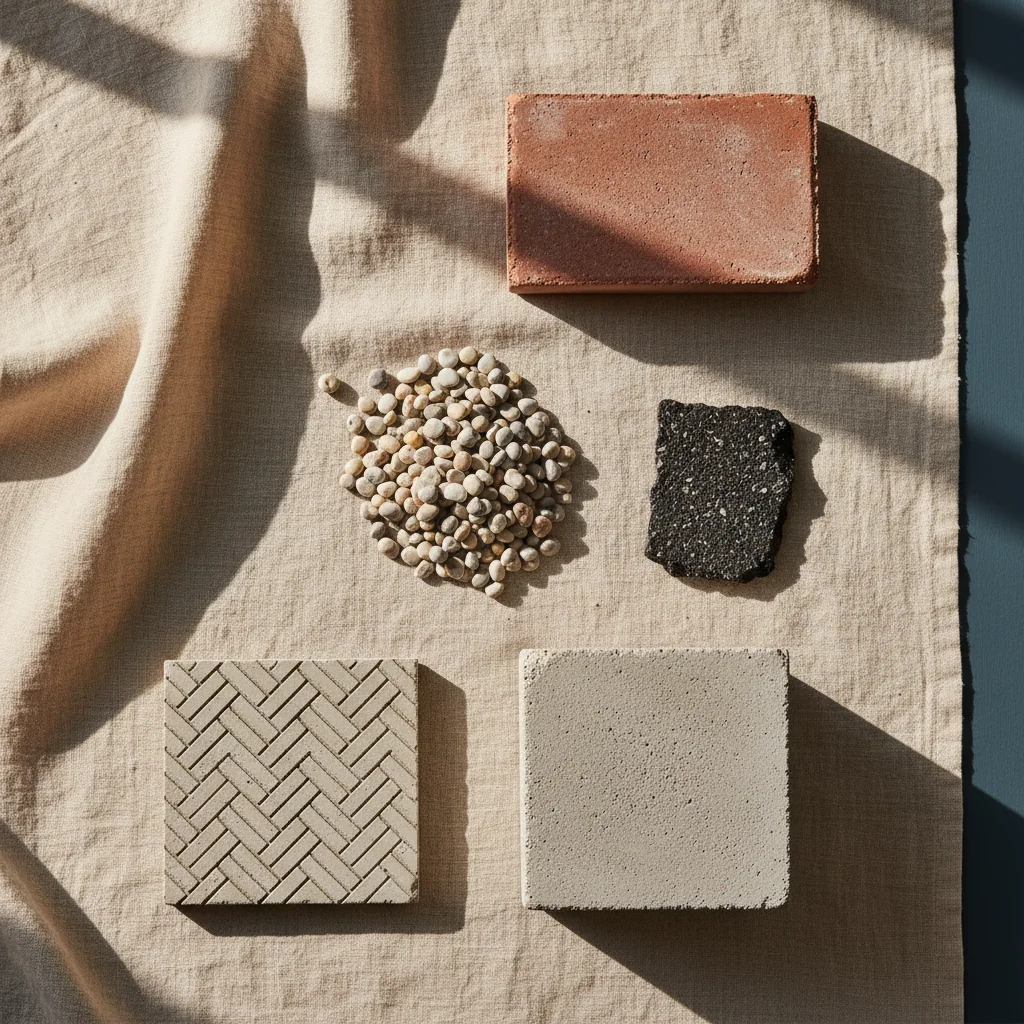
The quick answer: gravel is the cheapest driveway material upfront at $1 to $3 per square foot. But upfront cost is only half the story. When you factor in how long each material lasts, how much you spend maintaining it each year, and when you will need to replace it entirely, the cost-per-year ranking changes significantly. Asphalt and concrete often end up being the best value over the life of your home.
We calculated the true annual cost for all five common driveway materials using national average prices, realistic lifespans, and typical maintenance expenses. Below is the full breakdown so you can compare options and make a decision based on what you will actually spend over time, not just what the contractor quotes you on day one.
Why Cost Per Year Matters More Than Upfront Cost
Most homeowners compare driveways by looking at the installation quote. That is understandable — it is the number staring you in the face. But driveways are not one-time purchases. They are long-term investments that need maintenance and eventually need replacement. The only fair way to compare them is to spread the total cost over the number of years each one lasts.
Here is a simple example. An 800 gravel driveway that lasts 10 years before needing a complete refresh costs $80 per year just in installation. Add $100 per year in maintenance (regrading, adding material), and you are at $180 per year. A $3,600 concrete driveway that lasts 30 years costs $120 per year in installation, plus maybe $30 per year in maintenance, for $150 per year. The concrete driveway is actually cheaper on an annual basis despite costing four times more upfront.
This is the principle behind cost per year — sometimes called annualized cost or lifecycle cost. It captures the full picture: installation, maintenance, sealing, patching, and the eventual replacement that every driveway material requires.
The formula is straightforward:
True Cost Per Year = (Total Installation Cost / Lifespan in Years) + Annual Maintenance Cost
We used this formula for every material below, using a standard 400-square-foot driveway (roughly a single-car-width driveway that is 12 feet wide and 33 feet long) at national average prices.
All 5 Options Ranked by Cost Per Year
The table below ranks every common driveway material from lowest annual cost to highest. All figures assume a 400 sqft driveway at national average contractor prices, with typical maintenance schedules followed.
| Rank | Material | Upfront $/sqft | Total Cost | Lifespan | Maint./yr | True Cost/Year |
|---|---|---|---|---|---|---|
| 1 | Asphalt | $4 – $8 | $2,400 | 20 yrs | $50 | $170 |
| 2 | Concrete | $6 – $12 | $3,600 | 30 yrs | $30 | $150 |
| 3 | Gravel | $1 – $3 | $800 | 10 yrs | $100 | $180 |
| 4 | Stamped Concrete | $12 – $18 | $6,000 | 30 yrs | $50 | $250 |
| 5 | Pavers | $10 – $25 | $7,400 | 50 yrs | $60 | $208 |
National average prices based on contractor surveys, HomeAdvisor, and Angi data for 2025-2026. Maintenance costs assume typical recommended schedules are followed. Lifespan assumes proper installation and drainage.
The surprise result: Concrete and asphalt take the top two spots when ranked by annual cost, despite gravel being far cheaper upfront. Gravel lands in third place because its short lifespan and ongoing maintenance expenses add up. Pavers, despite their high upfront cost, are competitive thanks to their exceptional 50-year lifespan.
Let us dig into each material in detail.
1. Gravel — $180/Year
Gravel is the undisputed champion of low upfront cost. At $1 to $3 per square foot installed, a 400 sqft gravel driveway runs $400 to $1,200, with the national average landing around $800. That is roughly a quarter of what asphalt costs and a fifth of concrete. For homeowners on a tight budget, gravel gets you a functional driveway for the least amount of money down.
The catch is maintenance. Gravel driveways need regular upkeep to stay functional and presentable:
- Regrading every 1 to 2 years ($75 to $200 per session) to fix ruts, potholes, and uneven settling
- Adding fresh gravel every 2 to 3 years ($50 to $150) as material migrates, compacts, and washes away
- Weed control — gravel driveways are prone to weed growth through the surface, requiring herbicide or landscape fabric
- Snow removal is harder — plows can displace gravel, and you lose material every winter
When you add it all up, typical annual maintenance runs about $80 to $120 per year. Combined with the replacement cycle (most gravel driveways need a full refresh every 8 to 12 years), the annualized cost climbs to around $180 per year.
Best For
- Rural properties with long driveways where paving would cost tens of thousands of dollars
- Temporary solutions — if you plan to pave in a few years but need something functional now
- Budget-conscious homeowners who are comfortable with regular maintenance
- Large properties where a 1,000+ sqft driveway would be prohibitively expensive to pave
2. Asphalt — $170/Year
Asphalt hits the sweet spot between affordability and durability for many homeowners. At $4 to $8 per square foot installed, a 400 sqft asphalt driveway costs $1,600 to $3,200, with the national average around $2,400. That is three times the cost of gravel but only two-thirds the cost of concrete.
Asphalt driveways typically last 15 to 25 years with proper maintenance, with 20 years being a reasonable expectation for a well-installed driveway in a moderate climate. The key maintenance requirement is sealcoating:
- Sealcoating every 2 to 3 years ($0.15 to $0.25/sqft, or $60 to $100 for a 400 sqft driveway)
- Crack filling as needed ($50 to $150 per session, typically every 3 to 5 years)
- Patching for potholes or alligator cracking ($100 to $300 when needed)
Average annual maintenance comes to about $40 to $60 per year if you stay on top of sealcoating. Neglect the sealcoat and the lifespan drops dramatically — an unsealed asphalt driveway can start deteriorating in as little as 5 to 7 years, which would make it one of the most expensive options per year.
Asphalt also has a practical advantage in cold climates: it is flexible. Unlike concrete, it can absorb minor ground movement from freeze-thaw cycles without cracking. It also absorbs heat from the sun, which helps melt snow and ice faster in winter. When cracks do appear, staying ahead of them is cheap — see typical asphalt crack filling and sealing cost.
Best For
- Cold climates (Northeast, Midwest) where freeze-thaw cycles are common
- Budget-conscious homeowners who want a paved surface without concrete prices
- Homeowners who will commit to sealcoating on the recommended schedule
- Resale value — a well-maintained asphalt driveway looks clean and is expected by buyers in many markets
3. Concrete — $150/Year
Concrete offers the best balance of cost and durability among all driveway materials. At $6 to $12 per square foot installed, a 400 sqft concrete driveway costs $2,400 to $4,800, with the national average around $3,600. That is a significant investment compared to gravel or asphalt, but concrete pays for itself over time through its long lifespan and minimal maintenance needs.
A properly installed concrete driveway lasts 25 to 35 years, with many lasting 40 years or more in favorable climates. The maintenance requirements are modest:
- Sealing every 3 to 5 years ($0.10 to $0.20/sqft, or $40 to $80 for a 400 sqft driveway) — recommended but not strictly required
- Crack repair as needed ($50 to $150 per occurrence, typically infrequent)
- Power washing once a year to maintain appearance ($0 if DIY, $100 to $150 if hired out)
Annual maintenance averages $20 to $40 per year, making concrete the lowest-maintenance paved option. Combined with its 30-year average lifespan, concrete delivers the lowest true cost per year at roughly $150 for a standard driveway.
The main vulnerability of concrete is freeze-thaw damage. In cold climates, water seeps into hairline cracks, freezes, expands, and causes spalling (surface flaking). Road salt and deicing chemicals accelerate this process. If you live in a cold climate, make sure your contractor uses air-entrained concrete and applies a quality sealer after curing.
Best For
- Hot and moderate climates (South, Southwest, West Coast) where freeze-thaw is not a concern
- Homeowners who want low maintenance — concrete requires the least ongoing attention of any paved option
- Curb appeal — clean concrete with defined edges looks sharp and adds to home value
- Long-term homeowners who plan to stay in their house for 15+ years and want to recoup the investment
4. Stamped Concrete — $250/Year
Stamped concrete is regular concrete with a decorative pattern pressed into the surface before it cures. Common patterns mimic brick, cobblestone, slate, or natural stone. At $12 to $18 per square foot installed, a 400 sqft stamped concrete driveway costs $4,800 to $7,200, with the national average around $6,000. That is roughly 60 to 70 percent more than plain concrete for the same material underneath.
The lifespan of stamped concrete is essentially the same as regular concrete — 25 to 35 years — because the structural slab is identical. However, the maintenance requirements are slightly higher because the decorative surface needs extra care:
- Resealing every 2 to 3 years ($0.20 to $0.35/sqft, or $80 to $140 for a 400 sqft driveway) — more critical than with plain concrete because the sealer protects the color and pattern
- Color touch-ups may be needed every 5 to 10 years as the integral color fades from UV exposure
- Crack repair is more visible and harder to patch seamlessly because you need to match the pattern
Annual maintenance averages $40 to $60 per year. Combined with the higher upfront cost, stamped concrete comes in at about $250 per year — considerably more than plain concrete for what is fundamentally the same product with a decorative finish.
The value proposition of stamped concrete depends on what you are comparing it to. Versus plain concrete, it is a significant premium for aesthetics. But versus real stone or brick pavers, it delivers a similar look at 30 to 50 percent less cost.
Best For
- Homeowners who want the look of pavers or natural stone without the full paver price tag
- Moderate to warm climates where deicing chemicals will not damage the surface
- Homes where curb appeal is a priority — stamped concrete makes a strong first impression
- Shorter driveways where the per-square-foot premium does not result in a massive total cost difference
5. Pavers — $208/Year
Interlocking pavers (brick, concrete, or natural stone) are the premium driveway option. At $10 to $25 per square foot installed, a 400 sqft paver driveway costs $4,000 to $10,000, with the national average around $7,400. The wide price range reflects the variety of paver materials — standard concrete pavers sit at the low end, while natural stone (bluestone, travertine, granite) sits at the high end.
The standout feature of pavers is their exceptional lifespan of 40 to 50+ years. Unlike poured surfaces, individual pavers can be lifted and replaced if one cracks or stains, without disturbing the rest of the driveway. This modular design also makes pavers the best choice for areas with tree roots — you can lift a section, trim the root, relevel the base, and relay the pavers.
Maintenance requirements are moderate:
- Polymeric sand refilling every 3 to 5 years ($50 to $100) to keep joints sealed against weeds and insects
- Sealing every 3 to 5 years ($0.15 to $0.30/sqft, or $60 to $120 for a 400 sqft driveway) — optional but recommended for stain protection
- Weed and moss removal from joints ($25 to $50/year if not sealed)
- Releveling individual pavers that settle unevenly ($100 to $200 per occurrence, infrequent)
Annual maintenance averages $50 to $70 per year. Despite the high upfront cost, the 50-year lifespan brings the annual cost down to roughly $208 — which is actually less than stamped concrete per year. If you plan to stay in your home for decades, pavers can be a reasonable long-term investment.
Best For
- Luxury and high-value homes where appearance and property value matter
- Areas with heavy tree roots — pavers can be lifted and reset without demolition
- Homeowners who want a 50-year driveway and are willing to pay the upfront premium
- Climates with significant freeze-thaw — pavers flex with ground movement better than poured concrete
Other Cost Factors to Consider
The numbers above cover material and installation for a new driveway on a prepared base. But several additional factors can significantly affect your total project cost:
Demolition of Old Driveway
If you are replacing an existing driveway, you will need to demolish and haul away the old material first. This typically adds $2 to $4 per square foot ($800 to $1,600 for a 400 sqft driveway). Concrete demolition is at the higher end because it is heavier and harder to break up. Asphalt is cheaper to remove. Gravel usually does not need formal demolition — it can often be graded and used as a base for the new surface.
Drainage Requirements
Poor drainage is the number one killer of driveways. If your property does not drain water away from the driveway naturally, you may need to install a French drain, channel drain, or regrade the surrounding landscape. Drainage work adds $500 to $3,000+ depending on the scope. Skipping drainage to save money upfront almost always leads to premature driveway failure and more expensive repairs later.
Permits
Many municipalities require a permit for driveway installation or replacement, especially if you are changing the driveway footprint, altering drainage patterns, or working near the street right-of-way. Permit costs typically range from $50 to $300. Your contractor should handle the permit process, but it is worth asking about upfront.
Slope and Grading
A flat, level lot is the cheapest to pave. If your driveway is on a slope, the contractor may need to do additional grading, retaining walls, or drainage work. Steep driveways also limit your material options — gravel does not work well on slopes because it migrates downhill with every rainstorm. Asphalt and concrete handle moderate slopes well. For steep grades, concrete with a broom finish (for traction) or pavers are the best choices.
Regional Labor Costs
The national averages in this article are just that — averages. Labor costs vary dramatically by region. A concrete driveway that costs $9 per square foot in a mid-sized Midwestern city might cost $14 per square foot in the San Francisco Bay Area or $7 per square foot in a rural Southern town. Material costs are more consistent nationwide, but labor is the biggest variable. Always get at least three local quotes before making a decision.
Base Preparation
Every driveway needs a compacted gravel base beneath the surface material. For new construction on undisturbed soil, this is usually included in the installation quote. But if your soil is soft clay, has high water content, or was recently filled, additional base preparation (excavation, geotextile fabric, extra gravel) may be needed. This can add $1 to $3 per square foot to the project cost.
The Bottom Line
When you rank driveway materials by true cost per year instead of upfront price, the order changes in ways most homeowners do not expect:
- Concrete — ~$150/year (lowest annual cost, best for warm and moderate climates)
- Asphalt — ~$170/year (excellent value, especially in cold climates)
- Gravel — ~$180/year (cheapest upfront but maintenance adds up)
- Pavers — ~$208/year (high upfront cost offset by 50-year lifespan)
- Stamped Concrete — ~$250/year (decorative premium over plain concrete)
Gravel still makes sense for long rural driveways, temporary solutions, and homeowners who genuinely cannot afford a paved surface right now. But for a standard residential driveway where you plan to stay for at least 10 years, concrete and asphalt are the smartest financial choices when you consider the full lifecycle cost.
The best material for your specific situation depends on your climate, your budget, how long you plan to stay in your home, and how much maintenance you are willing to do. Our free driveway cost calculator lets you plug in your state, driveway dimensions, and preferred material to get a personalized cost estimate including annual maintenance projections.