
Tree Removal Cost Calculator
Tree removal costs $200–$750 for small trees (under 30 feet) and $1,500–$3,500+ for very large trees over 80 feet. Most residential jobs — a mature oak or large pine in a typical suburban yard — land in the $800–$1,800 range. Use the calculator below to get a more specific number, then read on for what actually drives the price.
When do you actually need to remove a tree? The clearest signs: dead or dying branches concentrated in the upper crown, fungal growth (mushrooms or conks) at the base of the trunk, a trunk that's hollow or has significant bark loss, or a noticeable lean that wasn't there before. Trees under stress from drought, road salt, or construction-damaged roots often look fine for years before they go — then start dropping large branches with no warning. Most arborists call this "sudden branch drop," and it's most common in mature oaks, elms, and large maples on hot, calm summer days. If a tree is within striking distance of your house, a car, or a play area, a dead or declining tree is a liability, not just an eyesore.
How long do trees typically last? In a forest, oaks and maples can live 200–400 years. In a suburban yard with compacted soil, limited root spread, drought stress, and occasional construction damage, the same species often start showing serious decline at 60–100 years. Signs that a tree is entering its decline phase: increasing deadwood in the canopy each year, bark that peels or splits without recovering, and a crown that's noticeably thinner than neighboring trees of the same species.
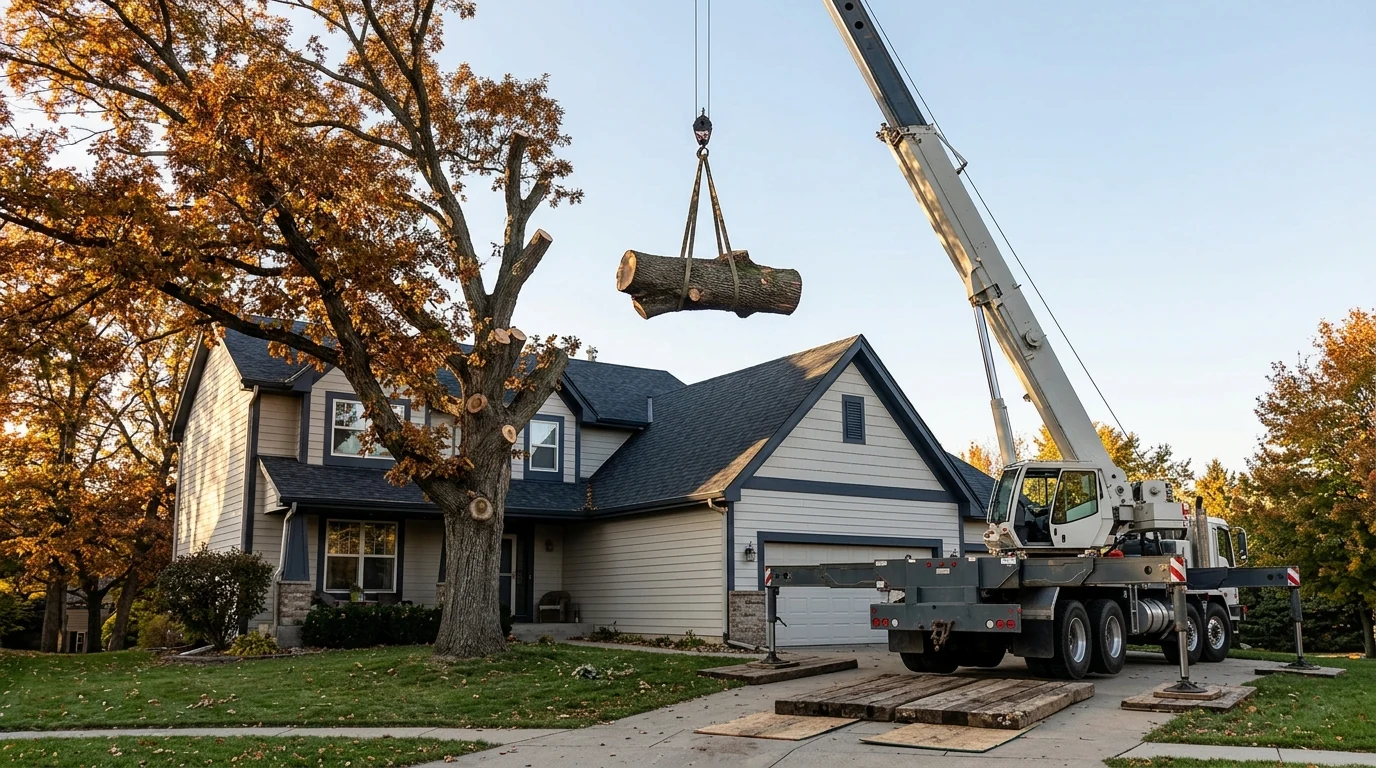
Access is where costs really vary. Most tree removal quotes assume the crew can get equipment to the base of the tree — usually meaning a truck-mounted chipper within about 100 feet. Backyard trees, especially in fenced lots, often can't be reached that way. In those cases, arborists either hand-carry sections of trunk out through a gate (slow, expensive labor) or bring in a crane. Crane removal typically adds $300–$800 to the job and requires enough clearance above the tree to lift sections straight up. Trees near power lines add another layer: in most areas the utility company has to send someone to either cut power or supervise, which can delay scheduling by days. If your tree is in a tight backyard with a narrow gate and power lines overhead, expect to pay 50–100% more than the base rate for the same size tree in an open front yard.
What's usually not included in the quote. Stump grinding is almost always a separate line item — budget $100–$400 depending on stump diameter. Hauling away the wood is typically included, but some contractors will chip it on-site and leave the mulch (often at a small discount). Permit fees, if required in your municipality, are usually your responsibility. And if there's any damage to a fence, irrigation system, or landscaping during removal, that's a separate negotiation — it's worth walking the path with the crew before they start.
1. Your Tree
Most companies offer 10–20% bulk discounts for multiple trees.
2. Site Conditions & Add-Ons
Dead trees can't be safely climbed — crews must use bucket trucks or cranes, adding $500–$1,500 to the job.
3. Your Tree Removal Estimate
Cost Breakdown
Estimates based on national average pricing. Actual costs depend on tree species, condition (dead/diseased trees may cost more), root system, accessibility, local permit requirements, and contractor availability. Emergency removal after storms typically costs 50–100% more. This is a planning tool — get at least 3 quotes from local arborists.
How This Calculator Works
This calculator estimates tree removal cost based on tree height, trunk diameter, site conditions, and add-on services.
Base cost is determined by tree height, which is the primary factor arborists use for pricing. Taller trees require more time, larger crews, and heavier equipment. Trunk diameter adds cost because thicker trunks take longer to cut and produce more debris.
Proximity surcharges apply when trees are near structures. Trees close to houses, fences, or power lines require sectional removal (cutting the tree in pieces from the top down) rather than felling it whole. This takes more time and skill, and may require a crane for very tight situations.
Stump handling is priced separately. Stump grinding shreds the stump to 6–12 inches below grade and is the most common choice. Full stump removal extracts the stump and major roots, costing more but necessary if you're building or planting in that spot. Leaving the stump saves money but it takes 3–7 years to decompose naturally.
Your Estimate
No email, phone number, or sign-up required. Prices based on national average arborist pricing by tree size.
Got your estimate? Don't sign the first bid.
Use your number to catch padded and lowball contractor quotes. Our free checklist shows exactly what to verify on every bid before you hire.
Tree Removal Guides
In-depth articles on materials, costs, and decisions.
Frequently Asked Questions
Answers to common tree removal questions.
How much does tree removal cost?
How much does stump grinding cost?
How much does stump removal cost?
Does tree removal include stump removal?
Do I need a permit to remove a tree?
What factors affect tree removal cost?
More Home Improvement Calculators
Planning more than tree removal? Browse every free estimator on RemodelCostCalc.
Exterior
Gravel, asphalt, and concrete driveway costs by linear and square foot.
Compare wood, vinyl, chain-link, and aluminum fence costs by linear foot.
Pressure-treated, cedar, and composite deck costs with railing and stairs.
1-coat, 2-coat, and metallic epoxy floor costs with DIY vs pro pricing.
Landscaping
Concrete slab, driveway, and patio pour costs by cubic yard and finish.
Concrete, paver, flagstone, and brick patio installation costs by sq ft.
Concrete block, natural stone, poured concrete, timber, and gabion wall costs.
Bermuda, Bluegrass, Fescue, Zoysia, and St. Augustine sod costs by sq ft.
Mulch, gravel, and river rock volume and cost by area and depth.
Interior
Minor, mid-range, and major kitchen remodel costs with cabinet and counter pricing.
Half, full, and primary bathroom remodel costs by tier and fixtures.
Framing, drywall, egress, and permit costs to finish a basement.
Home Systems
Natural gas, propane, oil, electric, and heat pump operating costs by state.
Vinyl, wood, fiberglass, and composite window replacement costs per window.
Tank, tankless, and hybrid heat pump water heater costs and payback.
System cost, payback period, savings, and federal tax credit by state.