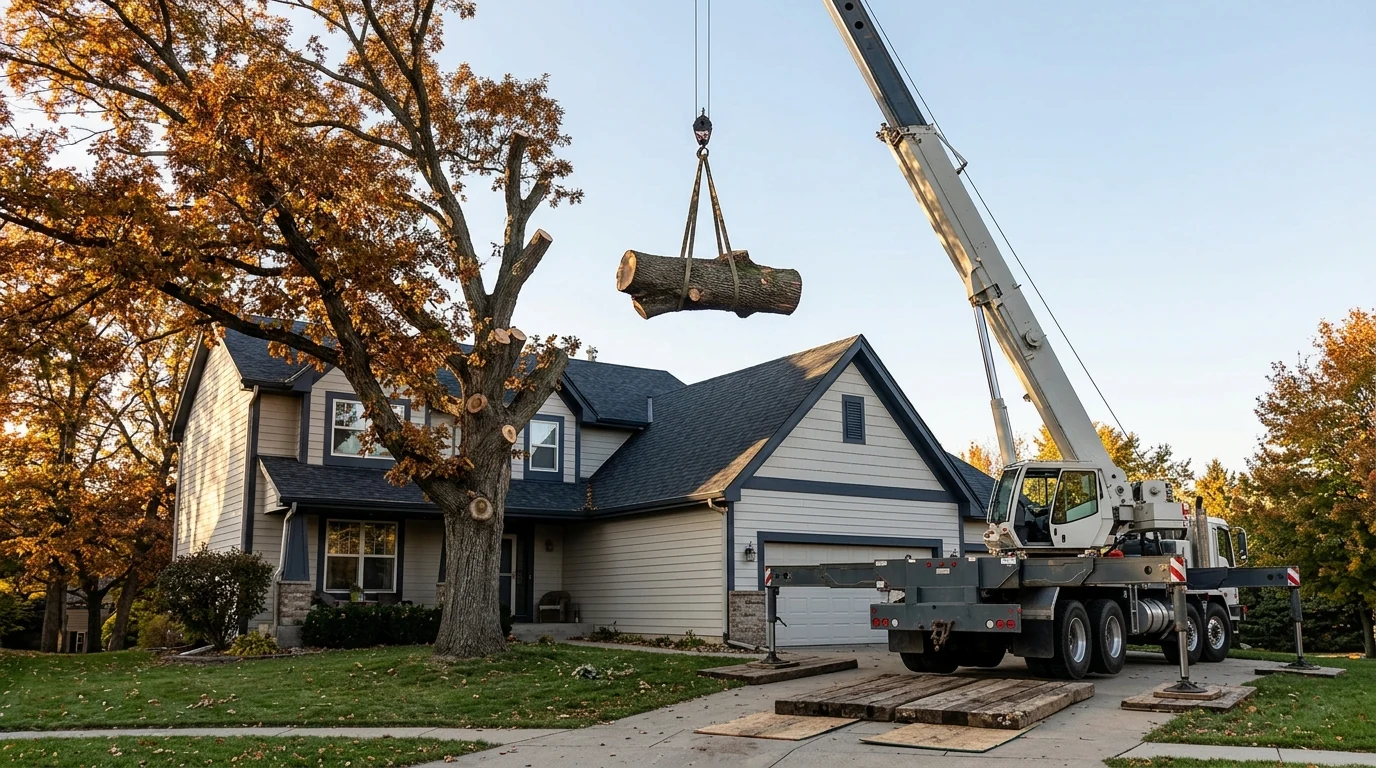
A crane quote for a big tree next to the house usually looks like the expensive option, and on big trees it often is not. A rented crane with an operator rarely costs less than about $1,100 once the minimum hours and travel are added. But it can take a day or more of climbing and rigging off the job, and a day of a tree crew's time usually costs more than the crane. Here is how to tell which of your two quotes is actually the expensive one.
What you are paying for in each bid
The two bids sell the same result with different inputs. In a climb-and-rig removal, a climber works down the tree cutting it into small pieces, and the ground crew lowers each piece on ropes through a block so nothing hits the roof. In a crane removal, the climber or a crane-mounted saw cuts much larger sections, and the crane lifts each one over the house and sets it down in the driveway or the street. Arborists call each lift a pick.
The climbing method is slow on a large tree because every piece has to be small enough to lower under control. Industry write-ups put a large tree over a structure at 8 to 16 hours or more of rigging work for a 3 to 5 person crew, against roughly 2 to 8 hours with a crane (ArboStar). That gap in crew hours is the whole argument for the crane, so it is the number to pin down in both quotes.
What the crane itself costs
The crane's line on the bid is set by its size, the minimum billing hours and the drive to your house. Published rate sheets from crane rental companies show roughly these operated rates (crane plus operator):
| Crane class | Hourly, with operator | Usual minimum |
|---|---|---|
| 12–38 ton boom truck | $140–$175 | 3–4 hours |
| 40–75 ton mobile crane | $205–$310 | 3–6 hours |
| 90–275 ton crane | $310–$595 | 4–8 hours |
Rates from published crane-service rate sheets such as North Texas Crane Service, compiled by Rigging Force. Big metro areas and emergency calls run higher.
Two billing habits matter more than the hourly rate. Many crane companies bill "portal to portal", so the clock runs from when the crane leaves the yard until it gets back, and some add a flat mobilization fee or a fuel surcharge on top. A 40-ton crane at $250 an hour with a 4-hour minimum and a $400 travel charge is about $1,400 before anyone touches the tree.
Bigger is not about the weight of the tree alone. A crane's lifting capacity falls quickly as the boom reaches out, so a crane parked 60 feet from the tree needs far more tonnage than one parked beside it. When one company quotes a 25-ton truck and another quotes a 60-ton crane for the same tree, the difference is usually where each plans to set up.
Cost guides put a complete crane-assisted removal of a large tree near a house at roughly $2,000 to $8,000, with the crane itself making up about $500 to $2,500 of it (CostToRemoveATree). The low end of that crane range is mostly companies that own their crane. They tend to price it as a few hundred dollars on top of the job, which is why some quotes, and our own tree removal cost calculator, show a crane as a modest add-on rather than a four-figure rental.
The math: when the crane quote comes out cheaper
A crane pays for itself when it saves more crew time than it costs to bring in. The crew's time is the expensive part of tree work. The workers themselves are not highly paid: the median wage for tree trimmers and pruners is $24.50 an hour (BLS wage data via O*NET, 2025). But a tree company has to bill each crew-day for wages, workers' comp insurance for work at height, liability cover, the chipper, the truck and the days lost to weather. For the table below we price a crew-day at $3,000. Treat that as a planning figure, not a quote; your local rate may be well above or below it.
| 80 ft oak over the roof, fenced backyard | Climb and rig | Crane |
|---|---|---|
| Crew time | 2 days: $6,000 | 1 day: $3,000 |
| Crane (40-ton, 4-hour minimum plus travel) | None | $1,100–$1,700 |
| Take down and rebuild a fence section for access | $500–$1,000 | None (pieces go over the house) |
| Rutted lawn from equipment in the yard | $200–$600 | Little or none |
| Total | $6,700–$7,600 | $4,100–$4,700 |
Illustrative model, not a quote. Crane cost uses the 40–75 ton rates above; fence and lawn lines are planning ranges. Stump grinding and debris hauling are left out because they cost the same either way.
Flip the inputs and the crane loses. A 40-foot maple in an open front yard takes a crew half a day to climb, so the crane can save two or three hours at most, while still charging its full 4-hour minimum and travel. In that case the crane adds $1,000 or more and buys almost nothing. A rough rule from the table: if the climbing bid will take less than a full day, the crane will almost always cost more. If the climbing bid takes a day and a half or more, or means pulling down a fence or driving a truck across the backyard, get a crane price before you sign.
A real pair of quotes
Quotes from actual homeowners show the crane does not always come in cheaper, and it is worth knowing what the extra money buys when it does not. One homeowner on Reddit posted two bids for taking down two large maples (one behind a fence and leaning over a neighbor's yard) plus trimming three more trees. The climbing bid was $5,300 and meant taking part of the fence down and driving a truck into the backyard. The crane bid was $6,700 and lifted everything out over the house in one day without touching the fence (r/homeowners).
The $1,400 gap there is about what a crane's minimum costs, so the crane was not buying speed. It was buying an untouched fence, an undamaged lawn and pieces that never swing near the neighbor's roof. That can be worth $1,400, but it is a different decision from "the crane is faster, so it should be cheaper," and you should know which one you are making.
When the crane is not optional
Some trees should not be climbed at any price, and then the comparison is moot. The cases where a reputable arborist will insist on a crane (or a bucket truck, on smaller trees) are:
- The tree is dead or badly decayed. Dead wood breaks unpredictably under a climber's weight and the shock of rigging. This is why our calculator adds 35% for dead trees.
- There is no drop zone. If every limb hangs over the house, a garage or a neighbor's roof, the rigging loads get large and the margin for error disappears.
- The tree is storm-damaged or split. A trunk with a crack in it or hung-up limbs can move when you cut it.
The tree care safety standard, ANSI Z133, was revised this year as Z133-2026, and it has its own rules for crane work. A company that does crane removals regularly should be able to tell you how it plans the lifts and estimates the weight of each piece.
When a crane cannot do the job
The crane quote assumes the crane can get close enough and set up safely, so check that before you compare prices. Three things rule it out or push the price up.
Room for the outriggers
A crane stands on outriggers, steel legs that swing out and lift the truck level. On 20 to 45 ton cranes the full spread is roughly 17 to 24 feet (National Crane 1300A spec sheet), wider than most single-car driveways. If the crane has to set up in the street, ask the company whether you need a street-use permit and who pulls it.
Your driveway
Outriggers put a huge load on small spots, and a standard 4-inch residential driveway can crack under them. Good crews set the outriggers on crane mats, timber cribbing or engineered pads, as in our photo. Ask whether mats are included, and who pays if the driveway cracks anyway. Replacing even a section is not cheap; see our concrete driveway cost guide for what a new slab runs.
Power lines
Overhead lines change the plan for a crane more than for a climber. Under federal crane rules, if any part of the crane or its load could come within 20 feet of a power line, the operator has to either get the line de-energized, stay 20 feet away, or take formal precautions such as a dedicated spotter to work as close as the 10-foot minimum for lines up to 50 kV (OSHA 29 CFR 1926.1408). If a service drop or a street line runs near your tree, ask each bidder whether they have called the utility and whether the utility's schedule will set the date.
Seven questions to put to both bidders
Most crane-versus-climb confusion goes away once both bids answer the same questions. Our guide to comparing contractor quotes covers the general method; these are the ones specific to this job.
- How many crew-days is your bid based on, and how many people? This is the number the crane is supposed to replace.
- Do you own the crane or rent it? A rented crane comes with its own minimum, travel billing and insurance.
- What size crane, and where will it set up? The setup spot explains most of the difference in tonnage between bids.
- Is the crane priced as a flat fee or by the hour, and who pays if the job runs over the minimum?
- Are ground mats included, and who is responsible for driveway or lawn damage?
- For the climbing bid: does anything have to come down to get equipment in, such as a fence section, and is putting it back in the price?
- Can you send certificates of general liability and workers' comp insurance straight from your insurer? Ask for the crane company's too if the crane is rented.
Make sure both bids cover the same things after the tree is down. Stump grinding and debris hauling are often priced separately, and a crane bid that leaves the logs in your driveway is not comparable to a climbing bid that chips everything. If the crew has to drive across the lawn either way, our sod cost calculator will tell you what re-sodding the ruts costs.
To check the base price of the removal before any crane is added, run your tree's height and trunk diameter through the tree removal cost calculator with "Tight / Power Lines" or "Near House/Fence" selected. Then set each bid against it: if the climbing bid is built on two or more crew-days, the crane bid is probably the cheaper job, and if the crane bid is higher, the gap should be roughly one crane minimum and no more.