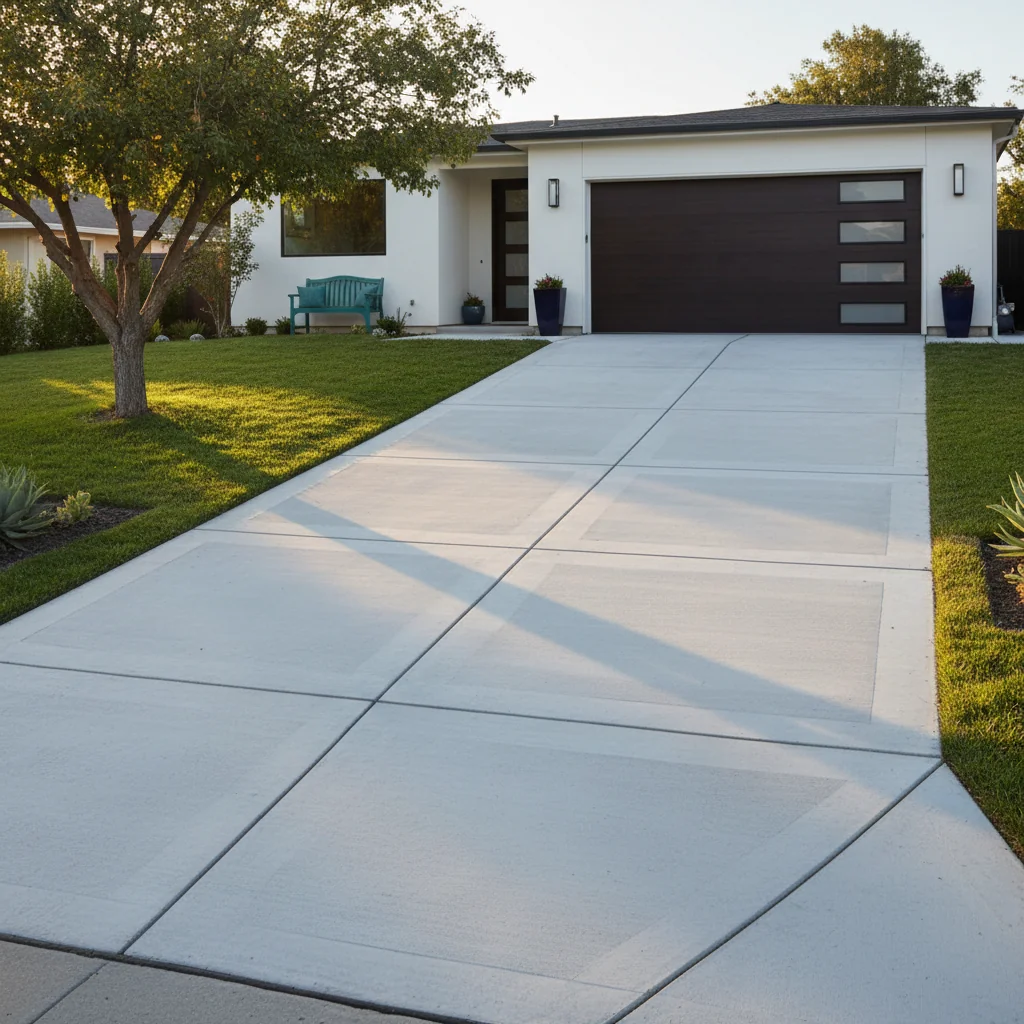
A concrete driveway costs $6 to $12 per square foot installed, putting a standard two-car driveway (400-600 sq ft) in the $2,400 to $7,200 range. Concrete is roughly twice the upfront cost of asphalt, but it lasts 25-40 years with almost no maintenance, which makes the long-term math closer than the sticker price suggests.
Where you land in the $6-$12 range depends on three things: the finish you pick (basic broom vs. stamped), the reinforcement (rebar, fiber mesh, or both), and your local labor market. Below is the per-square-foot breakdown by size, plus what each line item on a concrete bid actually pays for.
Concrete Driveway Cost by Size
Driveway dimensions are the biggest single variable. Here's what a basic broom-finish concrete driveway costs at typical residential sizes:
| Driveway Type | Typical Size | Low End ($6/sf) | Midpoint ($8/sf) | High End ($12/sf) |
|---|---|---|---|---|
| Single car | 12' x 20' (240 sq ft) | $1,440 | $1,920 | $2,880 |
| Double car | 20' x 20' (400 sq ft) | $2,400 | $3,200 | $4,800 |
| Double car (long) | 20' x 30' (600 sq ft) | $3,600 | $4,800 | $7,200 |
| Triple car / wide | 30' x 20' (600 sq ft) | $3,600 | $4,800 | $7,200 |
| Long rural | 12' x 80' (960 sq ft) | $5,760 | $7,680 | $11,520 |
| Circular / large | ~1,200 sq ft | $7,200 | $9,600 | $14,400 |
Prices include materials, labor, and standard 4-inch slab on a flat lot. Decorative finishes, thicker slabs, or significant grading add 20-80% on top.
Most residential concrete driveways land between $3,000 and $6,500. Quotes well above $12/sq ft for a basic broom-finish driveway are either including extras (decorative finish, demolition, drainage work) or are simply expensive markets like the coastal Northeast or Bay Area.
What Goes Into a Concrete Driveway Quote
A concrete bid bundles materials, labor, finishing, and reinforcement into a single per-square-foot number. Here's what each component is worth:
Concrete Material: $2.00 - $4.00/sq ft
Ready-mix concrete is delivered by truck and priced by the cubic yard. As of early 2026, residential mixes run $140-$200 per cubic yard delivered, with regional variation. A standard 4-inch-thick driveway uses about 1 cubic yard per 80 square feet of slab, so material alone is $1.75-$2.50/sq ft before any reinforcement.
Higher PSI mixes (4,000+ psi instead of the standard 3,000-3,500) cost an extra $5-$15 per yard but resist freeze-thaw damage better. Most contractors in northern climates default to 4,000 psi.
Labor and Forming: $2.00 - $4.00/sq ft
Concrete is labor-intensive in a way asphalt is not. The crew has to set wood forms around the perimeter, install reinforcement, prep the subgrade, place the concrete in a tight time window before it sets, screed and float the surface, cut control joints, and apply the chosen finish.
A typical residential driveway pour takes a 4-5 person crew most of a day, plus return visits to remove forms and seal the surface. Labor is the line item that varies most by region.
Reinforcement: $0.30 - $1.50/sq ft
Plain concrete cracks. The question is whether it cracks at the control joints (good) or randomly across the slab (bad). Reinforcement controls where cracks happen and keeps small cracks from widening into structural failures.
- Wire mesh: $0.30-$0.50/sq ft. Welded wire fabric laid in the middle of the slab. Adequate for light residential use on stable soil.
- Rebar grid: $0.75-$1.50/sq ft. #4 rebar on 16-18 inch centers, tied into a grid. Standard for driveways that will see truck or RV traffic, or where soil shifts.
- Fiber mesh: $0.25-$0.40/sq ft. Polypropylene fibers mixed into the concrete itself. Reduces shrinkage cracks but doesn't replace structural reinforcement.
Most quality contractors use rebar plus fiber mesh for driveways. Quotes that skip reinforcement entirely are bidding the cheapest possible job — fine for a low-traffic flat lot, risky anywhere else.
Subgrade Prep: $0.50 - $2.00/sq ft
What's under the slab matters more than the slab itself. The crew should excavate to 8-10 inches below the finished height, compact the subsoil, then add a 4-6 inch compacted gravel base. Skipping the gravel base saves money upfront but leads to cracking, settling, and a 5-10 year shorter lifespan.
Old Driveway Removal: $1 - $3/sq ft (if applicable)
Replacing an existing surface adds demolition and disposal cost. Removing old asphalt runs $1-$2/sq ft. Removing old concrete is $2-$3/sq ft because it's heavier and harder to break up. Most quotes itemize this separately.
Concrete Driveway Finishes: Cost by Style
Finish is the second biggest cost lever after size. A basic broom finish is the cheapest. Decorative finishes can double or triple the per-square-foot price.
| Finish | Cost / sq ft | Look | Maintenance |
|---|---|---|---|
| Broom finish | $6 - $10 | Lightly textured grey, traditional | Minimal |
| Smooth trowel | $7 - $11 | Polished flat grey | Slippery when wet — not recommended for driveways with slope |
| Exposed aggregate | $8 - $13 | Pebble-textured surface, decorative | Reseal every 3-5 yrs |
| Stamped concrete | $12 - $20 | Imitates flagstone, brick, or slate | Reseal every 2-3 yrs to keep color |
| Colored / dyed | +$2 - $5 | Integral pigment or surface dye | Reseal every 2-3 yrs |
| Polished concrete | $10 - $20 | High-gloss reflective finish | Periodic re-polishing |
Stamped concrete is the most popular upgrade. It mimics the look of pavers or flagstone at roughly 60-70% of the cost. The tradeoff is more maintenance — color sealer needs reapplication every 2-3 years, and stamped patterns are harder to repair invisibly when they crack.
Concrete vs. Asphalt: Cost Comparison
The most common decision homeowners face is concrete vs. asphalt. Here's the head-to-head on a 500 sq ft double-car driveway, including 25-year cost of ownership:
| Material | Installed Cost | Lifespan | Annual Maintenance | 25-Year Total Cost |
|---|---|---|---|---|
| Asphalt | $1,500 - $3,500 | 15-25 yrs | $50-$200 (sealcoating) | $3,000 - $8,000 (incl. one re-pave) |
| Concrete (broom) | $3,000 - $6,000 | 25-40 yrs | $0 - $50 | $3,500 - $7,000 |
| Stamped concrete | $6,000 - $10,000 | 25-40 yrs | $200-$400 (resealing) | $10,000 - $18,000 |
25-year totals assume midpoint installation, typical maintenance cycles, and one full asphalt re-pave at the 18-year mark. Inflation not included.
Concrete and asphalt land surprisingly close on lifetime cost. The right answer depends on your priorities: lower upfront cash favors asphalt, lower maintenance favors concrete, and curb appeal favors stamped concrete (with the running cost to match). For a deeper side-by-side, see our concrete vs. asphalt driveway cost comparison.
Regional Pricing
Concrete pricing varies 25-40% by region. Labor differences drive most of the variance, but material costs also shift with cement prices and trucking distance from the nearest batch plant.
| Region | Typical Range |
|---|---|
| South / Southeast | $5.50 - $9.00/sq ft |
| Midwest | $6.00 - $10.00/sq ft |
| Mountain / Plains | $6.50 - $10.50/sq ft |
| West Coast | $8.00 - $13.00/sq ft |
| Northeast | $8.00 - $14.00/sq ft |
Rural areas in any region run cheaper than nearby metros. Concrete trucks have a roughly 90-minute window between the batch plant and the pour, so jobs more than an hour from a plant pay a premium for either extra trucks or specialty mixes that delay setting.
Concrete Driveway Repair Costs
Concrete is durable but not indestructible. Here's what common repairs run:
| Repair | Cost | When It's Needed |
|---|---|---|
| Crack injection (epoxy) | $5 - $15/linear ft | Hairline to 1/4" cracks |
| Slab jacking / mudjacking | $3 - $8/sq ft | Sunken slab on stable subgrade |
| Polyurethane foam lifting | $5 - $12/sq ft | Faster, cleaner alternative to mudjacking |
| Resurfacing (overlay) | $3 - $7/sq ft | Surface wear, no structural damage |
| Section replacement | $8 - $15/sq ft | Single panel cracked or heaved |
| Full replacement | $8 - $15/sq ft | Widespread structural failure |
Repair vs. Replace
Hairline cracks at control joints are normal and don't need repair. Cracks wider than 1/4 inch should be sealed to prevent water infiltration and freeze-thaw damage. Sunken or heaved slabs can usually be lifted back into place with mudjacking or polyurethane foam for a fraction of replacement cost.
Full replacement makes sense when you have widespread cracking, multiple heaved sections, or visible pitting and spalling across most of the surface. As a rule of thumb, if repair costs exceed 50% of replacement, replace. Weighing a different surface? Asphalt repairs follow their own pricing — see asphalt driveway crack repair cost.
How to Save Money on a Concrete Driveway
Practical ways to keep concrete driveway cost down without compromising the slab:
- Get 3-4 quotes. Concrete pricing varies more between contractors than most homeowners expect. A simple flat driveway can quote between $6 and $11/sq ft from contractors in the same zip code.
- Stick with broom finish. A clean broom finish looks fine, lasts longer than decorative options, and runs 30-50% less than stamped or exposed aggregate. You can always overlay a decorative finish years later if your taste changes.
- Pour in shoulder season. Concrete season runs longer than asphalt season because the mix can be adjusted for temperature. April-May and September-October are usually 5-10% cheaper than peak summer.
- Right-size the footprint. A 16-foot-wide driveway handles two cars comfortably. Going wider than 20 feet adds material cost without much functional benefit.
- Skip the demolition. If you have an existing asphalt driveway in decent shape, you can sometimes pour 4-inch concrete directly over it. Saves $1-$2/sq ft in removal, but the contractor must verify base stability first.
- DIY the seal. A bottle of penetrating concrete sealer applied with a pump sprayer extends the life of decorative finishes. Costs $40-$80 per application versus $200-$400 for a contractor.
What to Expect During Installation
A typical residential concrete driveway install takes 2-4 days plus curing time:
Day 1: Demolition and Subgrade
If there's an existing driveway, it comes out first. The crew excavates to 8-10 inches below finish grade, compacts the subsoil, and lays a 4-6 inch gravel base in compacted lifts.
Day 2: Forms and Reinforcement
Wood forms (typically 2x4s staked into the ground) get set around the perimeter to define the slab edge. Reinforcement (mesh or rebar) is laid out and tied in place. Control joints are marked.
Day 3: The Pour
The concrete truck arrives, ideally at the start of the workday so the crew has plenty of working time. The mix is placed, screeded flat with a long board, then floated to bring fines to the surface. Control joints are cut into the wet concrete (or saw-cut later) every 8-10 feet to control where shrinkage cracks form. The chosen finish (broom, stamp, etc.) goes on while the concrete is still workable.
Day 4+: Curing
Concrete reaches about 70% of its final strength in the first week and 90% by 28 days. Keep cars off it for at least 7 days. In hot, dry weather, the contractor should wet-cure the surface (cover it with damp burlap or plastic, or spray it down regularly) for the first 3-5 days. A sealer can be applied after 28 days.
How Long Does a Concrete Driveway Last?
A properly installed concrete driveway lasts 25 to 40 years. The best installations push past 50. Lifespan comes down to four factors:
- Subgrade quality. Compacted gravel base on stable soil is everything. Poor base work caused most premature concrete failures we see in the field.
- Slab thickness. 4 inches is the residential standard. Heavy vehicle loads (RVs, work trucks, boats on trailers) call for 5-6 inches in the relevant areas.
- Reinforcement. Rebar plus fiber mesh is the long-life standard. Mesh-only is fine for light residential.
- Climate. Freeze-thaw is the main enemy. Northern climates benefit from 4,500+ psi mix, air-entrained concrete, and a quality penetrating sealer applied every 3-5 years.
If your slab is structurally intact at the 25-year mark, a thin overlay (1-2 inches of new concrete bonded to the old) can refresh the surface and add another 15-20 years of life for $3-$7/sq ft.
Frequently Asked Questions
How long until I can park on a new concrete driveway?
Wait at least 7 days for cars and 28 days for heavy vehicles like RVs or trucks. Concrete continues to gain strength for months — driving on it too early causes invisible micro-cracks that turn into visible cracks within a year.
Do I need a permit for a concrete driveway?
Most municipalities require a permit for new driveway installation, especially where the driveway meets the public street or sidewalk. Replacement of an existing driveway in the same footprint sometimes qualifies for a simpler permit or none at all. Your contractor should pull the permit and include it in the bid.
Stamped concrete vs. pavers — which lasts longer?
Pavers last longer (50+ years vs. 25-40) because individual pavers can be lifted and reset, and color is integral rather than surface-applied. But pavers cost roughly twice what stamped concrete costs to install. For most homeowners, stamped concrete hits the right balance of look, longevity, and budget.
Can I pour concrete in winter?
Cold-weather pours are possible down to about 25°F with the right mix admixtures and curing blankets, but they cost more and carry more risk of cracking. Most contractors won't pour below 35°F without a strong reason.