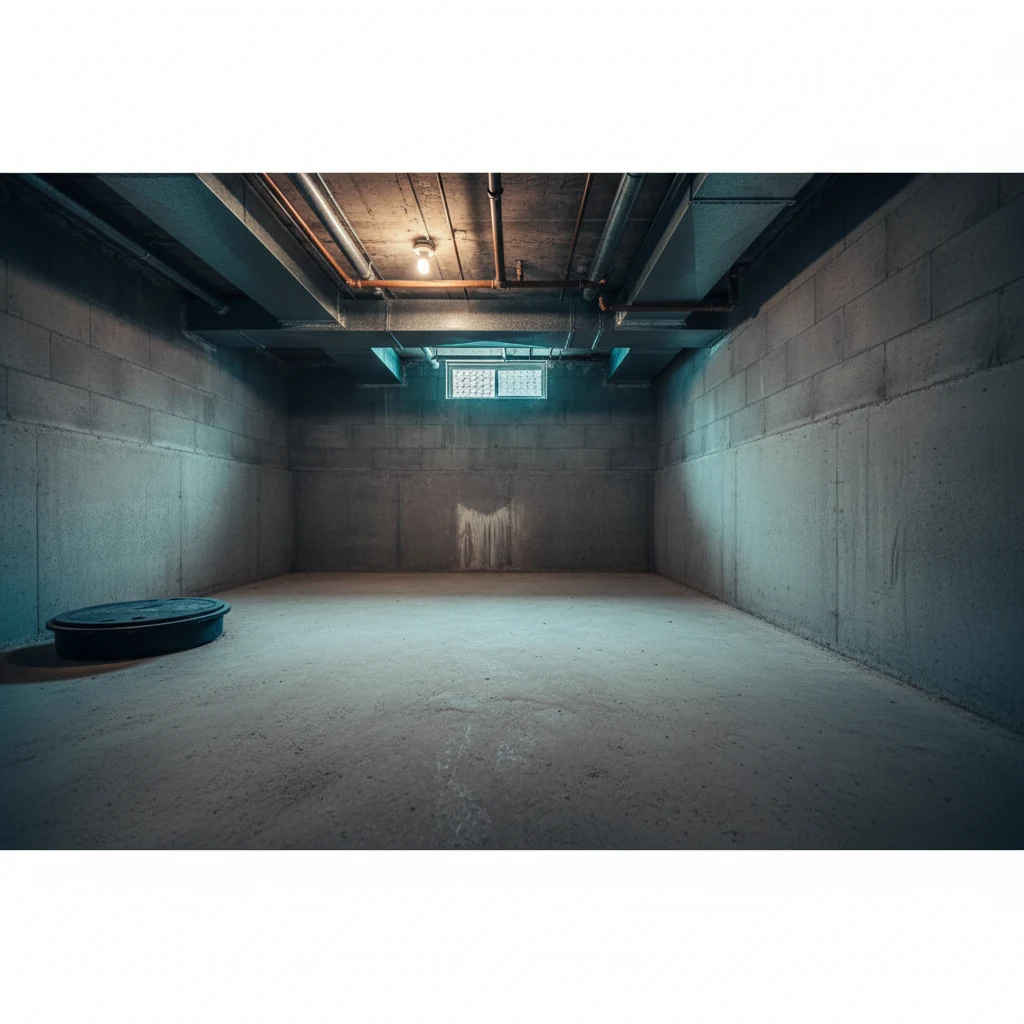
The standard advice on finishing a basement is that you'll get back roughly 70% of what you spend when you sell. That number traces to Remodeling magazine's annual Cost vs. Value Report, which has tracked midrange basement remodels for two decades. It's a real number, and it's roughly right — on average.
Averages hide the houses where the math doesn't work. Some basements lose money outright: you spend $40,000 and recoup $15,000. Not 70%. Not 50%. Sometimes the appraiser doesn't credit a single dollar.
Four specific home archetypes break the standard ROI model. If your house matches one of them, the average isn't your average. Here's how to spot them before you sign a contract.
Why The 70% Number Is An Average, Not A Promise
The Cost vs. Value Report is built from contractor-submitted job data and Realtor-estimated resale impact, aggregated across regions and homes that already qualify as "normal" candidates for the project. The most recent edition publicly available as of mid-2026 reports basement remodel recoupment in the high-60s to low-70s nationwide. (See the latest Cost vs. Value Report for current local data.)
That 70% figure assumes three things you can't always assume:
- The basement, once finished, will be legal habitable space under local code.
- The basement is structurally dry — no chronic moisture, no remediation costs hidden in the project budget.
- The home will sell into a market that has room to absorb a higher price based on the added square footage.
Break any of those three assumptions and the recoupment number falls. Break two of them and you're losing money in absolute terms. The four archetypes below each break at least one structural assumption in a predictable way.
Archetype 1: The Sub-7-Foot Ceiling Basement
The single most overlooked dealbreaker is ceiling height. Under IRC Section R305.1, habitable space — including a finished basement intended for sleeping, living, or family rooms — requires a minimum ceiling height of 7 feet (84 inches) measured from finished floor to the lowest projection from the ceiling. The code allows beams, girders, ducts, and similar obstructions to project down to 6 feet 4 inches, but only across portions of the room, not as a general ceiling.
Here's the problem: most older homes have raw basement ceiling heights of 7'-2" to 7'-6". By the time you're done, you've lost:
| Element | Typical Loss | Running Subtotal (from 7'-6") |
|---|---|---|
| Subfloor + finished floor | 1.5"–2.5" | 7'-3.5" |
| Drywall ceiling + framing | 1.5" | 7'-2" |
| HVAC trunk lines (drop) | 8"–14" in soffits | ~6'-6" under soffits |
| Recessed lighting / sprinkler housings | 0.5"–1" | ~6'-5" |
If your raw ceiling is under 7'-6", the finished result lives in the gray zone where some rooms are barely code-compliant and entire stretches under HVAC soffits are illegal. An appraiser walking the space won't credit it as habitable square footage. The county won't issue a final certificate of occupancy. A future buyer's home inspector will flag it.
The financial damage isn't subtle. You spend $35,000 on what becomes, on paper, a "below-grade utility room" rather than 800 square feet of livable space. The Cost vs. Value model assumes added livable square footage; you got none. Recoupment in this scenario typically runs 15–25%, not 70%.
The fix is rarely worth it. Lowering a basement floor by even 6 inches requires underpinning the foundation — that's $30,000–$80,000 of structural work before you've started the actual finish. The math almost never works.
Before you commit to a basement project, measure clear height at the lowest point you'll actually occupy — under the main HVAC trunk, not in the open middle of the room. If it's under 7'-0" after planned finishes, walk away from the project entirely.
Archetype 2: The High-Water-Table House
The second archetype is the basement that's already telling you it has a moisture problem — and the homeowner's hoping that "finishing it" will somehow fix that.
It won't. Water intrusion gets worse, not better, when you add drywall and flooring on top of it. Mold, rot, and ruined finishes follow within 3–7 years. The Cost vs. Value Report's 70% number assumes a normal basement; if yours requires moisture remediation before finishing, the project economics shift in ways the average won't capture.
Signs you're in this archetype
- Efflorescence — white chalky deposits on concrete walls. Indicates water moving through the foundation, leaving mineral deposits.
- Persistent musty smell, especially after rain. Tells you moisture is sitting somewhere you can't see.
- Sump pump that runs frequently, even outside heavy rain events.
- Visible water staining at the base of foundation walls or around penetrations.
- Bowed or cracked foundation walls, especially horizontal cracks (a hydrostatic pressure signal).
What you're really spending
An interior drainage system (interior French drain) plus a sump pump runs $4,500–$7,500 on a typical residential basement, with whole-system installs ranging $3,000–$10,000 depending on perimeter length and whether concrete needs to be cut and rebuilt. Add a dehumidifier ($1,500–$3,000), foundation crack injection ($500–$1,500 per crack), and grading work outside ($1,500–$5,000) and your pre-finish spend lands at $8,000–$15,000.
That's all sunk cost. None of it adds resale value above what a normal-basement house would already include. So a $30,000 finish becomes a $40,000+ project, and the $30,000 of recoupment-eligible work returns ~70% — while the $10,000 of remediation returns close to zero. Effective recoupment on the total spend: around 50%, not 70%.
And that's only if the remediation actually holds. A major weather event two years later can still send water through. When it does, the drywall comes out and you start over.
Archetype 3: The Sub-$300K-Market Home
The third archetype isn't about the basement at all — it's about the neighborhood. In any housing market, there's a price ceiling set by comparable sales in the local area. Lenders won't appraise above the comp ceiling. Buyers won't pay above it.
The fixed costs of finishing a basement don't scale down for cheaper houses. A code-compliant basement bedroom needs an egress window: IRC Section R310 requires a minimum 5.7 sq ft net clear opening, at least 20 inches wide and 24 inches tall, with a sill no higher than 44 inches above the floor. Cut into a concrete foundation wall, that runs $3,000–$5,500 per window installed. Add the basement bathroom rough-in ($8,000–$15,000), code-required electrical service upsizing ($2,000–$3,500 if your panel is at capacity), and permits ($500–$2,000) and you're looking at $13,000–$26,000 in fixed costs before any per-square-foot finishing begins.
On a $700,000 home, that fixed cost is a small fraction of resale value. On a $250,000 home, it's the entire recoupment budget. Run the math:
| Home Value | Total Project Cost | Realistic Resale Add | Effective Recoupment |
|---|---|---|---|
| $250K market | $32,000 | $10,000–$15,000 | 31–47% |
| $400K market | $38,000 | $22,000–$28,000 | 58–74% |
| $650K market | $48,000 | $32,000–$38,000 | 67–79% |
Resale-add ranges based on neighborhood comp ceilings; below-grade square footage typically credits at 50–75% of above-grade.
The brutal math at the bottom of the table is structural, not bad luck. In a $250K market, neighborhood comps cap your post-renovation home value somewhere around $275K–$295K regardless of what you spent. You can't sell a $310K house in a $280K neighborhood.
This is the archetype where homeowners often do better directing their renovation budget elsewhere — a kitchen update or bathroom remodel tends to recoup at higher percentages on lower-priced homes because they affect the appraisal more directly than below-grade square footage. Check what the calculator says for those projects too before committing.
Archetype 4: The Already-Maxed Home
The fourth archetype is the inverse of the third. Instead of being too low for the neighborhood, your home is already at the top.
If your house is the priciest comp in a 0.5-mile radius — the 4-bedroom in a neighborhood of 3-bedrooms, the renovated colonial on a block of un-renovated colonials, the corner lot with the addition no one else has — you've hit the neighborhood ceiling effect. Adding finished basement square footage doesn't push your home's value higher because there are no comparable sales above it to appraise against.
An appraiser in this scenario will typically credit the finished basement at $0 to $25 per square foot, not the $50–$100 per square foot that the Cost vs. Value model assumes. The square footage exists, the work was done, the photos look great — but there are no comp sales to support a higher number.
How to test if you're in this archetype
- Pull actual sold comps (not list prices) for the last 6 months in a 0.5-mile radius. Filter to homes with similar bed/bath count and lot size.
- Sort by sold price. Find your house's current estimated value in that distribution.
- If your post-finish value would put you at or above the highest sold comp in the set — you're already at or near the ceiling.
The Cost vs. Value Report doesn't account for this because it averages across normal-position homes. If you're at the top, you're not normal-position, and the average doesn't apply.
The fix here isn't to skip the project — it's to recognize you're spending for use, not for resale. If you'll get $40,000 of enjoyment over 10 years out of a finished basement, that may be worth it as consumption. But don't kid yourself about the recoupment number. Treat the entire project budget as money spent, not money invested.
The Decision Framework
Before you commit, run these four questions in order. The first one that returns a "no" should stop the project — or at least restart the conversation:
- Ceiling check. Will finished clear height be at least 7'-0" everywhere a reasonable adult would walk? (Includes under HVAC soffits.)
- Moisture check. Is the basement currently dry, with no efflorescence, no musty odor, and a sump pump that's idle most of the time?
- Market check. Will your post-finish home value still sit comfortably below the highest sold comp in your immediate neighborhood?
- Spend check. Estimate the project total. (Use the basement remodel cost calculator for a state-adjusted figure.) Then estimate resale add at 60% of that — not 70%. Are you comfortable with that math even after softening the recoupment assumption?
If you answer "yes" to all four, the standard 70% recoupment story is roughly right and the project makes financial sense. If you answer "no" to any one of them, you're in archetype territory and the average doesn't apply to your house.
What Cost vs. Value Reports Get Right (And Wrong)
The Cost vs. Value Report is genuinely useful as a benchmark. It's the largest dataset on remodeling ROI in the U.S., and the year-over-year trends tell you something real about how categories of work are valued by buyers. The 70% basement number is in the right ballpark for the average house in the average neighborhood with the average basement.
What the report doesn't tell you is which house you have. The methodology can't — it's an aggregate. Reading "70% recoupment" and assuming it applies to your specific home is the equivalent of reading "the average American driver gets 25 mpg" and assuming you'll get 25 mpg in your own car, regardless of what you drive or how. The number is true; its application to you isn't automatic.
This is also why the report's regional cuts matter more than the national average. Cost vs. Value publishes localized numbers for major metros. If your zip code shows basement remodels at 55% recoupment instead of 70%, that's a structural feature of your local market — not something to argue with.
Bottom Line
The right question isn't "is finishing a basement worth it?" It's "is finishing this basement worth it?" Four archetypes break the standard ROI math: sub-7-foot ceilings, chronic moisture, sub-$300K markets, and homes already at the neighborhood ceiling. If your house matches any of them, expect recoupment of 30–50%, not 70%.
None of this means you shouldn't finish a basement. It means you should know what you're buying. A basement finished as consumption — for the kid's playroom, the home theater, the in-law suite — can be worth every dollar even at 40% recoupment, because the value isn't in the resale. A basement finished as investment requires the standard math to actually apply. Check that it does before you commit.
If your house clears the four-question filter, run a real cost estimate using the basement finishing cost calculator — with your state, your size, and your scope. The state-adjusted number is what your project will actually cost, not the national midrange figure that Cost vs. Value publishes.