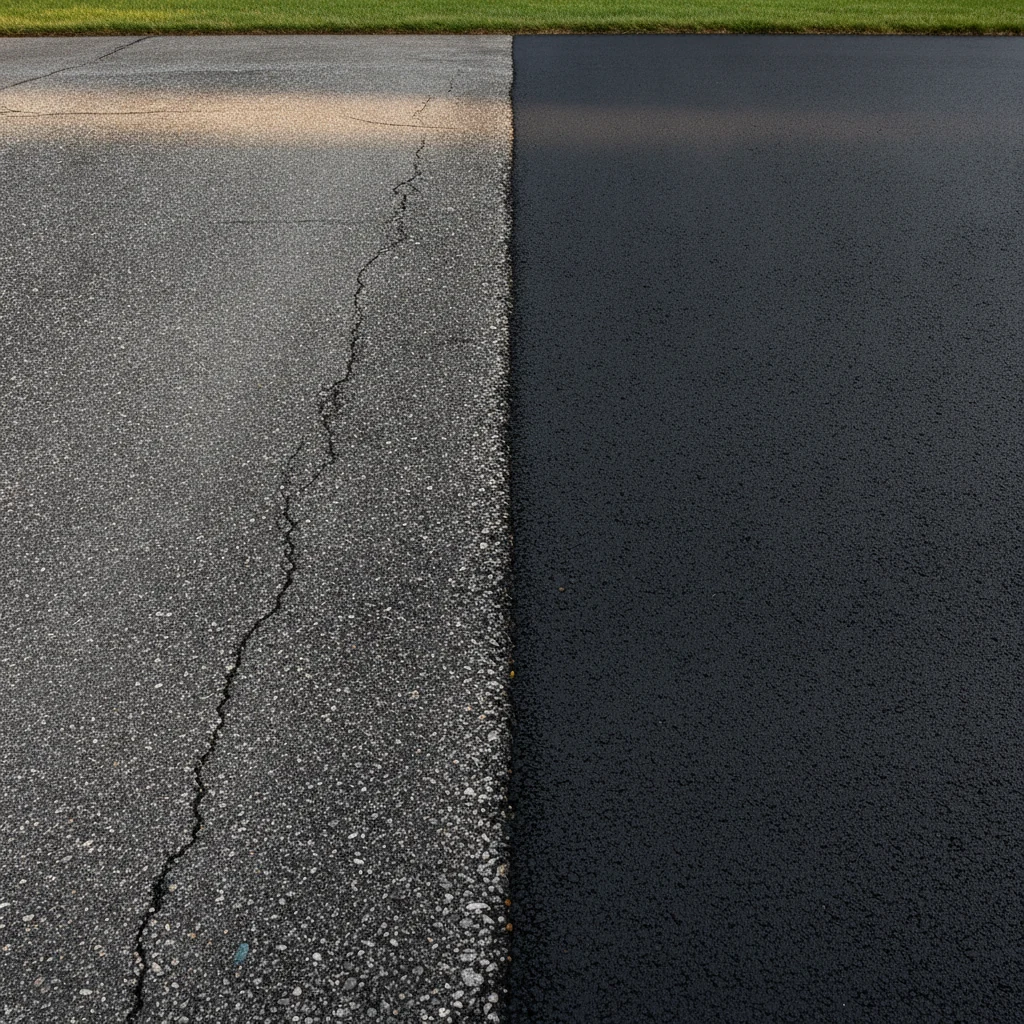
An asphalt driveway resurfacing job runs $2 to $5 per square foot. A full replacement runs $3 to $7. On a 600-square-foot driveway that is a gap of roughly $600 to $1,200 — so resurfacing looks like the obvious money-saver. It usually isn't that simple, and the upfront price is the worst number to decide on.
Two things actually decide whether you should resurface or replace, and neither one is the sticker price: is the base underneath sound, and how long will you own the house. Get the first one wrong and resurfacing becomes the most expensive choice on the board — you pay for the overlay, watch it fail in two or three years, and pay for the replacement anyway.
The cost-per-year math nobody runs
Cost guides quote the upfront number and stop. But a driveway is bought by the year, not by the square foot. A $1,800 surface that lasts 8 years and a $3,000 surface that lasts 20 years are not what they look like at the register. Spread each option over the service life it actually buys and the picture flips:
| Option | Upfront (600 sq ft) | Expected life | Cost per service-year |
|---|---|---|---|
| Resurface (1.5–2" overlay) | $1,200 – $3,000 | 8 – 15 years | ~$80 – $375/yr |
| Full replacement | $1,800 – $4,200 | 15 – 25 years | ~$72 – $280/yr |
Cost-per-year is upfront cost divided by expected service life. It deliberately ignores the time-value of money, which we account for separately below.
Read the right-hand column, not the left. On a per-year basis the two options nearly overlap. A typical resurfacing (~$2,000 over ~11 years) lands around $180 a year; a typical replacement (~$3,000 over ~20 years) lands around $150 a year. The "cheaper" option is, per year of driveway you actually get, often the more expensive one. The headline savings of resurfacing live entirely in the fact that you spend less today — which is a real benefit, just not the one the sticker price implies. More on that in a moment.
Why the base under the asphalt decides everything
Resurfacing is a 1.5- to 2-inch layer of fresh asphalt bonded over your existing surface. It restores the look and the wearing surface. What it does not do is fix anything below it. The single biggest determinant of how long an overlay lasts isn't the new asphalt — it's the integrity of the base and sub-base it sits on. Lay a perfect overlay over a base that has already failed and the failure telegraphs straight up through the new surface, usually within a couple of seasons.
That is why an overlay over a sound base reliably buys 8 to 15 years, while an overlay over a compromised base can be cracking again before the next winter is out. Drainage, installation quality (proper tack coat and compaction), and freeze-thaw climate all modulate the result too — but base condition is the gatekeeper. It is the difference between resurfacing being smart and resurfacing being money set on fire.
How to read your own driveway in five minutes
You don't need a contractor to take the first read. Walk the driveway and look for the failure signals that mean the damage is structural, not cosmetic:
- Alligator cracking — interconnected cracks in a scaly, alligator-skin pattern. This is base failure, not surface wear. An overlay will not fix it.
- Potholes — recurring or large potholes mean the layers below have given way.
- Sinking, soft spots, or heaving — any movement underfoot or visible dips/humps point to an unstable sub-base.
- Standing water — if water pools instead of running off, you have a drainage/grade problem that an overlay can't correct and may worsen.
- Extent — once more than 25–30% of the surface needs repair, you're patching a structural problem, not a cosmetic one.
The quarter test: if you can fit a quarter into a crack, it's deep enough to be structural — and resurfacing alone won't hold over it.
Isolated hairline cracks, fading, and surface roughness on an otherwise stable, well-draining driveway are the good news — that's exactly the condition where an overlay earns its keep. (If the surface is genuinely still in good shape and you're just chasing looks, you may not need either job yet — see the third option below.)
The cost of guessing wrong
Here is the scenario that makes resurfacing the most expensive decision a homeowner can make. You have an 18-year-old driveway with spreading alligator cracks. Resurfacing quotes come in around $2,400 and replacement around $3,600, so you take the overlay to save $1,200. The base was already gone, so the new surface cracks within two to three years and you replace it anyway for $3,600.
You didn't spend $2,400. You spent $6,000 — the overlay plus the replacement — for a driveway you could have had for $3,600. The $1,200 you "saved" turned into a $2,400 penalty. This is the single most common way the cheaper-upfront instinct backfires, and it's why the base check has to come before the price comparison.
When ownership time horizon flips the answer
Base condition decides whether resurfacing will last. Your time horizon decides whether it's the right financial move even when it will. This is where spending less today is a genuine advantage rather than a trap:
- Selling within 1–3 years (sound base): resurfacing wins. A fresh black surface delivers most of the curb-appeal of a replacement for roughly half the cash, and deferring the big spend keeps that capital in your pocket — let the next owner amortize the replacement.
- Staying long-term, driveway under ~15 years (sound base): resurfacing is a legitimate buy — 8–15 more years for $2,000-ish is a fair trade, and you push the replacement decision out a decade.
- Staying long-term, driveway already 20+ years or facing its second overlay: lean toward replacement. Overlays add height each time and hit diminishing returns; at this age the per-year math and the risk both favor starting fresh.
The deferral itself has value the cost-per-year table doesn't capture: a dollar you don't spend until 2034 is worth more than a dollar spent in 2026. For a short-horizon owner that tips the scale toward resurfacing even when the annual cost is a touch higher. For a forever-home owner with an aging slab, it doesn't.
The third option: do neither (yet)
If your driveway is structurally fine and only a few years into its life — faded, maybe a hairline crack or two, but no alligatoring, potholes, or pooling — the right answer is often neither resurfacing nor replacement. Sealcoating at $0.20–$0.50 per square foot every few years protects a healthy surface from water and UV and stretches the years before you face the resurface-or-replace question at all. Sealcoating a failing driveway is lipstick; sealcoating a healthy one is the cheapest mile-per-dollar you can buy. Don't let a refresh impulse push you into a four-figure job a $200 maintenance coat would defer.
Putting it together
Run the checks in this order, because the price comparison is the last question, not the first:
- Base failed (alligatoring over 25–30%, potholes, sinking, standing water): replace. An overlay will fail — see "the cost of guessing wrong."
- Base sound, surface worn, selling soon: resurface. Curb appeal now, capital deferred.
- Base sound, surface worn, staying, driveway under ~15 yr: resurface. Buys 8–15 years at a fair per-year cost.
- Base sound but driveway 20+ yr / second overlay: lean replace. Diminishing returns.
- Surface still healthy, just cosmetic: sealcoat and revisit in a few years.
For replacement and resurfacing prices on your exact square footage, run the numbers on the driveway cost calculator. To pressure-test the replacement figure, see our breakdown of asphalt driveway cost per square foot, and if the damage turns out to be isolated cracks rather than base failure, crack repair and patching may be all you need before any overlay. If you've decided to replace and you're rethinking the surface entirely, compare the long-run numbers in concrete vs. asphalt and our ranking of driveway options by cost per year.
Frequently asked questions
Can you resurface an asphalt driveway with potholes?
No. Potholes are a symptom of base or sub-base failure, and an overlay laid over a failed base will crack and pothole again within a few years. Recurring potholes are a replace signal, not a resurface one.
How many times can an asphalt driveway be resurfaced?
Usually once, occasionally twice, before replacement becomes the better call. Each overlay adds 1.5–2 inches of height and can create problems at the garage threshold, drainage edges, and transitions. By the second overlay you're often paying resurfacing prices for replacement-level disruption — at which point starting fresh wins.
Is it cheaper to resurface or replace a driveway?
Resurfacing is cheaper upfront — about $2–5 per square foot versus $3–7 to replace. But on a cost-per-year-of-service basis the two are close, because replacement lasts roughly twice as long. Resurfacing only stays cheaper if the base is sound; over a failed base it ends up costing more than replacement would have.
Does resurfacing fix cracks?
It covers hairline and minor surface cracks. It does not fix structural cracking — the alligator-pattern, quarter-deep cracks that signal base failure will reappear through the new surface. Match the fix to the crack type, not the other way around.