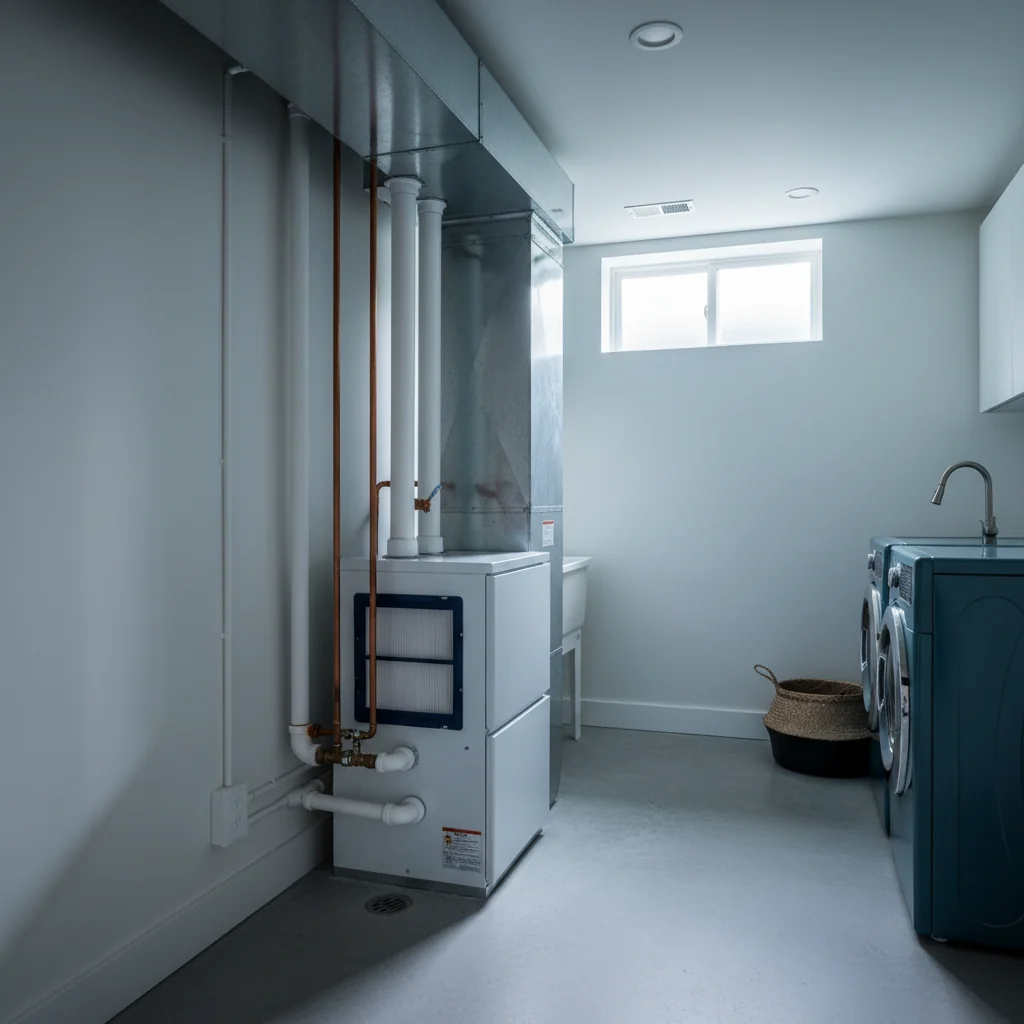
A gas furnace lasts 15 to 25 years. An electric furnace lasts 20 to 30 years. Most homeowners get a call about replacement somewhere between year 12 and year 18, when the unit starts breaking down often enough that repair costs catch up to a new install.
The lifespan range is wide because climate, maintenance habits, sizing, and brand all matter. This guide covers what determines how long your specific furnace will last, the warning signs that you're near the end, and the math for deciding whether to repair or replace.
Average Furnace Lifespan by Type
| Furnace Type | Typical Lifespan | Best Case | Worst Case |
|---|---|---|---|
| Standard gas furnace (80% AFUE) | 15-20 years | 25 years | 10 years |
| High-efficiency gas (90%+ AFUE) | 15-25 years | 30 years | 10 years |
| Electric furnace | 20-30 years | 35+ years | 15 years |
| Oil furnace | 15-25 years | 30 years | 10 years |
| Propane furnace | 15-20 years | 25 years | 10 years |
| Heat pump (ducted) | 10-15 years | 20 years | 8 years |
DOE and ASHRAE field data, 2024-2026. Heat pumps run shorter because the same equipment handles both heating and cooling, doubling annual run time vs. a furnace that only operates in winter.
Electric furnaces last longest because they have fewer moving parts and no combustion. There's no heat exchanger to crack, no flue to corrode, no gas valves to fail. The blower motor is the most likely point of failure, and it's a relatively cheap component to replace.
Gas and oil furnaces fail faster because combustion is hard on metal. The heat exchanger — the steel chamber where flame heats the air — eventually develops cracks from thermal cycling. A cracked heat exchanger usually means replacement, not repair.
What Determines How Long Your Furnace Lasts
1. Sizing
An oversized furnace short-cycles — turns on, blasts heat for 5-10 minutes, shuts off, then restarts. Each cycle stresses the ignition system, blower motor, and heat exchanger. Short-cycling can cut lifespan by 30-40%.
An undersized furnace runs nearly continuously in cold weather, which is also bad — components designed for intermittent duty wear out from constant operation. The sweet spot is a Manual J load calculation that sizes the furnace to actually match your home's heating demand. Most homes have furnaces 30-50% larger than they need.
2. Annual Maintenance
A furnace that gets a professional tune-up every fall lasts 30-40% longer than one that doesn't. Annual maintenance catches small problems (dirty burners, weak igniter, loose belt) before they cascade into expensive failures.
| Maintenance | Frequency | Cost |
|---|---|---|
| Filter replacement | Every 1-3 months | $10-$25 each |
| Professional tune-up | Annual (fall) | $80-$200 |
| Belt + lubrication | As needed | $50-$120 |
| Burner cleaning | Every 2-3 yrs | included in tune-up |
| Heat exchanger inspection | Annual | included in tune-up |
3. Filter Discipline
The single most impactful homeowner habit. A clogged filter restricts airflow, which makes the heat exchanger run hotter than designed and wears out the blower motor. Replacing a $15 filter every 1-3 months is the easiest way to add 5-10 years of life to a furnace.
4. Climate and Run Time
A furnace in Minnesota running 1,800 hours per winter ages roughly twice as fast as one in Atlanta running 600 hours. Heat pumps wear even faster because they also run for cooling — total annual hours can hit 2,500-3,500 in mixed climates.
5. Installation Quality
Bad installation kills furnaces faster than anything else. Common mistakes that shorten life: oversized ductwork that doesn't match the unit's CFM, undersized return air, improper flue venting, miswired thermostats, lack of a dedicated electrical circuit. A good install is worth 5-10 years on the back end.
Signs Your Furnace Is Near the End
The clearest indicators that your furnace is approaching replacement, ranked from "watch closely" to "replace soon":
- Age over 15 years. Past this point, the next major repair is often the trigger to replace.
- Rising gas/electric bills with no other explanation. Aging combustion equipment loses efficiency. A 10-year-old 80% AFUE furnace might be running at effective 70% by year 15.
- Uneven heating between rooms. Often a duct or thermostat issue, but progressive unevenness usually means the blower is losing capacity.
- Cycling more frequently. Short-cycling that didn't happen before is a sign of failing flame sensors, dirty burners, or a thermostat in the wrong location.
- Yellow burner flame instead of blue. Indicates incomplete combustion. Could be dirty burners (cheap fix) or a cracked heat exchanger (replacement). Get a technician.
- Soot or rust around the unit. Sign of combustion issues or corrosion. Investigate immediately.
- Loud noises (banging, screeching, humming). Banging often means delayed ignition (dangerous). Screeching means a failing blower motor. Humming means electrical problems.
- Frequent repairs. Two service calls in one heating season is a strong replace signal.
- Cracked heat exchanger. Carbon monoxide risk. Most technicians won't even attempt repair — they'll red-tag the unit and require replacement.
Repair vs. Replace: The Math
The standard rule of thumb is the 5,000 rule: multiply the repair cost by the furnace's age. If the result exceeds $5,000, replace. Otherwise repair.
| Repair Cost | Furnace Age | Score | Decision |
|---|---|---|---|
| $400 | 8 yrs | 3,200 | Repair |
| $400 | 15 yrs | 6,000 | Replace |
| $800 | 10 yrs | 8,000 | Replace |
| $1,200 | 5 yrs | 6,000 | Replace (or repair under warranty) |
| $1,500 | 18 yrs | 27,000 | Replace immediately |
The 5,000 rule is a starting point, not a final answer. Three other factors should override it:
- Heat exchanger or control board failure on a 12+ year unit: always replace. These repairs run $1,200-$2,500 on a unit that's likely to fail somewhere else within 2 years anyway.
- Igniter, flame sensor, or blower capacitor on any unit: repair. These are sub-$300 jobs even on a 20-year-old furnace.
- Anything that requires "we don't carry that part anymore": replace. Salvage parts on furnaces older than 15 years are unreliable.
Cost to Replace a Furnace in 2026
| Furnace Type | Unit Cost | Installed Cost |
|---|---|---|
| Standard gas (80% AFUE) | $1,200 - $2,500 | $3,000 - $5,500 |
| High-efficiency gas (95%+ AFUE) | $2,000 - $4,500 | $4,500 - $8,500 |
| Modulating gas (97%+ AFUE) | $3,500 - $6,000 | $6,500 - $11,000 |
| Electric furnace | $800 - $2,500 | $2,000 - $5,000 |
| Oil furnace | $2,500 - $5,000 | $5,000 - $10,000 |
| Heat pump (ducted, replacing furnace) | $3,500 - $7,500 | $7,500 - $15,000 |
Installation costs include the unit, labor, basic permits, code-required upgrades (often a new flue or condensate drain on high-efficiency units), and disposal of the old furnace. Costs go up if your ductwork needs sealing, your gas line needs upgrading, or your electrical panel needs a service upgrade for an electric or heat-pump replacement.
Should You Replace Early?
The case for proactive replacement (before the unit fully fails):
- Schedule choice. Replacing in October on a 65°F day is much easier than replacing in February at 10°F when contractors are slammed and no one wants to be without heat for 24 hours.
- Energy savings. Going from 80% AFUE to 95%+ AFUE cuts gas use by ~15%. On a $1,500/year heating bill, that's $225/year — about $2,250 over 10 years.
- Tax credits. The federal 25C credit covers 30% of the cost (up to $600) for high-efficiency gas furnaces or up to $2,000 for heat pumps. Many states stack additional rebates on top.
- Pairing with other work. If you're already opening up a wall, redoing ductwork, or finishing a basement, replacing the furnace at the same time is dramatically cheaper than doing it as a standalone job later.
The case against early replacement: a working furnace that's 10-12 years old probably has another 5-8 years of service left, and the energy savings rarely cover the install cost in under 8 years. Don't let an aggressive HVAC salesperson talk you into replacing a unit that still works.
How to Make Your Furnace Last Longer
- Change filters on schedule. Every 1-3 months for standard pleated filters. Mark a recurring calendar reminder. This single habit adds the most life of anything you can do.
- Annual professional tune-up. Schedule for September or October before the heating season starts. $80-$200 well spent.
- Don't block return air. Furniture in front of return grilles, closed bedroom doors, or partially closed dampers all reduce airflow and stress the unit.
- Keep the area around the furnace clear. Combustion air requirements depend on free airflow into the furnace closet or utility room. Don't store boxes, paint cans, or laundry hampers within 3 feet of the unit.
- Run a smart thermostat. Modern thermostats reduce short-cycling by adapting to your home's thermal mass. Cycle reduction directly extends component life.
- Address ductwork leaks. Leaky ducts force the furnace to run longer to deliver the same comfort. Sealing supply and return ducts (mastic or aerosol seal) typically cuts run time by 10-15%.
- Watch the flame. A glance into the burner compartment a few times a winter takes 30 seconds. Steady blue flame = healthy. Yellow, flickering, or sooty = call a tech.
Frequently Asked Questions
Can a furnace last 30 years?
Yes, but it's the exception. A combination of light use (mild climate, undersized house), excellent maintenance, soft water, and a high-quality original install can push gas furnaces past 25 years and electric furnaces past 30. Most homeowners replace 5-10 years before the absolute end of life because repair costs become unjustifiable.
Should I replace a 20-year-old furnace that still works?
Probably yes, unless you have a specific reason to wait. The unit is past expected lifespan, energy efficiency has degraded, parts may be hard to source, and modern replacements are 15-25% more efficient. Schedule replacement during the off-season when contractor pricing is best.
How long should a new furnace last with no major repairs?
A well-installed, properly maintained mid-range gas furnace should run 8-12 years before needing any major repair beyond filters and an annual tune-up. Premature failures (under 8 years) almost always trace back to installation errors or skipped maintenance — not manufacturing defects.
Does brand matter for furnace lifespan?
Less than installation quality. Top-tier brands (Trane, Carrier, Lennox) have slightly better failure rates, but a poorly installed Trane will fail before a well-installed Goodman. The contractor matters more than the badge.
What's the cheapest way to extend furnace life?
Filter discipline. A $15 filter changed every 2 months costs $90/year and adds 5-10 years of furnace life. Nothing else comes close to that ROI.