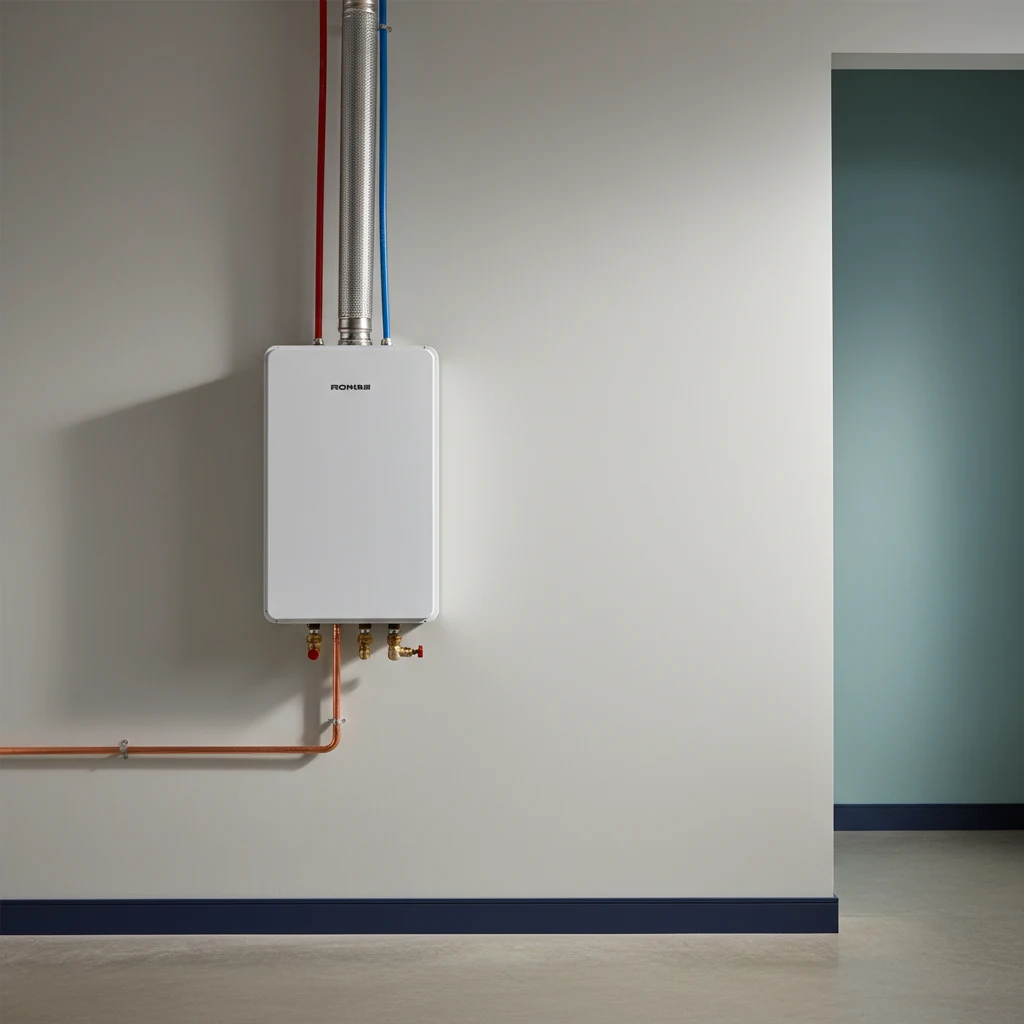
A propane tankless water heater installed in 2026 typically runs $3,000 to $6,500 all-in: roughly $900–$2,200 for the unit, $1,500–$3,500 for installation, and another $300–$800 for venting and propane-line work. The real spread depends almost entirely on whether your home already has the gas line, electrical, and venting in place — or whether the installer is starting from scratch.
The reason quotes vary so widely is that propane tankless units have specific requirements that gas storage tanks don't: a larger gas line (typically 3/4″) to support 150,000–199,000 BTU/hr peak burn, category III stainless venting, and a 120V outlet within reach. Each missing piece adds $200–$1,500 to the install. This guide breaks the cost down by line item, walks through operating cost math at current propane prices, and shows when propane tankless makes sense vs. the alternatives.
Real 2026 Install Cost: Line by Line
Here is what a typical propane tankless install looks like for a single-bath or two-bath home, broken into the components a contractor will quote separately:
| Line Item | Low-end | Typical | High-end |
|---|---|---|---|
| Tankless unit (5–10 GPM, condensing or non-condensing) | $900 | $1,400 | $2,200 |
| Plumber labor (4–10 hrs) | $600 | $1,100 | $1,800 |
| Propane line upsize / new run (3/4″, 15–40 ft) | $200 | $450 | $1,200 |
| Stainless category III venting kit + wall penetration | $200 | $350 | $700 |
| Electrical (120V outlet near unit, if missing) | $0 | $150 | $500 |
| Permit + inspection | $50 | $150 | $300 |
| Removal & disposal of old tank | $0 | $150 | $300 |
| Condensate drain (condensing units only) | $0 | $100 | $300 |
| Total installed cost | ~$2,000 | ~$3,900 | ~$6,500+ |
Source: contractor pricing surveys + manufacturer-published install requirements (Rinnai, Navien, Rheem, Takagi). 2026 averages.
The two line items that move the most are the propane line upsize and the vent run. A propane storage water heater needs only about 40,000–50,000 BTU/hr, so older homes typically have a 1/2″ line. A propane tankless wants 150,000–199,000 BTU/hr at peak, which usually requires a 3/4″ or even 1″ line depending on length and other appliances on the same trunk. If the new line has to be run from the regulator at the propane tank into the house, expect the high end of the $200–$1,200 range.
Vent length and route matter too. A side-wall vent that exits within a few feet of the unit is the cheap case. A vertical run through finished space — or a reroute around joists — can push venting alone past $700.
Operating Cost: How Much Propane Actually Burns
Propane delivers 91,500 BTU per gallon, and a modern condensing tankless runs at 0.93–0.96 UEF (Uniform Energy Factor — the efficiency rating that replaced EF in 2017). At today's national average residential propane price of about $2.60/gallon, that puts delivered hot-water cost at roughly $30 per million BTU for a condensing unit and $36 per million BTU for a non-condensing model.
| Heater type | Fuel | Efficiency (UEF) | $/MMBTU delivered |
|---|---|---|---|
| Propane tankless (condensing) | Propane @ $2.60/gal | 0.95 | $29.91 |
| Propane tankless (non-condensing) | Propane @ $2.60/gal | 0.82 | $34.66 |
| Propane storage tank | Propane @ $2.60/gal | 0.62 | $45.83 |
| Natural gas tankless | NG @ $1.10/therm | 0.95 | $11.58 |
| Electric tankless | Electricity @ $0.165/kWh | 0.99 | $48.86 |
| Heat pump water heater | Electricity @ $0.165/kWh | 3.50 (UEF as COP) | $13.82 |
Source: U.S. Energy Information Administration (EIA) residential energy prices; ENERGY STAR UEF specifications. National averages — your state can vary by ±40%.
For a typical household using ~17 million BTU/year of hot water (DOE estimate for a 4-person home), the annual operating costs work out to about:
- Propane tankless (condensing): ~$510/year
- Propane tankless (non-condensing): ~$590/year
- Propane storage tank: ~$780/year (the standby losses on stored hot water are why tankless wins)
- Natural gas tankless: ~$197/year
- Heat pump water heater (electric): ~$235/year
Two takeaways. First: going condensing saves about $80/year compared to a non-condensing propane tankless — not enough on its own to recover the $300–$600 upcharge for the unit, but it stacks with the longer expected service life and tighter venting flexibility. Second: if you have access to natural gas, the operating-cost gap is roughly $300/year — over a 15-year service life that's about $4,500 in fuel savings, which can outweigh the cost of running a new gas line in many cases.
Sizing: GPM and BTU for Propane vs Natural Gas
Propane and natural gas tankless units look identical on a spec sheet, but propane systems often need slightly different sizing because of how propane delivers heat at the burner. Use this as a starting point:
| Household type | Peak fixtures running | Recommended GPM | Typical BTU/hr |
|---|---|---|---|
| 1 bath, 1–2 people | 1 shower | 4–5 GPM | 120,000 |
| 2 bath, 2–3 people | 1 shower + 1 sink | 6–7 GPM | 150,000 |
| 3 bath, 3–5 people | 2 showers + 1 sink | 8–9 GPM | 180,000 |
| 4+ bath, 5+ people | 2 showers + dishwasher | 9–11 GPM | 199,000 |
GPM rated at 35°F temperature rise (typical southern climate). For northern climates with 50–70°F rises, derate by 25–40% — or step up one size.
The most common sizing mistake on propane installs: assuming the existing 1/2″ gas line will support the new unit. It almost never does. A 199,000 BTU/hr propane tankless on a 1/2″ line will starve at peak demand, drop output temperature, and trigger the unit's low-pressure fault. Always size the gas line to match the unit's peak BTU rating — or accept a smaller unit that fits your existing line.
Federal Tax Credit: The 25C Rules That Apply
Some high-efficiency propane tankless models qualify for the federal Section 25C Energy Efficient Home Improvement Credit: 30% of the cost (including installation), capped at $600 per year for water heaters. To qualify, the unit must meet the highest efficiency tier of the Consortium for Energy Efficiency (CEE) — for propane tankless, that generally means a UEF of 0.95 or higher.
Practically, this means most condensing propane tankless models (Rinnai RUR series, Navien NPE-A2, Rheem RTGH series) qualify, while standard non-condensing models do not. The credit is claimed on IRS Form 5695. Keep your install receipt and the manufacturer's certification statement — the IRS does not require manufacturer certification for water heaters in the same way it does for some other products, but having the documentation on hand simplifies any future audit.
Some states layer their own rebates on top. State utility programs in California, Massachusetts, New York, and Oregon typically offer $100–$500 in additional rebates for ENERGY STAR-certified high-efficiency tankless units. Check your utility's rebate database before you buy; rebates change quarterly.
When Propane Tankless Makes Sense (and When It Doesn't)
Propane tankless is the right call in three specific situations:
- Off-grid or rural with no natural gas service. If you already have a propane tank for heating, cooking, or backup generation, adding tankless hot water onto the same fuel system is logical. The alternative — running 200+ amp electric service for an electric tankless — is often more expensive than the install cost difference.
- Replacing an aging propane storage tank in a small/medium home. Going from a propane tank (UEF ~0.62) to a propane tankless (UEF ~0.95) cuts annual fuel use by about 35% — enough to recover the install cost difference in 6–10 years for a heavy-use household.
- New construction in propane country. Building from scratch means the gas line, venting, and electrical are all part of the rough-in — eliminating the most expensive retrofit line items. Install cost on new construction often runs $2,000–$3,000 instead of $3,500–$6,500.
Where propane tankless does not make sense:
- Anywhere natural gas is available. The 60–70% lower fuel cost makes natural gas tankless or even a natural gas storage tank a better long-term play. See our propane vs natural gas heating comparison for the per-state numbers.
- Small homes with low hot-water demand. If you use under $300/year in hot water energy regardless of fuel, the install cost premium over a propane storage tank takes 25+ years to recover.
- Homes with grid power and warm climates. A heat pump water heater (HPWH) at $235/year operating cost beats propane tankless at $510/year — and the IRA-era tax credits for HPWH are larger ($2,000 max under 25C).
Maintenance and Service Life
Propane tankless units carry the same maintenance requirements as natural gas tankless: annual descaling ($150–$300 if done by a plumber, ~$30 in vinegar and an hour of your time if DIY), and a periodic check of the burner, fan, and venting. Skipping descaling is the single biggest reason units fail before their rated life — mineral buildup on the heat exchanger insulates it from the burner, dropping efficiency and eventually causing thermal cracking.
Manufacturer-rated service life is 15–20 years; real-world life with annual maintenance averages 12–18 years in moderate-hardness areas and as little as 8–12 years in hard-water regions (much of the West, Texas, Florida, and the Midwest) without a softener or aggressive descaling. By comparison, propane storage tanks typically last 10–13 years.
Choosing Between Tankless and a Storage Tank on Propane
If you've decided to stay with propane and the question is just tank-vs-tankless, here's the short version:
- Tank wins on upfront cost. A 50-gallon propane storage tank installed runs $1,500–$2,800 — roughly half the install cost of tankless.
- Tankless wins on operating cost. About $270/year cheaper to run on propane.
- Tankless wins on lifespan. Roughly 5–7 extra years on the unit.
- Payback math: The tankless premium of ~$1,500–$2,500 typically recovers in 6–10 years through fuel savings alone, and longer if you factor in not having to replace the tank twice over the tankless unit's life.
For a heavy-use household (4+ people, multiple showers/day), tankless almost always wins on total cost over the unit's life. For a 1–2 person home with modest usage, the math is closer to a wash and the tank's lower upfront cost often wins.
The Bottom Line
Budget $3,000–$6,500 for a propane tankless install in 2026, with the wide spread driven mostly by gas-line and venting work. Operating cost will run roughly $500/year for a typical household at current propane prices — about 2.5x what natural gas costs, but 30–40% less than a propane storage tank. The 25C federal tax credit knocks 30% off (capped at $600) for high-efficiency models with UEF ≥ 0.95, which covers most modern condensing units.
If natural gas service is available within reasonable distance of your home, the long-term economics still favor running a gas line and going natural gas tankless. If you're in propane country and replacing an aging tank, propane tankless is a solid choice — just budget realistically for the gas-line and venting work that the lowest online estimates often omit.
For a personalized estimate using your home's actual specs and your local fuel prices, use our free water heater cost calculator. It compares propane tankless, natural gas tankless, electric tankless, heat pump water heaters, and storage tanks side by side.
Shopping for the unit?
Popular tankless water heaters on Amazon
The install is a plumber job, but the unit itself you can buy yourself — here are well-reviewed high-output (199k BTU) gas tankless models.
As an Amazon Associate, RemodelCostCalc earns from qualifying purchases. Prices and availability are shown on Amazon.