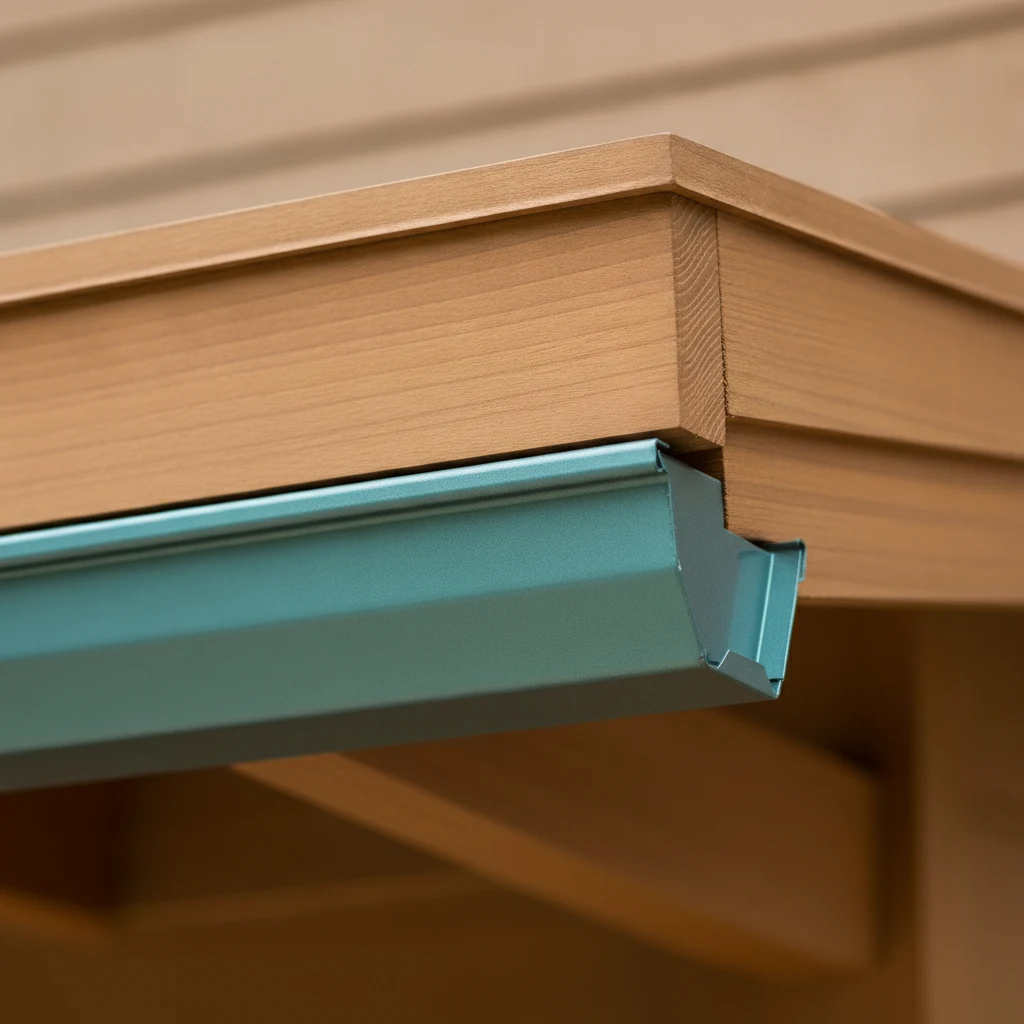
A standard gutter replacement for a 150-foot ranch house should cost $1,200 to $2,500. If you've received a quote pushing $3,500 or higher, the gutters probably aren't the reason. The variable that explains most extreme quote spreads isn't the gutter material or the labor rate — it's the condition of what's behind your gutters.
The part of your house that gutters hide
Gutters attach to the fascia board — the horizontal piece of finished lumber that runs along the lower edge of your roofline. Every bracket, spike, and hanger screws into that board. The fascia also carries the drip edge where the roof sheds water, and in many homes it supports the soffit panels below.
After 15 to 20 years of water exposure, fascia boards rot. Not from above (the roof covers them), but from behind — from water that backs up when gutters overflow, sag, or pull away from the house. That rot is completely invisible until a crew removes the gutters to start your replacement job.
This is why gutter contractors often can't give you a final price until the old gutters come down. Fascia rot is confirmed by independent contractor surveys as the most common unexpected cost adder in gutter replacement projects (HomeGuide 2025–2026) — and it's the one cost drivers most cost-guide articles bury in a footnote rather than lead with.
What gutter replacement actually costs, by material
Gutter pricing is almost always quoted per linear foot installed — meaning labor and material together, not material alone. The range within each material type is wide because gauge, profile (K-style vs. half-round), and second-story access premiums all move the number.
| Gutter material | Installed cost/ft | Typical 150-ft job | Lifespan |
|---|---|---|---|
| Vinyl (sectional) | $3–$10 | $450–$1,500 | 10–15 years |
| Aluminum (sectional) | $5–$12 | $750–$1,800 | 15–20 years |
| Seamless aluminum | $8–$20 | $1,200–$3,000 | 20–30 years |
| Steel (galvanized) | $9–$18 | $1,350–$2,700 | 15–20 years |
| Copper | $25–$50+ | $3,750–$7,500+ | 50+ years |
Sources: HomeGuide, Angi 2025–2026. Regional labor variation adds or subtracts roughly 10–15% in high-cost metros vs. national average.
Seamless aluminum is the standard recommendation for most homes — it eliminates the joints where sectional gutters fail, and it sits at a price point where the 20-to-30-year lifespan is cost-competitive with replacing vinyl gutters twice. Our gutter replacement cost calculator lets you model these trade-offs against your home's linear footage.
The fascia adder: what it costs and when it applies
When a crew discovers rotted fascia, work stops. New gutters cannot be safely anchored to compromised wood — the brackets won't hold, and a gutter full of water weighs roughly 8 pounds per linear foot. The fascia has to be replaced before installation continues.
| Fascia condition | What happens | Added cost |
|---|---|---|
| Solid, paintable | Clean, prime, paint. Gutters mount to existing fascia. | $0 (included in standard labor) |
| Surface staining, minor soft spots | Partial replacement of damaged sections (2–4 ft per occurrence). | $50–$200 total |
| Widespread rot along a full run | Full fascia replacement before gutters mount. Material: primed pine, cedar, or PVC. Painter returns after. | $7–$22/linear ft |
| Rot into rafter tails or soffit | Structural repair required. Carpenter involvement. | $500–$2,500+ total |
Fascia replacement pricing: Modernize 2025. Actual scope determined at teardown.
On a 150-foot house with full fascia rot, that $7–$22/ft adder adds $1,050 to $3,300 on top of the gutter line item. That is how a $1,800 aluminum gutter job becomes a $4,500 quote — and why two houses on the same street get wildly different numbers from the same contractor.
What to ask before signing a gutter quote
Most homeowners compare quotes by total price and material type. A better frame is to understand how each contractor handles the unknown before teardown. These three questions separate quotes that will stick from ones that will expand mid-job:
- "Does your quote include fascia inspection and replacement, or is that a change order?" — A quote that includes fascia assessment (even as a contingent line item) is more trustworthy than one that ignores it entirely.
- "What material and thickness (gauge) of fascia board do you use?" — Standard primed pine ($1–$3/ft) vs. PVC or cedar ($4–$8/ft) is a meaningful durability difference. Cedar and PVC are worth the upcharge.
- "Can I see the existing fascia before teardown?" — If a contractor can't or won't point you to the most accessible section of fascia to assess, that's a red flag. Healthy fascia is firm and paint-holds well; soft spots press in noticeably under thumb pressure.
If you're collecting multiple bids, the guide to comparing contractor quotes explains why the lowest number is often the one with the most aggressive change-order risk — not the best value.
Why seamless gutters earn their price premium
Sectional gutters fail where sections join. A standard K-style gutter section is 10 feet long, so a 150-foot run has 15 joints. Each joint is a potential leak — and when joints leak, water drips onto the fascia behind the gutter rather than running to the downspout. That's the most common mechanism behind the very fascia rot this article is about.
Seamless gutters are extruded on-site to run the full length of each roof section — a 45-foot run gets a single piece, with joints only at corners and downspouts. The failure rate per linear foot is dramatically lower. For most homes, the $3–$8/ft price premium over sectional aluminum is the single highest-ROI upgrade available in a gutter job — it reduces both short-term leak risk and the long-term fascia damage those leaks cause.
The math on copper gutters follows the same logic taken further: copper oxidizes to a protective patina rather than rusting through, and properly installed copper gutters frequently outlast the structure they protect. At $25–$50/ft installed, copper makes sense for historic homes, high-end properties where aesthetics matter, or any situation where "never replace gutters again" has real value.
What removal and disposal add to any quote
Teardown and disposal of existing gutters aren't always broken out as a separate line — some contractors bundle it, others itemize it. Industry pricing data puts removal at $0.65 to $2.00 per linear foot (Angi 2025), adding $100 to $300 to a typical job. It's worth confirming this is included before comparing quotes: a base installation price that excludes teardown looks artificially low.
Similarly, second-story access adds $1–$3/ft in most markets — the crew needs extension ladders or scaffolding rather than standard step ladders, and the work takes longer. A two-story home effectively pays a second-story premium on every foot of upper-level gutter.
Checking your own fascia before you call anyone
You can get a rough sense of your fascia condition before the first contractor visit. Walk the perimeter of your house and look up at the line where gutters meet roofline. Signs of likely rot:
- Paint peeling specifically on the fascia (not just general exterior peeling) — moisture is pushing from behind
- Gutters pulling away from the house at one or more points — the screws have lost grip, which is a fascia-depth problem
- Water stains or dark streaking on the fascia face — indicates overflow is running behind the gutter rather than into it
- Soft, spongy feel if you press on an accessible section — the wood fiber has broken down
Healthy fascia is firm, paint-holds smoothly, and shows no gapping between the board and the roof deck above it. If your fascia checks out on a visual walk, your quote is more likely to be final. If you see two or more warning signs, budget for at least partial fascia replacement when collecting bids.
For a current estimate on what your specific home's gutter work might cost — factoring in linear footage, material choice, and story count — the gutter replacement cost calculator builds the scenario in under a minute. If your fascia inspection revealed soft spots, add a 20–30% contingency line to whatever figure the calculator returns — that's the realistic budget for a job with moderate fascia unknowns.