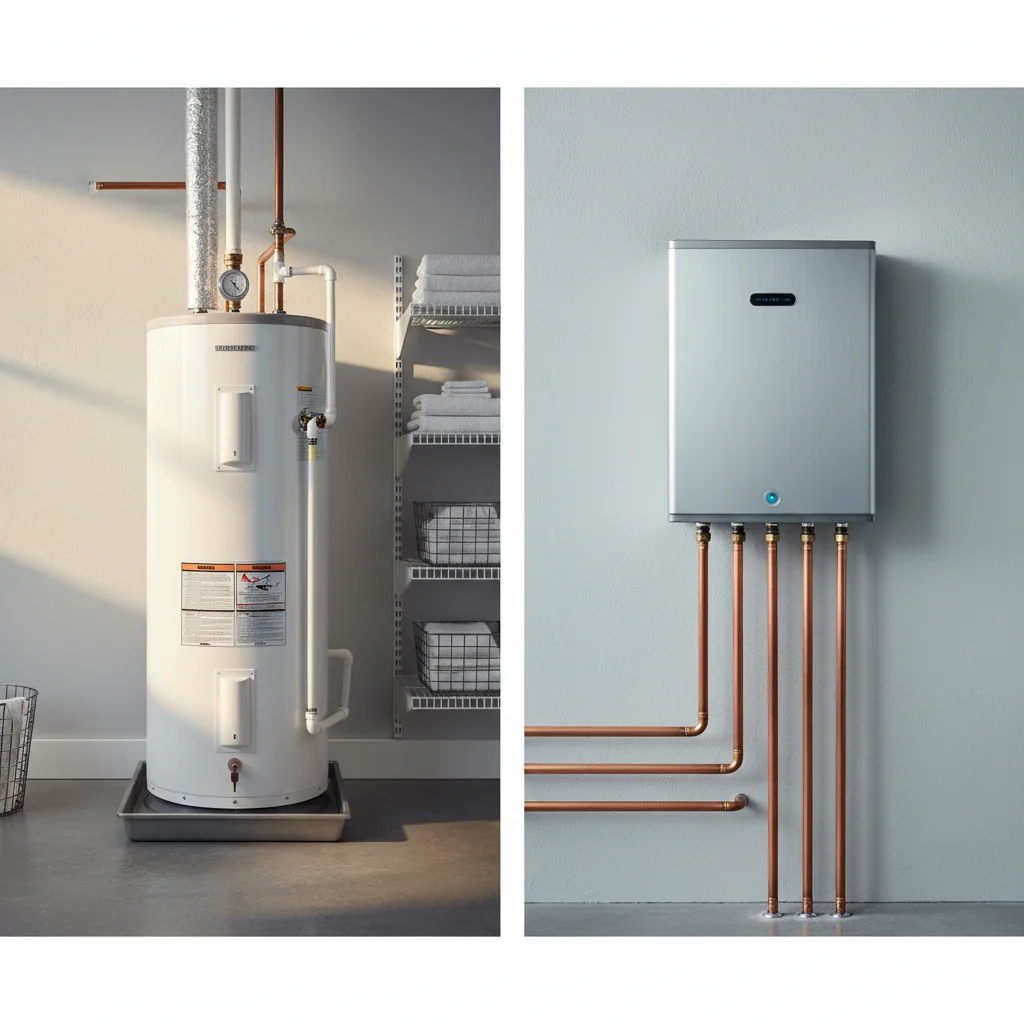
A tank water heater costs $800 to $2,000 installed. A tankless water heater costs $2,500 to $6,000 installed. The headline price gap is real — tankless is roughly 2-3x the upfront cost — but the ten-year total cost of ownership tells a different story once energy savings, lifespan, and maintenance enter the math.
This guide walks through the actual numbers: install cost, operating cost, lifespan, replacement schedule, and the specific home situations where each technology pays back. By the end, you'll know whether tank or tankless is the right call for your home in 2026.
The Quick Answer
Most households are best served by one of these two paths:
- Stick with a tank if you already have one, your hot-water demand is moderate (1-3 people, no soaking tub), and the existing heater is the same fuel type as your replacement. Lowest upfront cost wins.
- Go tankless if your existing tank is failing, you have natural gas service, you have multiple simultaneous hot-water demands (large family, soaking tub plus shower), or you want to free up the floor space and stop paying to keep 50 gallons hot 24/7.
The decision rarely comes down to lifetime cost alone — both technologies are within 10-20% of each other over 20 years. It comes down to fit: physical space, demand profile, fuel availability, and whether you're upgrading proactively or replacing a failing unit.
Tank vs Tankless: At-a-Glance Comparison
| Factor | Tank Water Heater | Tankless Water Heater |
|---|---|---|
| Unit cost | $400 - $1,200 | $1,200 - $3,000 |
| Installation cost | $400 - $800 | $1,300 - $3,000 |
| Total installed | $800 - $2,000 | $2,500 - $6,000 |
| Lifespan | 10-15 years | 20-25 years |
| Annual operating cost (gas) | $280 - $480 | $200 - $360 |
| Annual operating cost (electric) | $500 - $700 | $370 - $520 |
| Hot water output | Limited by tank size; runs out | Endless, but limited by flow rate |
| Floor space | ~5-7 sq ft (large unit) | ~2 sq ft (wall-mounted) |
| Standby loss | 10-30% of energy use | Near zero |
| Recovery time | 30-60 min for full reheat | Continuous |
Installed Cost Breakdown
Tank Water Heater Install: $800 - $2,000
Tank installations are simple. The plumber drains the old unit, disconnects gas/water/electric, swaps in the new one, reconnects everything, and starts it up. The job typically takes 2-3 hours.
| Component | Cost |
|---|---|
| 40-50 gallon gas tank unit | $500 - $1,000 |
| 40-50 gallon electric tank unit | $400 - $900 |
| Heat-pump (hybrid) tank unit | $1,500 - $2,500 |
| Standard install labor | $300 - $600 |
| Code-required upgrades (expansion tank, drip pan) | $100 - $250 |
| Old unit removal | $50 - $150 |
Tankless Water Heater Install: $2,500 - $6,000
Tankless installs almost always cost more because the unit itself runs $1,200-$3,000 and the install almost always requires upgrades to gas line size, venting, or electrical service.
| Component | Cost |
|---|---|
| Gas tankless unit (whole-home) | $1,200 - $2,800 |
| Electric tankless unit (whole-home) | $700 - $1,800 |
| Standard install labor | $800 - $1,500 |
| Gas line upgrade (typical) | $300 - $1,000 |
| Stainless venting kit | $200 - $500 |
| Electrical upgrade (electric units) | $500 - $1,500 |
| Old unit removal | $50 - $150 |
Whole-home electric tankless typically requires 120-150 amps of dedicated capacity, which means a service-panel upgrade in many older homes. Factor this in before assuming an electric tankless is the budget option.
For a deeper look at the propane variant, see our propane tankless water heater cost guide.
Operating Cost: Where Tankless Wins
Tankless water heaters are 24-34% more efficient than tank units according to the Department of Energy. The savings come from eliminating standby loss — the energy a tank uses to keep 40-50 gallons hot 24 hours a day, even when nobody's using hot water.
Annual Operating Cost (Average U.S. Family of 4)
| System | Energy Use / Year | Annual Cost | vs. Standard Gas Tank |
|---|---|---|---|
| Standard gas tank (0.62 EF) | 240 therms | $360 | baseline |
| High-efficiency gas tank (0.70 EF) | 210 therms | $315 | -$45/yr |
| Gas tankless (0.95 EF) | 155 therms | $235 | -$125/yr |
| Standard electric tank (0.93 EF) | 4,800 kWh | $670 | +$310/yr |
| Electric tankless (0.99 EF) | 4,500 kWh | $630 | +$270/yr |
| Heat-pump tank (3.0+ COP) | 1,500 kWh | $210 | -$150/yr |
Assumes $1.50/therm natural gas, $0.14/kWh electric, and DOE-published energy factors for an average family of four using 60-65 gallons of hot water per day.
The most efficient water heater on the market today isn't actually a tankless — it's a heat-pump tank, which extracts ambient heat from the surrounding air to warm the water. Heat-pump tanks cost $1,500-$2,500 for the unit but cut electric water heating bills by 60-70% versus standard electric tanks.
10-Year Total Cost of Ownership
The right way to compare tank vs. tankless is total cost over 10 years (the typical tank lifespan). Here's the math for a family of four with natural gas service:
| System | Install | 10 Yrs Energy | Maintenance | 10-Year Total |
|---|---|---|---|---|
| Standard gas tank | $1,200 | $3,600 | $200 | $5,000 |
| High-efficiency gas tank | $1,600 | $3,150 | $200 | $4,950 |
| Gas tankless | $3,800 | $2,350 | $700 | $6,850 |
| Heat-pump tank (hybrid) | $2,500 | $2,100 | $300 | $4,900 |
Over a single 10-year cycle, a standard gas tank still costs less than gas tankless. But tankless lasts 20-25 years versus 10-15 for tanks, so you typically replace the tank twice during a tankless's lifetime. Run the math out 20 years and the gap closes:
| System | 20-Year Cost |
|---|---|
| Standard gas tank (replaced once at year 12) | $8,800 |
| Gas tankless (no replacement) | $8,200 |
| Heat-pump tank (replaced once at year 14) | $8,400 |
Includes inflation-adjusted replacement costs and energy at projected 2030s prices. Heat-pump tank is the surprise winner over 20 years if you have an unconditioned basement, garage, or utility room with adequate air volume.
Hot Water Output: The Practical Difference
This is where lived experience diverges most. Tanks give you a fixed amount of hot water (40-80 gallons) and run out under heavy demand. Tankless gives you endless hot water but caps the flow rate.
Tank Sizing
| Household Size | Tank Size | First-Hour Output |
|---|---|---|
| 1-2 people | 30-40 gallons | 50-60 gallons |
| 3-4 people | 40-50 gallons | 60-75 gallons |
| 5+ people | 50-80 gallons | 75-100 gallons |
If two showers run simultaneously plus a dishwasher and washing machine, even a 50-gallon tank empties in 15-20 minutes. Recovery (full reheat) takes 30-60 minutes for gas and 1-2 hours for electric. This is the classic "running out of hot water on Sunday morning" problem.
Tankless Sizing (Flow Rate)
| Tankless Size | GPM Output | Simultaneous Use |
|---|---|---|
| 140,000 BTU | 4-5 GPM | 1 shower + 1 sink |
| 180,000 BTU | 6-7 GPM | 2 showers OR shower + dishwasher |
| 199,000 BTU | 8-10 GPM | 3 showers OR 2 showers + appliances |
A correctly sized tankless never runs out of hot water but can only deliver so many gallons per minute. Undersized tankless installs (140k BTU on a four-bath house) lead to lukewarm showers when too many fixtures run at once.
Maintenance and Repair
Tank Maintenance
Tanks need almost no maintenance to function, but a few simple steps extend lifespan:
- Annual flush: Drain a few gallons from the bottom valve to clear sediment. DIY-friendly. Takes 15 minutes.
- Anode rod replacement: Every 3-5 years, depending on water hardness. The sacrificial rod corrodes so the tank itself doesn't. $50-$150 if a plumber does it; $30 in parts if DIY.
- Pressure relief valve test: Lift the lever annually to confirm the valve releases. Free.
Tankless Maintenance
Tankless systems require annual descaling, especially in hard-water areas. Mineral buildup inside the heat exchanger reduces efficiency and shortens life if ignored.
- Annual descaling: $150-$300 by a plumber, or DIY with a $100-$150 descaling kit and white vinegar. Takes 1-2 hours.
- Filter cleaning: Every 6 months. Free.
- Flue inspection: Annually. Plumbers usually fold this into the descaling visit.
Skipped descaling is the single biggest reason tankless units fail prematurely. A neglected unit in hard-water areas can fail in 8-10 years instead of the rated 20-25.
When Tank Wins
- Replacing a failing tank with the same fuel type. The work is mostly already done — same pipe routing, same gas/electric, same vent. Tank-to-tank swap is the cheapest path back to hot water.
- Small households (1-2 people) with low simultaneous demand. A 30-40 gallon tank handles all realistic demand. Tankless's main advantage (endless hot water) is wasted.
- Older homes with undersized gas service. Many homes built before 1990 have 1/2-inch gas lines that can't supply a whole-home tankless's 150-200k BTU input. Upgrading the gas line can add $500-$1,500 to a tankless install.
- Heat-pump tank candidate. If you have an unconditioned basement, garage, or utility room with at least 700-1,000 cubic feet of air volume and you currently use electric, a heat-pump tank is cheaper to operate than gas or electric tankless and qualifies for the same federal tax credit (up to $2,000).
- Short-time-horizon ownership. If you're selling within 5 years, the tank's lower upfront cost typically beats tankless's slow energy payback.
When Tankless Wins
- Heavy simultaneous hot-water demand. Large families, soaking tubs, or homes where multiple showers run at the same time. Tankless eliminates the "out of hot water" problem.
- Tight installations. Tankless mounts on a wall and frees up 4-6 square feet of floor space. Useful in small mechanical closets, condos, and homes where the water heater currently sits in a closet you'd rather use for something else.
- Long ownership horizon. 15+ years in the home. Tankless's longer lifespan and lower operating cost compound over time.
- Vacation homes. A tank that sits unused for months still spends energy maintaining temperature. Tankless only fires when you need hot water, eliminating standby loss in part-time-occupied homes.
- Natural gas service with adequate gas line capacity. Gas tankless dramatically outperforms gas tanks. If your home has 3/4-inch or larger gas line and adequate venting, tankless is the more efficient choice.
Hybrid Setups Worth Knowing About
A few less-common configurations can outperform either pure tank or pure tankless:
Tankless Plus Small Buffer Tank
Pairing a tankless with a small (5-10 gallon) buffer tank smooths out the "cold water sandwich" effect — the brief lukewarm slug that happens when a tankless cycles on. Adds $500-$800 but eliminates the most common tankless complaint.
Point-of-Use Electric Tankless
For long pipe runs (kitchen sink 40 feet from the main water heater), a small electric point-of-use tankless ($200-$400 unit) installed under the sink delivers instant hot water and reduces water waste. Pairs well with a primary tank or central tankless.
Heat-Pump Tank
Worth its own category. A 50-gallon heat-pump tank delivers tank-style storage with operating costs lower than gas tankless. Best for homes that currently use electric water heating and have a suitable mechanical room with adequate air volume. See our cheapest way to heat home guide for context on heat-pump economics.
How to Get the Best Quote
- Get 3 bids. Quotes for the same work routinely vary by 30-40% within a single zip code, especially for tankless.
- Ask about gas line size. If your existing line is 1/2 inch, factor in the upgrade cost — many bids leave it out and surprise you mid-job.
- Check the AHRI rating. The unit's UEF (Uniform Energy Factor) determines tax-credit eligibility and operating cost. Don't accept "high efficiency" without the actual number.
- Ask about warranty handling. Most tankless warranties (10-15 years on the heat exchanger) are voided if the unit isn't professionally descaled annually. Get the maintenance plan in writing.
- Pull the permit. Most municipalities require permits for water heater replacement. Skipping the permit voids most homeowner insurance coverage if the unit fails and causes water damage.
Frequently Asked Questions
How long does a water heater last?
Tank water heaters: 10-15 years. Tankless: 20-25 years with annual descaling. Lifespan depends most on water hardness — soft water nearly doubles tank life; hard water cuts tankless life by 30-40% if descaling is skipped.
Can I install a tankless myself?
Most municipalities require a licensed plumber for gas water heater installations. Electric tankless is sometimes DIY-eligible, but the typical install requires a 240V dedicated circuit and a service-panel upgrade — both of which need an electrician anyway.
Does tankless really pay back?
For most households, the energy savings alone don't cover the higher install cost over the first 10 years. The payback case strengthens if you (a) factor in tankless's longer lifespan, (b) qualify for the federal tax credit, (c) avoid running out of hot water (which is hard to value but easy to enjoy), or (d) value the floor space.
What size tankless do I need?
Add up the GPM of fixtures you'd realistically use simultaneously. A standard shower is 1.8-2.5 GPM, kitchen sink 1.5 GPM, dishwasher 2 GPM, washer 2-3 GPM. Two showers + a kitchen sink = 6-8 GPM, which calls for a 199,000 BTU unit in cold climates.
Can I run a tankless on solar?
Electric tankless's 24-30 kW load is too spiky for most residential solar systems. A heat-pump tank pairs much better with solar — its lower, steadier 1-2 kW draw fits residential PV output well.
Shopping for the unit?
Popular tankless water heaters on Amazon
The install is a plumber job, but the unit itself you can buy yourself — here are well-reviewed high-output (199k BTU) gas tankless models.
As an Amazon Associate, RemodelCostCalc earns from qualifying purchases. Prices and availability are shown on Amazon.