Basements punish you in categories kitchens and bathrooms don't. Moisture is the headline, but the bigger story is everything else: egress code, ceiling height, the mechanicals already living down there, radon, and whether the city even considers your finished space "habitable." Three composite projects below — a Cleveland walkout, a Boston duplex, and an Atlanta full-finish — average a 49% overrun. Almost all of it is structural to basements as a category, not bad luck.
This is the version of the story where the egress window quote was for the window, not for the dig. Where the radon test came back at 6.5 pCi/L the week before drywall. Where the panel that runs your house turns out to be the wall you wanted to demo. The cost numbers are real. The categories of surprise repeat enough that you can plan around them.
Story 1: The Cleveland Walkout — $32K → $48K (+50%)
The Bartoses (composite) bought a 1965 ranch in suburban Cleveland with a 900 sq-ft walkout basement: poured concrete walls, exposed joists, a dehumidifier they ran year-round. They wanted to finish it as a family room plus one legal bedroom plus a small bathroom. Initial bid: $32,000 across ten weeks. Final: $48,000 across sixteen.
- Egress window install (+$3,800). The "bedroom" required a code-compliant egress window: minimum 5.7 sq ft of openable area, 24" minimum opening height, 20" minimum opening width, sill no more than 44" above floor. Their existing basement window didn't qualify. The install required cutting the poured-concrete foundation wall, fabricating an egress well in the exterior soil, drainage at the bottom of the well, and a code-compliant cover. The window itself was $400; everything else was the rest.
- Ceiling height variance for HVAC ducts (+$2,100). One run of HVAC trunk-line dropped the ceiling height to 6'8" along a four-foot span. Code minimum for habitable rooms is 7'0" (some jurisdictions allow 6'8" with caveats). The contractor rerouted the duct to run inside the wall cavity, plus relocated two supply registers. Half a day of HVAC labor, half a day of framing.
- Subfloor moisture mitigation (+$2,400). Their slab tested at 18% moisture content (target for finished flooring is <4%). The contractor installed a dimpled vapor-barrier membrane, then a foam-and-OSB subfloor system on top. They had budgeted glue-down LVP directly on slab. Real cost difference plus the time to let the moisture meter readings stabilize.
- Bathroom rough-in upcharge (+$3,400). The original builder had stubbed a 3" drain at the wrong location for the layout they wanted. Concrete saw work to relocate the drain, a new vent stack tied into the upstairs system, plus the city's pre-cover inspection. None of this was visible in the bid because the drain stub looked like it was in roughly the right place.
- Window-well drainage tie-in (+$1,200). The egress window's drain at the bottom of the well had to tie into a French drain or sump system to prevent flooding. Their existing perimeter drain was the wrong elevation for a passive tie-in. Active pumping plus the pump install.
What they'd do differently: have a plumber and HVAC tech walk the basement during the bid phase. Run a moisture meter on the slab in three locations across two seasons before flooring decisions. Confirm the egress requirements with the city's residential inspector before pricing — egress install ranges $3,000–$8,000 depending on soil, slope, and proximity to property lines.
Story 2: The Boston Duplex — $38K → $54K (+42%)
The Sokolovs (composite) owned half of a two-family in Cambridge built in 1922. They wanted to finish 700 sq ft of their basement as a media/family room plus a small office, no bedroom, no bathroom — should have been the simple version. Initial bid: $38,000 across eight weeks. Final: $54,000 across fourteen.
- Radon mitigation (+$2,400). Massachusetts requires radon testing for any habitable basement-conversion permit; the test came back 6.5 pCi/L (action level is 4.0). Sub-slab depressurization system: vent pipe through the slab, fan, exterior discharge. Required a re-permit and an additional inspection. Cheap mistake to plan around; expensive surprise to discover three weeks into framing.
- Underground oil-tank discovery (+$3,200). When the contractor opened the wall behind where the new entertainment center would go, they found a buried 275-gallon oil tank that had been abandoned, partially filled with sludge, and never properly decommissioned. Mass DEP requires licensed removal. The tank itself was free; the certified removal, soil testing, and reporting were not.
- Structural wall reinforcement (+$2,800). A 1922 fieldstone foundation wall on the west side had hairline cracks that had been "stable for years" but a structural engineer flagged them once living-space loading was applied. Two carbon-fiber straps and an epoxy-injection treatment. The engineer's letter was an additional permit submission.
- Electrical panel relocation (+$2,400). The 200A panel sat on the wall they wanted to make their media wall. Relocating it required a licensed electrician, a service-disconnect for the duration, an electric utility coordination call, and a city inspection. Half a day of "no power." All-day for the panel work.
- Asbestos popcorn-style insulation (+$1,200). A small section of pipe insulation in the mechanical room tested positive for asbestos. Licensed abatement plus disposal.
What they'd do differently: in a pre-1980 home, budget for radon testing, abatement allowance, and a structural-engineer walk-through BEFORE finalizing the bid. In Massachusetts, NJ, NY, or any state with abandoned-oil-tank prevalence, ask the seller (during purchase) or the contractor (during demo) to scan for buried tanks before opening walls.
Story 3: The Atlanta Full-Finish — $22K → $35K (+59%)
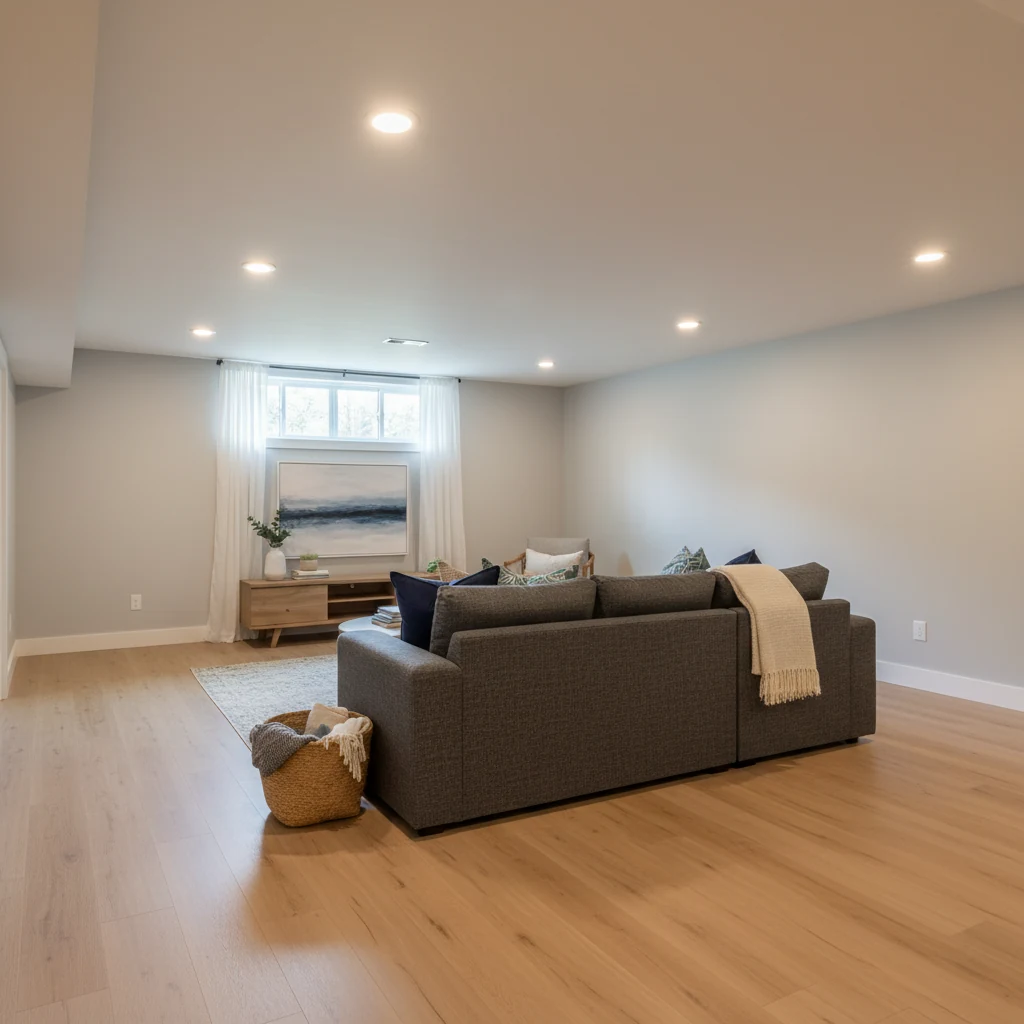
The Patels (composite) had an unfinished poured-concrete basement under a 1995 Atlanta-suburb colonial: 1,100 sq ft, 8'4" ceiling height, dry-feeling, daylight basement with two existing egress-sized windows. They wanted a simple finish: one big rec room, no bedroom, no bathroom, LVP floor, drywall walls, recessed lights. Initial bid: $22,000. Final: $35,000.
- Encapsulation of adjacent crawlspace (+$3,800). A small crawlspace adjacent to the basement (under the kitchen extension) had never been encapsulated. Once the basement was sealed and conditioned, that crawlspace became the air-quality liability for the whole conditioned space. Encapsulation, a small dehumidifier, and rigid-foam insulation on the perimeter. Not in the original bid because the original bid was for the basement only — but practically required once the basement was finished.
- Sump pump install (+$1,800). Atlanta's clay soil holds water during heavy rain seasons. The basement had hydrostatic pressure cracks at the slab-to-wall joint that weren't actively leaking but had efflorescence. A perimeter interior drain plus a sump basin and pump. Hadn't been needed in 30 years of unfinished use. Required once finished.
- Dehumidifier dedicated circuit (+$700). Ducted whole-basement dehumidifier required a 240V circuit. The existing panel had no spare 240V capacity at the amperage required.
- Drop-ceiling tile cost vs. drywall recalc (+$1,400). Originally specced drop-ceiling for mechanicals access. Mid-project the Patels switched to drywall ceilings with strategic access panels — it looked better but cost more in materials and labor. The "small access panel" approach also required the contractor to coordinate with the HVAC tech to confirm where panels needed to be, adding a half-day of meetings.
- Permit re-submission for occupancy classification (+$900). The original permit was for "unfinished storage" → "finished space." The county wanted documentation that this was rec-room space and not a bedroom (no closet, no egress upgrade) to avoid sleeping-room code requirements. Three rounds of permit clarification. Worth it — kept them out of the bedroom-code rabbit hole — but added time.
What they'd do differently: price the moisture-and-air-quality side of the project as a separate line item before any finishing decisions. Test for hydrostatic pressure during the rainy season, not the dry season. Plan crawlspace work into the basement project, not as a future "we'll do that later" — once the basement is sealed, the crawlspace becomes the weak link.
The 5 Most Common Basement-Finishing Lessons, by Cost Impact
Three different climates, three different basement types, three different scopes, the same five categories of surprise. In rough order of how often they show up and how much they add:
| Lesson | Typical cost impact | How to avoid it |
|---|---|---|
| 1. Moisture / waterproofing not addressed first | $2,000–$8,000 | Test slab moisture in three locations. Inspect for hydrostatic cracks during rainy season. Run a perimeter drain assessment BEFORE specifying flooring. |
| 2. Egress / ceiling height code surprises | $2,500–$9,000 | Walk the space with a city residential inspector during bid phase. Egress windows in poured concrete cost $3K–$8K. Ceiling height under 7' requires HVAC reroute — price it. |
| 3. Mechanicals relocation (panel, HVAC, water heater) | $1,500–$5,000 | Map every existing mechanical against the new floor plan BEFORE pricing. Anything in the way of a wall, finished area, or ceiling drop has to move — and electrical panels are expensive to relocate. |
| 4. Radon / oil-tank / asbestos | $1,000–$5,000 | In any pre-1990 home, test for radon BEFORE finalizing the bid. In oil-heated regions (NE, mid-Atlantic), confirm any underground tanks were properly decommissioned. Older pipe insulation gets a quick asbestos test. |
| 5. Permit / occupancy / habitability classification | $500–$3,000 | Decide BEFORE the bid whether each space is a bedroom, office, or rec room. Each classification has different code requirements (egress, ceiling, ventilation, smoke detector). Re-classifying mid-project adds permit cycles. |
Sources: 2024 Remodeling Cost vs. Value Report; NAHB cost-of-finishing surveys; r/HomeImprovement and r/Renovations cost-overrun threads (n > 200); BLS construction-wage data; EPA radon action-level guidance; IRC habitability requirements.
What "Realistic" Basement Pricing Looks Like
The 2024 Remodeling Cost vs. Value Report puts a national-average mid-range basement-to-living-area conversion at roughly $57,683 for an 800 sq-ft conversion, with a 70.0% cost recovery at resale. NAHB cost-per-square-foot estimates for a basic finish (no bedroom, no bathroom) run $30–$50/sq ft; with a bedroom and full bath, $60–$90/sq ft is more honest.
If your contractor's bid is $25/sq ft for a basement with a bedroom, bathroom, and any moisture issues, you're looking at the optimistic case — meaning the bid assumes nothing surprises during demo. When the math fails, it usually fails because moisture and egress weren't priced honestly up front.
For a sanity check on the bid you have, run your project specs through our free basement finishing cost calculator — it uses regional labor and material indices to estimate what a comparable project should run in your zip code, broken out by line item. If the bid is more than 15% below the calculator's estimate, the gap is almost always one of the five categories above.
Three Things to Do Before You Sign
- Hire a moisture-and-air-quality assessment ($300–$600 from an indoor-air-quality firm or experienced contractor) BEFORE locking the renovation bid. Slab moisture, perimeter drainage, hydrostatic indicators, radon, and any HVAC modifications get priced into the bid instead of around it.
- Pull the permit early with whatever the most stringent classification might be (bedroom > office > rec room). It's easier to permit a "potential bedroom" and not finish it that way than to mid-project switch from "rec room" to "bedroom."
- Set a 30% contingency, not 15%. Basements average higher overrun rates than kitchens or bathrooms because the surprise categories (moisture, code, mechanicals) are bigger-ticket and more often hidden until demo.
None of this prevents every surprise. But it converts most of the surprise budget into the planned budget — which is the whole game on basement projects. The basements that finish on budget aren't the ones with no problems; they're the ones where the contractor priced the problems honestly before the first board got cut.