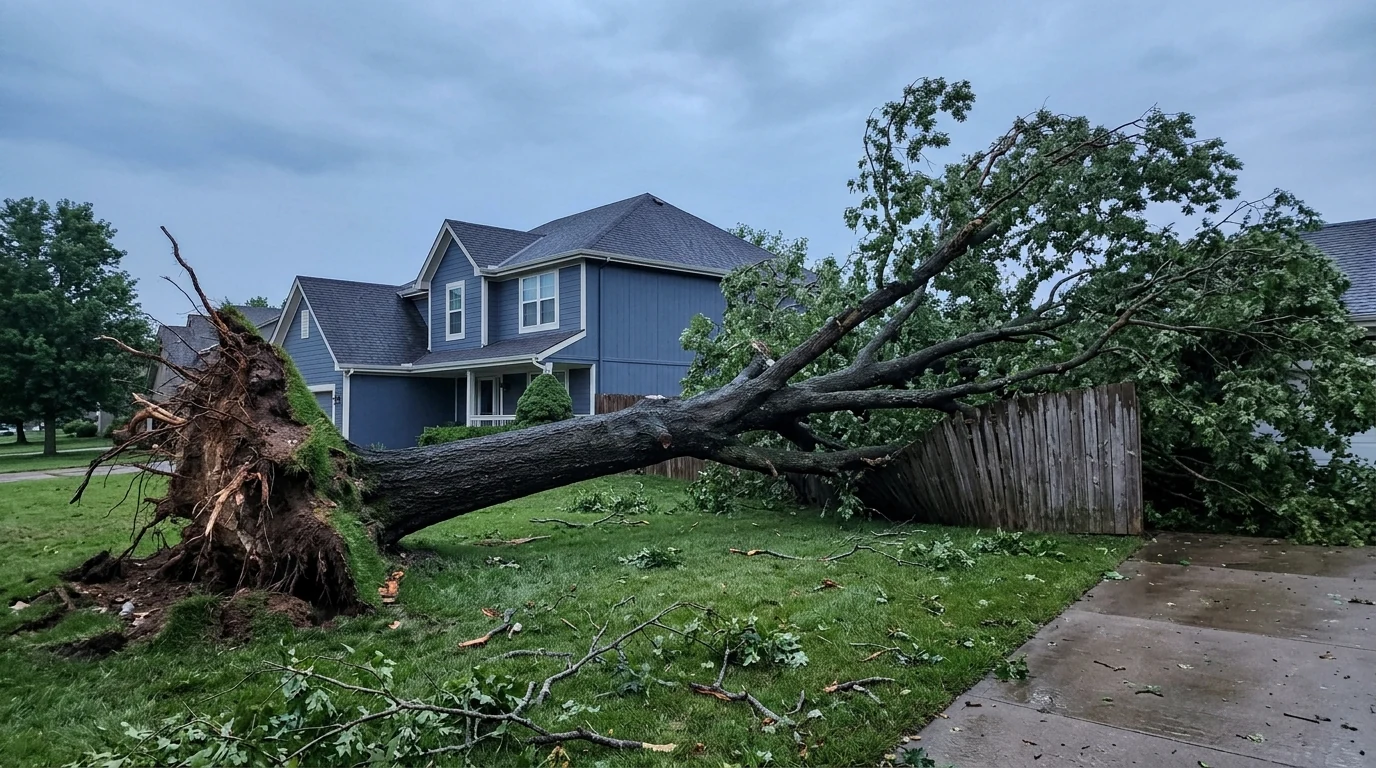
A tree that is already on the ground is usually the cheapest tree you will ever pay to have removed, and the one your insurance is least likely to pay for. A tree resting on your roof is the opposite: it costs the most to clear, and it is the case homeowners insurance was written for. Where the tree landed decides both the bill and who pays it, so that is the first thing to work out the morning after a storm, before you call anyone.
Why a downed tree costs less than a standing one
Most of what you pay for in a normal removal is getting the tree down safely, and a storm has already done that part. A crew taking down a standing tree near a house has to climb it, cut it into pieces small enough to lower on ropes, and control every piece on the way down. A tree lying in open lawn skips all of that. What is left is cutting the trunk into rounds (arborists call it bucking), chipping the branches and hauling the wood away.
That is why a fallen tree in the yard usually prices well below the same tree standing. Our tree removal cost calculator prices standing trees at $200–$750 under 30 feet, $600–$1,800 at 30–60 feet and $1,200–$2,500 at 60–80 feet. A tree of the same size lying in open ground with truck access is mostly a half-day to a day of ground work, so it tends to come in somewhere around half of those figures. The wood still has to go somewhere, though, and a big oak trunk is heavy, so haul-away is the line that keeps a fallen tree from being cheap.
Two things push a fallen tree back up to standing-tree prices or higher. The first is tension: a tree that came down across other trees, a fence or a slope is often bent and loaded like a spring, and cutting it in the wrong place can make a section jump. Crews price that risk in. The second is the calendar. After a big storm every tree company in the area is booked, and cost guides commonly put emergency or after-hours tree work at 25% to 100% above normal rates.
Cost and coverage by where the tree landed
The table below sets planning ranges for each landing spot next to what a standard homeowners policy does. The ranges are built from our standing-tree prices, our crane tree removal cost math and published cost guides; your quotes will vary with the size of the tree, access and how busy local crews are.
| Where it landed | Typical removal cost | What a standard policy does |
|---|---|---|
| Open yard, hit nothing | $150–$1,200 | Usually nothing |
| Across the driveway, car can't get out | $300–$1,500 | Removal up to $500 per tree, $1,000 per storm, after the deductible |
| On a fence or shed | $400–$2,000 plus the repair | Repair under Other Structures; removal under the same $500/$1,000 limit |
| On the house | $1,500–$5,000+, often with a crane | Repair and getting the tree off the house; the rest of the cleanup under the tree limit |
Planning ranges, not quotes. Stump grinding ($100–$400) is extra in every row and is not covered by insurance after a windstorm.
What your homeowners policy actually says about fallen trees
The fallen-tree rule in most homeowners policies is short, and it is stricter than people expect. The standard ISO HO-3 form, which most policies are built on, pays to remove your tree if wind, hail, or the weight of ice, snow or sleet brought it down, and only if it then either damaged a covered structure or blocked your driveway so that a registered vehicle cannot get in or out (or blocked a ramp built for someone with a disability). It pays no more than $1,000 per storm, however many trees came down, and no more than $500 for any one tree (ISO HO 00 03 05 11, Section I, Additional Coverages 1.b).
Three practical things follow from that wording:
- A tree that lands on the lawn and touches nothing is your bill. So is a tree that is leaning and might fall: until it damages something, there is no claim (United Policyholders).
- Blocking the driveway counts, but only fully. The trigger is that a car cannot get in or out. A tree lying beside the driveway, or across a walkway, does not qualify.
- The deductible applies. The tree money is added on top of your other limits, but it is part of the same claim, so your deductible comes off the total.
Your policy may not use these exact numbers. ISO's 2022 revision of the form raised the limits to $3,000 per storm and $1,500 per tree, and large carriers write their own forms with their own figures. Look for the "Debris Removal" section of your policy, which is where the tree limit lives, before you decide anything.
When the tree is on the house
A tree on the roof is the one case where cost stops being your main problem. The house repair is covered under your dwelling coverage, and insurers generally pay to get the tree off the house as part of that repair, because the roof cannot be fixed with a trunk lying on it. The tree limit then applies to cutting up and hauling away what is left on the ground. Some adjusters try to put the whole job under the $500 tree cap, so ask the tree company to split its invoice into "remove tree from structure" and "cut up and haul debris" lines. That split is what lets the adjuster pay the structural part as part of the house claim.
This is also where the bill climbs. Lifting a big trunk off a roof without dropping it through the rafters often needs a crane, and a rented crane with an operator rarely costs less than about $1,100 once minimum hours and travel are added. Our crane post walks through how those bids are built. Expect emergency pricing on top if you need it done the same day.
Before the crew arrives, your policy expects you to stop the damage from getting worse. The standard form requires you to make reasonable repairs to protect the property, such as tarping a hole in the roof, and it pays the reasonable cost of doing it (ISO HO 00 03 05 11, Additional Coverages 2 and Duties After Loss). Keep the receipts. If you need a sense of what the roof work itself will run, our roof replacement cost calculator gives a starting range.
File a claim or pay cash: the math
For anything short of the house, the claim often pays little or nothing once the deductible comes off. The policy pays the covered amount minus your deductible, and the tree part of the covered amount is capped. Here is how that works out with a $1,000 deductible:
| Scenario | Removal bill | Other damage | Covered amount | Claim pays |
|---|---|---|---|---|
| Tree across the driveway | $700 | None | $500 (one-tree cap) | $0 |
| Tree on a fence | $800 | $1,200 fence repair | $500 + $1,200 = $1,700 | $700 |
| Two trees on a fence | $1,600 | $2,500 fence repair | $1,000 + $2,500 = $3,500 | $2,500 |
| Tree on the house | $3,500 ($2,000 off the roof, $1,500 yard) | $9,000 roof and framing | $2,000 + $500 + $9,000 = $11,500 | $10,500 |
Illustrative. Assumes the HO-3 05 11 limits ($500 per tree, $1,000 per storm), a $1,000 deductible, and that the insurer treats lifting the tree off the roof as part of the house repair.
A claim also has a cost the table does not show. Even a small one goes on your insurance claims history, which carriers check at renewal, and it can raise your premium or cost you a claims-free discount for several years (Bankrate). That is why a claim that pays $700 is often not worth filing. A rough rule: if the claim would pay less than about the amount of your deductible, pay cash and keep the claim for something bigger.
Check whether your policy has a separate wind deductible before you run the numbers. In many coastal and storm-prone states, wind and hurricane damage carries a percentage deductible, typically 1% to 5% of the home's insured value (Insurance Information Institute). On a house insured for $350,000, a 2% wind deductible is $7,000, which wipes out every row in the table above except the house.
When it was the neighbor's tree, or a dead one
A neighbor's tree that falls on your property in a storm is still a claim on your own policy. The standard form covers a neighbor's tree on the same terms as yours. The neighbor is generally only on the hook if they were negligent, for example if the tree was visibly dead and you had told them so. If you can show that, your insurer may recover your deductible from them, which is a reason to photograph the trunk and the break before the crew cuts it up.
A dead or rotten tree changes things too. Insurers can refuse to pay for removing a tree that came down from decay rather than the storm, because wear, deterioration and poor maintenance are excluded. Under the standard form the damage the tree did to your house is generally still covered, but expect more questions and keep any photos that show the tree looked healthy before the storm.
What to do the morning after
- Stay clear of wires. If any line is touching the tree, call the utility first. No tree crew should cut it until the line is dealt with.
- Photograph everything before anything is moved: the whole tree, where it landed, the root plate or break, and the damage.
- Read the Debris Removal section of your policy and note your deductible and any separate wind deductible.
- Protect the house if the roof or a window is open. Tarp it and keep the receipt.
- Get two quotes unless it is an emergency, and make sure they price the same things: removal from the structure, cutting and hauling, and stump grinding as separate lines. Our guide to comparing contractor quotes covers what else to line up.
- Run the claim math with your own numbers before you call your insurer. Calling to ask a coverage question is not the same as filing a claim, but some carriers log the call, so read the policy first.
If the tree is lying in open lawn, price it against the standing-tree number from the tree removal calculator: a quote well above that figure for a tree that is already down deserves a question. If it hit a fence, our fence cost calculator gives a repair figure for your claim math. If it is on the house, call your insurer, get it tarped and get the invoice split.