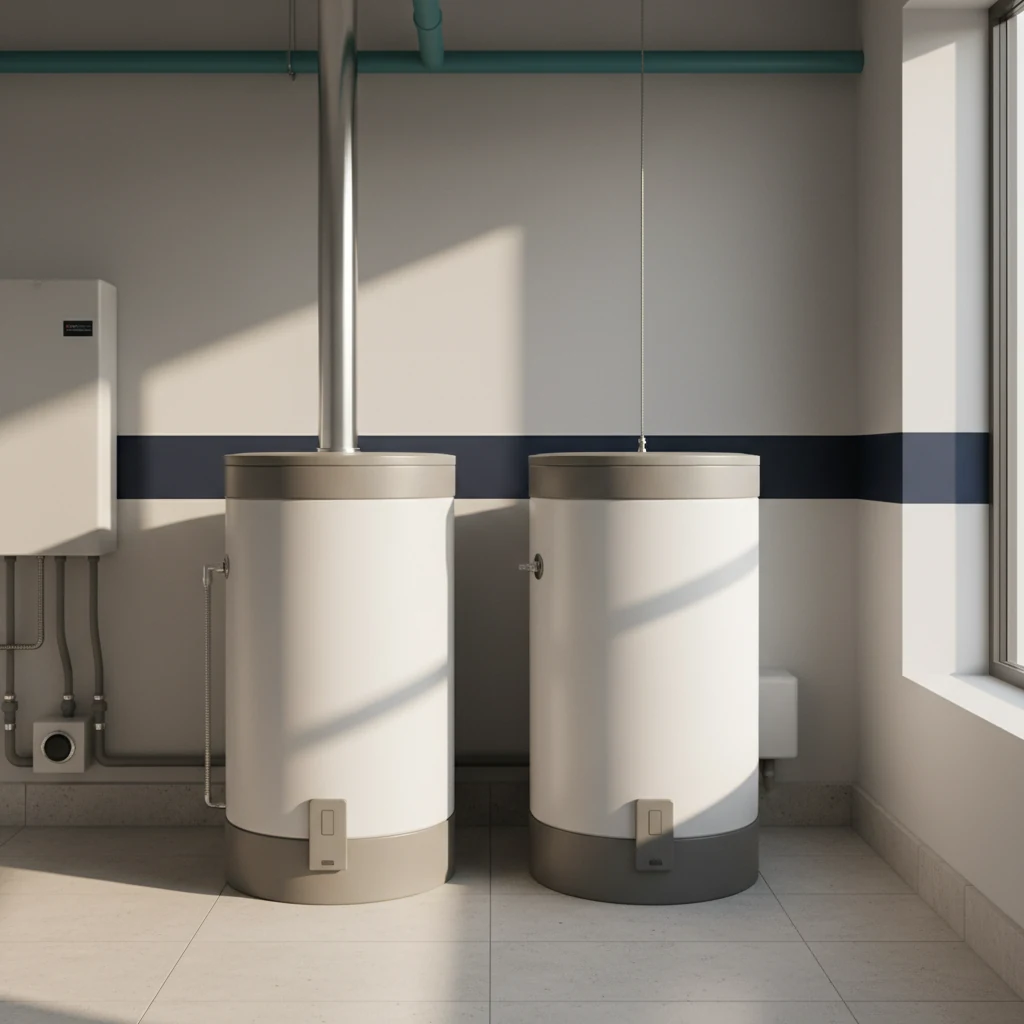
At the national-average energy rates in mid-2026, a standard electric tank water heater costs about $865 a year to run. A gas tank costs about $340. A heat-pump (hybrid electric) tank costs about $270. Those three numbers are the whole story — and they explain why "gas vs electric" is the wrong way to frame the decision.
Because here's the catch most comparisons miss: there are two electrics, and they sit on opposite ends of the operating-cost range. One is the most expensive water heater you can run. The other is the cheapest. Lumping them together as "electric" is how people end up with the wrong heater. This guide separates them, runs the actual rate math, and tells you which fuel wins for your situation in 2026 — a year in which the answer quietly changed.
The 30-Second Answer
- Already have a working gas line? Stay gas. It runs cheaper than a standard electric tank and — now that the federal heat-pump tax credit has expired — beats a heat pump on total cost for most households.
- No gas line at the house? Go electric. Running a new gas line and venting costs thousands, which erases gas's operating-cost edge. Between the two electrics, pick a heat-pump tank if you have a warm, roomy spot for it.
- Replacing a dying electric-resistance tank? Upgrade to a heat-pump tank. It cuts your water-heating bill by roughly two-thirds and pays for itself in 4–7 years against the resistance tank you're replacing.
The rest of this guide shows the math behind those calls, including the exact electricity price where the answer flips.
Why "Gas vs Electric" Is the Wrong Question
Ask "is gas or electric cheaper?" and you'll get a confident answer from half the internet that says gas, and an equally confident answer from the other half that says electric. Both are right, because they're talking about different electric heaters.
"Electric" covers two completely different machines:
- Electric-resistance tank — the cheap, common one. It heats water with a metal element, exactly like a kettle. Every unit of electricity becomes roughly one unit of heat (about 0.93 efficiency). It is the most expensive water heater to operate in almost every market.
- Heat-pump (hybrid) tank — it doesn't make heat, it moves heat from the surrounding air into the water, the way an air conditioner runs in reverse. That makes it 3–4× more efficient than resistance. It is the cheapest water heater to operate, full stop.
Gas sits in the middle. So the honest answer to "gas vs electric" is: gas beats resistance electric easily, and loses to heat-pump electric in most of the country. Which "electric" you mean decides everything.
Operating Cost: What Each Fuel Costs to Run in 2026
Here's the annual running cost for an average family of four (roughly 60–65 gallons of hot water a day), priced at the mid-2026 U.S. residential averages: $0.18 per kWh for electricity and $1.40 per therm for natural gas.
| Water Heater | Efficiency | Energy / Year | Annual Cost | vs. Gas |
|---|---|---|---|---|
| Standard electric-resistance tank | 0.93 EF | ~4,800 kWh | $865 | +$525/yr |
| Standard gas tank | 0.62 EF | ~240 therms | $340 | baseline |
| Heat-pump (hybrid) tank | 3.5 UEF | ~1,500 kWh | $270 | −$70/yr |
Electricity rate from the U.S. EIA Electric Power Monthly (residential average ~17.7–18¢/kWh in 2026); natural gas from EIA natural gas prices (~$13.94 per thousand cubic feet ≈ $1.40/therm). The heat-pump's 1,500 kWh is a real-world figure that already bakes in standby loss and some cold-weather backup heating — a lab-rated 3.5 UEF alone would suggest closer to 1,150 kWh. Plug your own rates in; they vary widely by state.
The ranking is the part to remember: resistance electric is roughly 2.5× the running cost of gas, while a heat pump edges out gas by a small margin. If "electric" means resistance, gas wins on operating cost in a landslide. If "electric" means heat pump, electric wins — but narrowly, and that narrow margin is what makes the upfront cost decisive (more on that below).
The Break-Even: At What Electricity Price Does Gas Stop Winning?
National averages are a starting point, not your bill. The cleaner way to decide is to find the electricity price at which each electric option ties gas. With a gas tank costing about $336 a year to run (240 therms × $1.40):
- Electric-resistance tank ties gas only at about 7¢/kWh ($336 ÷ 4,800 kWh). No U.S. residential customer pays that — even the cheapest states (Washington, Idaho, Utah) sit around 10–11¢. A resistance tank essentially never beats gas on running cost.
- Heat-pump tank ties gas at about 22¢/kWh ($336 ÷ 1,500 kWh). The 2026 national average is ~18¢, so a heat pump beats gas across most of the country. But in high-rate markets — California, New England, Hawaii, parts of New York — electricity runs 25–45¢/kWh, and there a heat pump can actually cost more to run than gas.
So the operating-cost decision reduces to two questions: do you have gas, and is your electricity above or below ~22¢/kWh? Everything else is detail.
Upfront Cost: Electric Is Cheapest to Buy, Gas Sits in the Middle
Operating cost is only half the math. The other half is what you pay to get the unit on the wall — and here the order reverses.
| Water Heater | Unit | Typical Installed | Why |
|---|---|---|---|
| Standard electric-resistance tank | $400 – $900 | $800 – $1,500 | No venting, no gas line — simplest install |
| Standard gas tank | $500 – $1,100 | $900 – $2,000 | Needs combustion venting / flue |
| Heat-pump (hybrid) tank | $1,500 – $2,500 | $2,700 – $4,500 | Pricier unit; needs air volume + condensate drain |
Two install gotchas decide more outcomes than the sticker price:
- Electric needs a dedicated circuit. A standard or heat-pump electric tank wants a 240-volt, 30-amp circuit. Plenty of older homes have no free breaker slot or not enough panel capacity, which adds $500–$1,500 for a panel or circuit upgrade. This is the hidden line item that turns the "cheap" electric tank into the expensive one.
- No gas line is a dealbreaker for gas. If the house has never had gas, running a service line and venting can cost several thousand dollars — far more than any operating-cost savings gas would ever return. For an all-electric home, gas is effectively off the table, and the real decision is resistance vs. heat-pump electric.
For the full format question — tank versus on-demand — see our tank vs tankless water heater cost comparison, and for the propane case specifically, the propane tankless cost guide.
What Changed in 2026: The Federal Heat-Pump Credit Expired
For three years, the easy answer to this whole question was "buy a heat pump and take the credit." The federal 25C Energy Efficient Home Improvement Credit paid 30% of a qualifying heat-pump water heater project, up to $2,000, and many states layered point-of-sale HEAR rebates on top. That subsidy erased most of the heat pump's price premium and made it the obvious pick.
That window has closed. The 25C credit terminated on December 31, 2025, and state HEAR rebate funding largely ran dry in early 2026. (We cover the aftermath in detail in our heat-pump water heater cost guide for 2026.) Without the credit, the heat pump's roughly $1,750 premium over a standard tank is back on your shoulders — and the payback math gets harsh:
A heat pump saves only about $70 a year versus a gas tank. Against a $1,750 premium, that's a ~25-year payback — longer than the heat pump itself will last (10–15 years). Replacing a working gas tank with a heat pump no longer pencils out on energy savings alone.
This is why the 2026 answer flipped. Pre-2026, a gas household swapping to a heat pump made sense on the credit. Post-2026, if your gas tank still works, the rational move is usually to stay gas — and revisit electrification when you're replacing the unit anyway, or if a new incentive appears. The heat pump still wins decisively in one scenario: when it's replacing a resistance tank (where it saves ~$600/year, not $70), the payback is 4–7 years even with no credit.
Which One Should You Buy? A Decision Guide
| Your situation | Best choice | Why |
|---|---|---|
| Working gas line, gas tank dying | Gas tank | Cheapest install path; runs cheaper than resistance; heat-pump payback too long without the credit |
| No gas line / all-electric home | Heat-pump tank | Running gas is thousands; heat pump cuts the all-electric running cost ~65% |
| Replacing a failing electric-resistance tank | Heat-pump tank | ~$600/yr savings → 4–7 year payback even with no credit |
| Cold garage / unheated basement, electric | Resistance tank or gas | Heat-pump efficiency drops below ~50°F ambient; the cold spot undercuts its advantage |
| High electric rates (CA, NE, HI > 25¢/kWh) | Gas (if available) | Above ~22¢/kWh even a heat pump can lose to gas on running cost |
| Have rooftop solar | Heat-pump tank | Its low, steady 1–2 kW draw fits solar output; effectively free hot water midday |
The Caveats That Can Flip the Math
Three real-world factors override the national averages often enough to mention:
- Climate and placement. A heat-pump tank pulls heat from the air around it, so it loves a warm utility room and struggles in a cold garage. Below about 50°F ambient it leans on its backup resistance element and its efficiency — and savings — fall. In the South and in conditioned basements it hits its rated numbers; in an unheated northern garage it may not.
- Solar and time-of-use rates. If you have rooftop solar or a time-of-use plan, a heat pump's modest, steady draw lets you heat water on cheap midday solar power, pushing its effective operating cost well below the table above. A resistance tank's big spiky draw fits solar far worse.
- Your actual rates. The single biggest variable is your utility bill. A household paying 11¢/kWh in the Pacific Northwest reaches very different conclusions than one paying 38¢ in Connecticut. Use the break-even numbers — 7¢ for resistance, 22¢ for heat-pump — against your own rate, not the national average.
For broader context on how fuel choice drives home energy costs, see our guide to the cheapest way to heat your home in 2026.
Frequently Asked Questions
Is a gas or electric water heater cheaper to run?
It depends which electric. A standard electric-resistance tank is the most expensive to run — about $865/year at the 2026 average of $0.18/kWh. A gas tank runs about $340/year. A heat-pump (hybrid electric) tank is the cheapest at about $270/year. Gas comfortably beats resistance electric and narrowly loses to a heat pump in most of the country.
Why is my electric water heater so expensive compared to my neighbor's gas?
Because resistance heating is the least efficient way to make hot water on a cost basis, and electricity is priced higher per unit of heat than natural gas. At national-average rates, the same hot water that costs a gas tank $340 costs a resistance tank about $865 — a real $525/year gap, not a measurement quirk.
Is it worth switching from gas to electric in 2026?
Usually not, if your gas tank works and you'd be moving to a heat pump. The 25C federal credit that paid up to $2,000 expired December 31, 2025, so the heat pump's ~$1,750 premium now takes about 25 years to recover against gas — longer than the unit lasts. Switching makes sense mainly with no gas line, very cheap or solar electricity, or non-financial electrification goals.
Do electric water heaters need a panel upgrade?
Both standard and heat-pump electric tanks need a dedicated 240-volt, 30-amp circuit. If your panel has no free slot or insufficient capacity, budget $500–$1,500 for the upgrade — the line item that most often erases electric's lower sticker price.
Which lasts longer, gas or electric?
Both standard tanks last about 10–15 years; water hardness matters more than fuel type. Heat-pump tanks are rated similarly but have a compressor that can fail earlier if the unit runs in a dusty or very cold space. Annual anode-rod checks extend any tank's life.
Bottom line: Don't ask "gas or electric." Ask "do I have a gas line, and is my electricity under 22¢/kWh?" If you have working gas, keep it in 2026. If you're all-electric or replacing a resistance tank, buy a heat-pump tank and put it somewhere warm. Then run your own rates through the water heater cost calculator before you sign a single bid.
Shopping for the unit?
Popular tankless water heaters on Amazon
The install is a plumber job, but the unit itself you can buy yourself — here are well-reviewed high-output (199k BTU) gas tankless models.
As an Amazon Associate, RemodelCostCalc earns from qualifying purchases. Prices and availability are shown on Amazon.