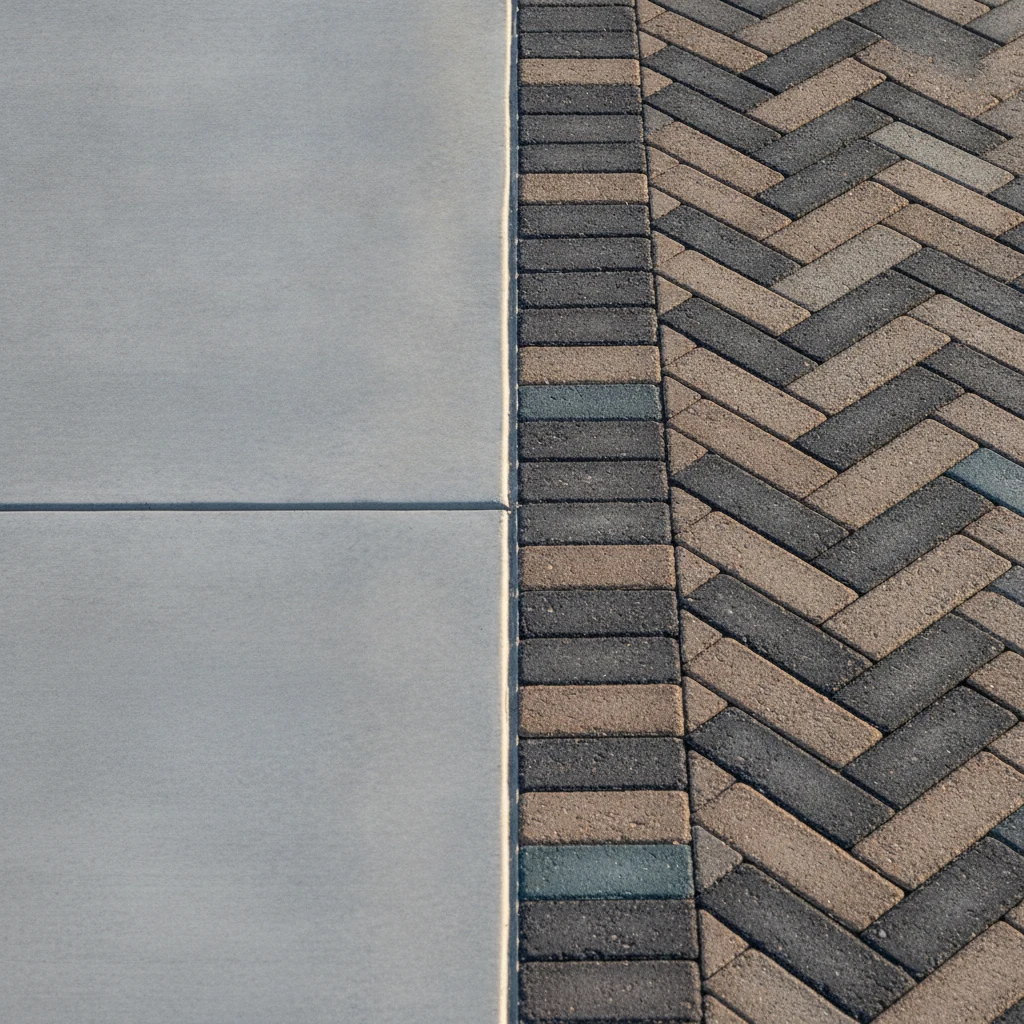
Pavers cost more to install than concrete — usually a lot more. That's where most comparisons stop, and it's the wrong place to stop. A poured concrete driveway might run $6–$12 per square foot while the same driveway in pavers runs $15–$25. But you don't buy a driveway for one year — you live on it for thirty. Once you count cracking, resealing, and the simple fact that you can lift and replace a single broken paver but never a single slab of poured concrete, the upfront gap narrows and sometimes flips.
Here's the honest cost-per-year math for pavers vs. concrete on a driveway or patio — and how to price your specific project before you decide.
Price your own project first
National averages are a starting point, not a quote. Before you weigh pavers against concrete, get your real number: our driveway cost calculator and patio cost calculator both price concrete and pavers side by side for your square footage and state, and the concrete calculator breaks down plain vs. stamped finishes. Run your size through it, then use the comparison below to decide which surface actually earns its price.
Upfront cost: concrete wins, clearly
On day one, concrete is the cheaper pour. These are 2026 installed ranges (materials + labor); your region and site prep move them:
| Surface | Installed cost / sq ft | 600 sq ft driveway |
|---|---|---|
| Standard poured concrete | $6–$12 | $3,600–$7,200 |
| Stamped / decorative concrete | $10–$20+ | $6,000–$12,000+ |
| Concrete pavers (interlocking) | $15–$25 | $9,000–$15,000 |
| Brick / premium pavers | $20–$30+ | $12,000–$18,000+ |
2026 US installed ranges aggregated across contractor-pricing sources; verified via search grounding. Freeze-thaw regions and poor soil raise both.
Notice that stamped concrete overlaps with base-level pavers. If you're paying for stamped concrete's looks, you're already in paver territory on price — which changes the decision.
The part the price tag hides: lifespan and repair
This is where pavers earn their premium. A poured slab and a paver field age completely differently:
| Poured concrete | Concrete pavers | |
|---|---|---|
| Typical lifespan | 25–40 years | 30–50+ years |
| How it fails | Cracks, spalls, heaves at joints | Individual pavers settle or chip |
| Repair | Patch or resurface — the fix usually shows | Lift and swap the affected pavers — invisible |
| Recover from a utility dig | Cut, re-pour, mismatched patch | Pull pavers, dig, re-lay the same pavers |
A crack in poured concrete is permanent-ish: you fill it, resurface it, or live with it, and any patch is visible. A damaged paver is a 20-minute swap with a spare from the same batch. Over 30 years, that difference is the whole argument.
Cost per year: the number that actually decides it
Divide the all-in cost (install + a realistic share of maintenance) by the years you'll get. Take that 600 sq ft driveway:
- Standard concrete: ~$5,400 installed, ~30-year life, resealing every 3–5 years → roughly $200–$230 per year.
- Concrete pavers: ~$12,000 installed, ~40-year life, occasional joint re-sanding and a few paver swaps → roughly $310–$340 per year.
Concrete still wins on cost per year for most driveways — it's cheaper to buy and lasts a long time. Pavers close the gap through longevity and cheap repairs, and they pull ahead when you factor in the two things this math leaves out: resale value and how the surface looks in year 15. Run your own numbers with the driveway calculator's cost-per-year view — the same framing that makes tar-and-chip vs. asphalt and concrete vs. asphalt honest comparisons instead of sticker-price ones.
Maintenance: different chores, similar effort
- Concrete wants resealing every 3–5 years (decorative finishes sooner) to fight stains and freeze-thaw scaling. Cracks, once they start, tend to grow.
- Pavers want joint sand topped up (polymeric sand helps) and occasional weeds pulled from the joints. No resealing required, though it's optional for color.
Neither is maintenance-free. The difference is that concrete maintenance fights an aging monolith, while paver maintenance is modular — you tend the joints, not the whole surface.
Resale and curb appeal
Pavers generally read as the premium surface and lift curb appeal more than plain gray concrete — a real factor if you might sell within the surface's life. Stamped concrete narrows that gap for less money, which is exactly why it exists. If resale in the next 5–10 years matters, pavers (or at least stamped concrete) usually justify the spend; if it doesn't, plain concrete's lower cost per year is hard to beat.
Which one should you actually pick?
- Choose concrete if: budget is the priority, you're staying long enough to amortize it, and you don't mind a functional gray (or a modest stamped upgrade) surface.
- Choose pavers if: you want the longest life with invisible repairs, you're in a freeze-thaw or expansive-soil area where slabs crack, resale/curb appeal matters, or a utility line runs under the surface.
- Split the difference with stamped concrete when you want paver looks closer to concrete money — just know you're paying paver-adjacent prices for a surface that still cracks like concrete.
Frequently asked questions
Are pavers really worth the extra cost?
For a driveway you'll keep 20+ years — or one you'll sell within the decade — usually yes, because of repairability, lifespan, and resale. For a short-term, budget-first project, plain concrete's lower cost per year usually wins.
Do pavers or concrete crack more?
Poured concrete cracks as a slab (it's designed with control joints to steer where). Pavers don't crack as a field — individual units can chip or settle, but the surface flexes at the joints, which is why pavers do better over freeze-thaw and soil movement.
Is stamped concrete cheaper than pavers?
Usually a little, but they overlap. Stamped concrete runs about $10–$20+ per sq ft installed vs. $15–$25 for concrete pavers — so a high-end stamp can cost more than base pavers while still cracking like concrete.
Which adds more home value?
Pavers typically add the most curb appeal and perceived value, with stamped concrete a strong middle option. Plain concrete is the functional, lowest-cost choice and adds the least.
Next step: run your driveway or patio square footage through the calculator to see concrete and paver costs side by side for your state — then use the cost-per-year lens above to pick the surface that's actually cheaper over the years you'll own it.