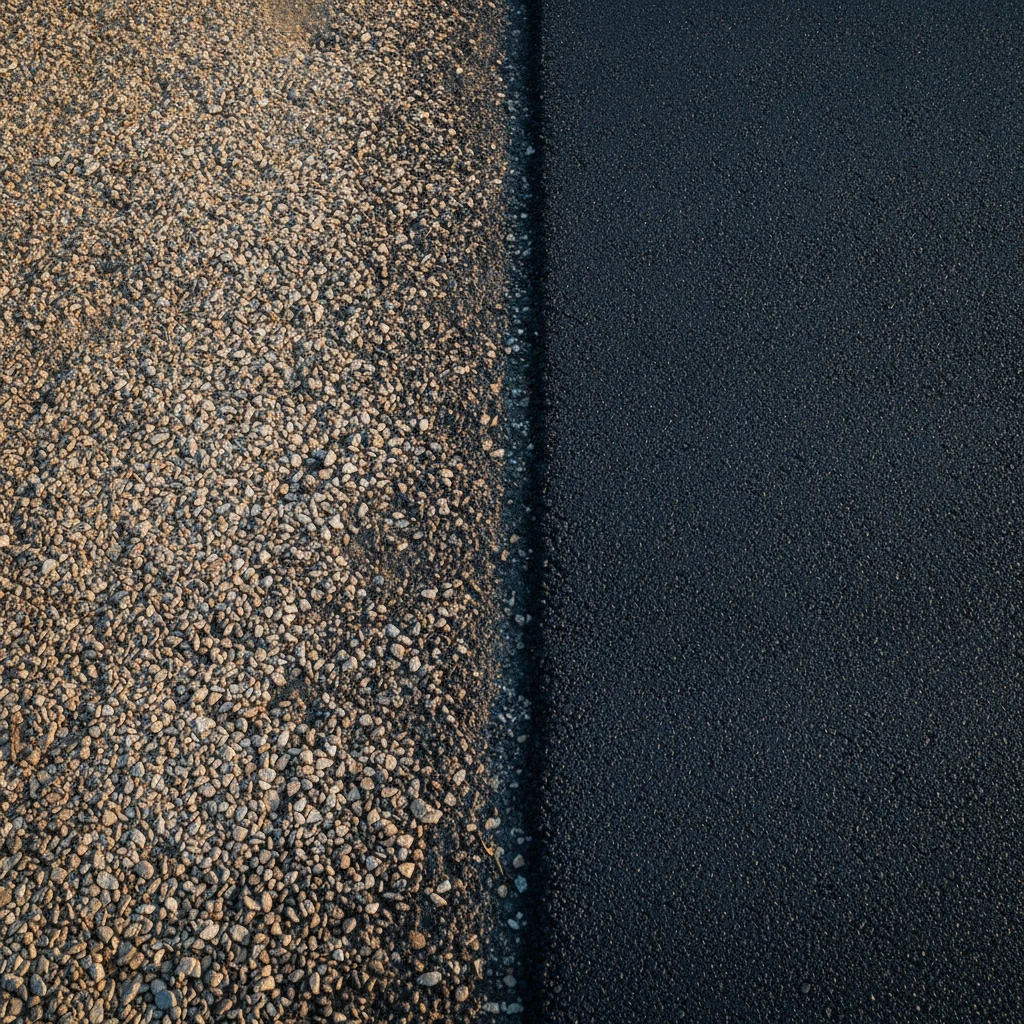
Here's the number that flips most tar-and-chip-vs-asphalt advice on its head: tar-and-chip costs $2-5 per square foot installed, asphalt costs $5-13 — but asphalt lasts roughly twice as long. That combination is exactly why "asphalt is cheaper in the long run" gets repeated everywhere and is only half true. Run the actual cost per year and the two land closer than almost any competitor guide admits — and the tiebreaker isn't the material at all. It's how long you plan to own the house.
Installed cost ranges verified against 2025-2026 contractor pricing data (Angi, Fixr, HomeGuide, Bob Vila driveway cost guides). Lifespans reflect industry-standard service-life figures. Figures are U.S. national ranges, professionally installed; local quotes vary with base condition and region.
This guide runs the break-even math for a typical 600 sq ft (roughly 20×30) driveway, counts the maintenance both surfaces actually need, and then tells you plainly which one wins for a 5-year owner versus a 20-year owner.
Upfront Cost: Where the Money Actually Goes
Tar-and-chip is genuinely the cheaper surface to install. For a 600 sq ft driveway:
| Surface | Installed cost / sq ft | 600 sq ft driveway |
|---|---|---|
| Tar-and-chip (chip seal) | $2 - $5 | $1,200 - $3,000 |
| Hot-mix asphalt (blacktop) | $5 - $13 | $3,000 - $7,800 |
Notice how wide each range is. That's not sloppy estimating — it's the single most important thing to understand before you compare materials. On both surfaces, the material is the cheap part. Excavation, grading, and a compacted base are where the money goes — often 60-70% of the total, the same pattern you see in our paver driveway cost breakdown. A tar-and-chip job over a sound existing base can land near $2/sq ft; the same job requiring full excavation and a new gravel base creeps toward $5. Asphalt behaves identically. So where your specific quote lands inside its range matters as much as which material you pick.
Lifespan: The Number That Changes Everything
This is where the two surfaces separate:
- Tar-and-chip: 7-10 years before it needs resurfacing or replacement. It sheds stone over time and can't be patched invisibly.
- Asphalt: 15-20 years with proper maintenance — roughly double.
So asphalt costs about 2× more upfront but lasts about 2× as long. If that were the whole story, it'd be a wash. It isn't, because of two things most guides skip: the maintenance each one needs along the way, and the fact that you may not own the house long enough to reach asphalt's second decade.
Maintenance: Count It on Both Surfaces
A cost-per-year comparison is meaningless unless you count upkeep for both options, not just the one you're suspicious of.
Asphalt
Asphalt needs sealcoating every 3 years or so (about $0.15-0.25/sq ft, so roughly $100-150 per application on a 600 sq ft drive), plus occasional crack filling as it ages. Budget somewhere around $500-900 in maintenance over a 15-20 year life. Skip the sealcoating and you don't save money — you just move the replacement forward.
Tar-and-chip
Tar-and-chip needs no sealcoating — that's a real advantage. There's no routine upkeep bill. The trade-off is that it can't be resealed to extend its life the way asphalt can; when it's worn, you re-chip or replace. Lower ongoing effort, shorter runway.
Cost Per Year: The Honest Numbers
Putting install plus lifetime maintenance over each surface's service life, at representative mid-range pricing for our 600 sq ft driveway:
| Tar-and-chip | Asphalt | |
|---|---|---|
| Install (mid-range) | ~$2,100 | ~$4,800 |
| Lifetime maintenance | ~$0 | ~$700 |
| Service life | ~8.5 yrs | ~17.5 yrs |
| Cost per year | ~$250 | ~$315 |
Simple nominal dollars — no inflation or time-value-of-money adjustment, to keep the comparison readable. Removal of an old surface (~$1-3/sq ft) applies to either choice and roughly cancels out.
Read that again: at typical pricing, tar-and-chip is not just cheaper upfront — it's competitive-to-cheaper on cost per year, too. The widely repeated "asphalt is cheaper over the long haul" only holds if you get asphalt near the low end of its range ($5-7/sq ft) and you keep the driveway long enough to amortize it. Push asphalt toward $9-13/sq ft and tar-and-chip wins the per-year math outright. This is the same lifetime-cost lens we use to rank surfaces in cheapest driveway options by cost per year.
The Real Tiebreaker: How Long Will You Stay?
Cost per year over a material's full life assumes you're there for the whole ride. Most people aren't. What actually matters is your cumulative spend over the years you'll own the home — and that changes the winner.
Asphalt starts about $2,700 behind (its higher upfront cost). Tar-and-chip only gives that lead back when it hits its second and third replacement cycles:
- Own for 5 years: Tar-and-chip wins easily. You paid ~$2,100, replaced nothing, and walk away. Asphalt cost ~$4,800+ and you never used most of its lifespan.
- Own for 10 years: Tar-and-chip still ahead. One re-chip (~$2,100 again) puts you near $4,200 — roughly even with asphalt plus its sealcoats, and often still cheaper.
- Own for 15-18 years: This is the break-even zone. By your third tar-and-chip surface you've spent more than one well-maintained asphalt driveway — right around when that asphalt is itself due for replacement.
- Own for 20+ years (forever home): Asphalt wins. One-and-a-half asphalt driveways beats two-to-three tar-and-chip re-dos, and the smooth surface is nicer to live on.
The break-even sits near 15 years — suspiciously close to how long asphalt lasts. Below it, tar-and-chip's lower cash outlay wins. Above it, asphalt's longevity finally pays for itself.
When Each One Actually Wins
Cost is only half the decision. Here's the honest split:
Choose tar-and-chip if…
- You'll likely move within 10-15 years. You capture the low outlay and never pay the longevity premium you won't use.
- Your asphalt quotes came in high ($9-13/sq ft) — the per-year gap flips in tar-and-chip's favor.
- You have a long rural driveway where the lower cost per square foot compounds hard, and a rustic, textured look suits the property.
- You want zero sealcoating chores.
Choose asphalt if…
- This is your forever home (15-20+ year horizon).
- You got an asphalt quote near the low end ($5-7/sq ft).
- You get real snow and plow with a metal blade — it pulls stones off tar-and-chip.
- You want a smooth, uniform, suburban-standard surface (and an HOA that expects one). If you're also weighing concrete, our concrete vs asphalt cost comparison runs the same math one tier up.
And if you're really just chasing the lowest number, note that tar-and-chip sits one rung above loose stone — compare it against a gravel driveway, which is cheaper still but needs regrading and doesn't shed mud the way a bound surface does.
The Bottom Line
Skip the blanket rule. Tar-and-chip and asphalt cost about the same per year at typical pricing, so decide on the two variables that actually move the needle: how long you'll own the home, and where your quotes land inside each range. Under ~15 years or with a pricey asphalt bid, tar-and-chip is the smarter spend. Past 15 years with a fair asphalt quote, pay up for the longer-lasting surface. Get itemized quotes for both, plug your real square footage into our driveway cost calculator, and compare the per-year figures for your numbers — not the averages.
Frequently Asked Questions
Is tar-and-chip the same as chip seal?
Yes. Tar-and-chip, chip seal, chipseal, "tar & chip," and (historically) macadam all describe the same method: hot liquid asphalt binder sprayed onto a prepared base, then loose stone chips rolled into it.
Can you put tar-and-chip over an existing asphalt driveway?
Often yes. If the existing asphalt base is structurally sound, a tar-and-chip coat can go right over it — which removes the excavation and base-prep cost and is one of the cheapest ways to refresh a tired driveway.
Does tar-and-chip hold up to snowplows?
Less well than asphalt. A metal plow blade catches and pulls loose stones off the surface. A rubber-edged blade, a raised blade, or a snowblower is gentler. In heavy-snow regions, this pushes the decision toward smooth asphalt.
Which driveway adds more resale value?
A smooth, uniform asphalt surface generally reads as more "finished" to buyers, so it tends to help resale slightly more in suburban markets. In rural and rustic settings the difference narrows or even reverses.