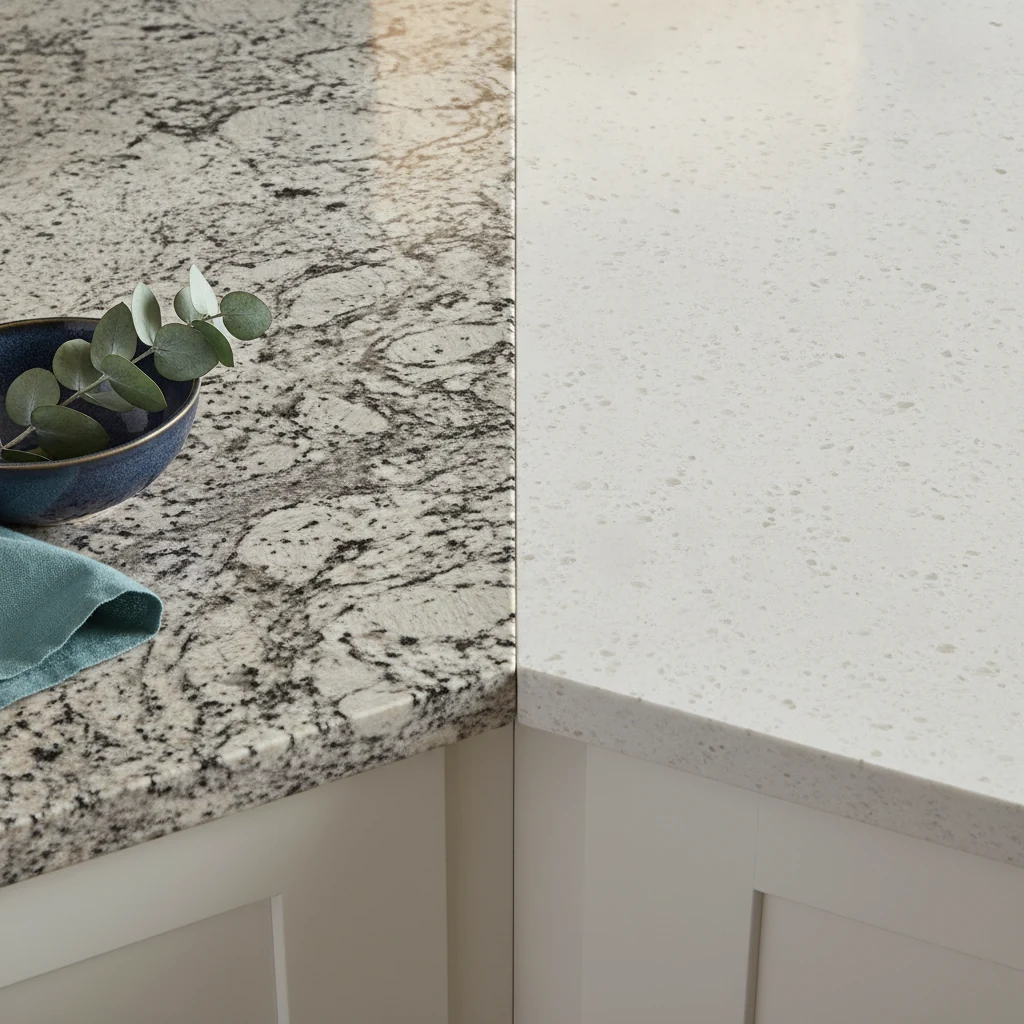
Most people think quartz is the expensive one and granite is the budget pick. Installed, they overlap almost completely — granite runs about $40–$100 per square foot and quartz about $50–$120, and a premium granite easily costs more than a mid-range quartz. So price is rarely the tiebreaker. The real decision is how you cook, how much maintenance you'll tolerate, and how long you plan to keep the kitchen.
Here's the honest quartz-vs-granite comparison — cost, durability, and the two gotchas (sealing and heat) that decide it for most kitchens — plus how to price your specific project.
Price your kitchen first
Countertops are one line item in a kitchen budget, and the "right" stone depends on how much of your budget it should eat. Run your project through our kitchen remodel calculator — it breaks out countertops alongside cabinets, appliances, and labor by grade and state — before you fixate on a material. Doing a bathroom vanity instead? The bathroom calculator prices those surfaces too. Get your number, then use the comparison below to spend it well.
Upfront cost: closer than you think
These are 2026 installed ranges (material + fabrication + install). Both span a wide band, and the bands overlap heavily:
| Material | Installed cost / sq ft | 40 sq ft kitchen |
|---|---|---|
| Granite (entry to mid) | $40–$100 | $1,600–$4,000 |
| Granite (premium / exotic) | $100–$200+ | $4,000–$8,000+ |
| Quartz (entry to mid) | $50–$120 | $2,000–$4,800 |
| Quartz (designer) | $120–$200 | $4,800–$8,000+ |
2026 US installed ranges, verified via search grounding. Edge profiles, cutouts, and slab rarity move the number more than the material choice does.
The takeaway: you can't reliably say one is "cheaper." A common builder-grade granite and a common quartz land in the same $50–$90 range. Spend the decision on how the surface behaves, not the sticker.
Durability head-to-head
| Granite (natural stone) | Quartz (engineered) | |
|---|---|---|
| Porosity / sealing | Porous — reseal every 1–5 years | Non-porous — never needs sealing |
| Stain resistance | Good if sealed; stains if not | Excellent (nothing soaks in) |
| Scratch resistance | Very hard (Mohs 6–7) | Slightly harder (Mohs 7) |
| Heat resistance | Excellent — shrugs off hot pans | Poor — hot pans can scorch/discolor it |
| Sunlight / outdoor | UV-stable, fine outdoors | Can fade/yellow in direct sun |
| Lifespan | 30–50+ years, refinishable | Decades (can't be refinished) |
Two lines in that table decide most kitchens: sealing and heat. They pull in opposite directions.
The two gotchas that actually decide it
Granite needs sealing; quartz doesn't. Granite is natural stone with tiny pores, so it needs sealing at install and re-sealing every one to five years (a 20-minute DIY job) or it can stain from oil and wine. Quartz is engineered with resin, non-porous, and never needs sealing — the low-maintenance win that's made it the modern default.
But quartz can't take heat, and granite can. That same resin binder is quartz's weakness: set a pan straight off the burner on it and you can scorch or discolor the surface (damage can start around 185°F). Granite formed under geological heat and barely notices a hot pot. If you're a heavy cook who forgets trivets, granite forgives you; quartz won't.
Cost per year: it's basically a wash — so pick on fit
Both materials last decades, and both recover roughly 60–80% of their cost at resale, so the long-run math is close. Quartz saves you the minor cost and effort of sealing; granite saves you from the one expensive mistake quartz is prone to (heat damage, which usually means replacing a section). Neither has a decisive cost-per-year edge — which is exactly why the decision should come down to how you actually use the kitchen, not a spreadsheet. It's the same lesson behind most kitchen remodel regrets: the expensive mistakes come from picking a material that doesn't match how you live, not from picking the "wrong" price tier.
Which should you choose?
- Choose quartz if: you want zero maintenance, a consistent modern look, maximum stain resistance, and you're disciplined with trivets (or don't cook heavy). Best for busy families and resale-minded modern kitchens.
- Choose granite if: you cook hot and often, want a natural one-of-a-kind slab, don't mind resealing occasionally, or the surface will see direct sun or an outdoor kitchen. Best for serious cooks and traditional/luxury kitchens.
- Either is a safe resale bet — both read as premium. Quartz has a slight edge with modern buyers for its low-maintenance reputation; granite holds strong in traditional and high-end markets.
Frequently asked questions
Is quartz cheaper than granite?
Not reliably. Installed, granite runs ~$40–$100/sq ft and quartz ~$50–$120, and the bands overlap. A premium granite costs more than a mid-range quartz. Fabrication, edges, and slab rarity move the price more than the material name.
Which lasts longer, quartz or granite?
Granite has a slight edge on paper — 30–50+ years and it can be refinished, while quartz lasts decades but can't be resurfaced. In practice both outlast most kitchens; damage (heat on quartz, staining on unsealed granite) ends them sooner than age does.
Can you put a hot pan on quartz?
No — use a trivet. Quartz's resin binder can scorch or discolor from direct high heat. This is granite's biggest advantage: it handles hot cookware without a mark.
Does granite really need sealing?
Yes, but it's easy. Seal at install and re-seal every 1–5 years depending on the stone and sealant. Skipping it is how granite stains. Quartz never needs it.
Next step: price your kitchen with countertops included to see what each grade does to your total — then pick quartz or granite based on how you cook and how long you'll keep it, not on which sticker looks smaller.