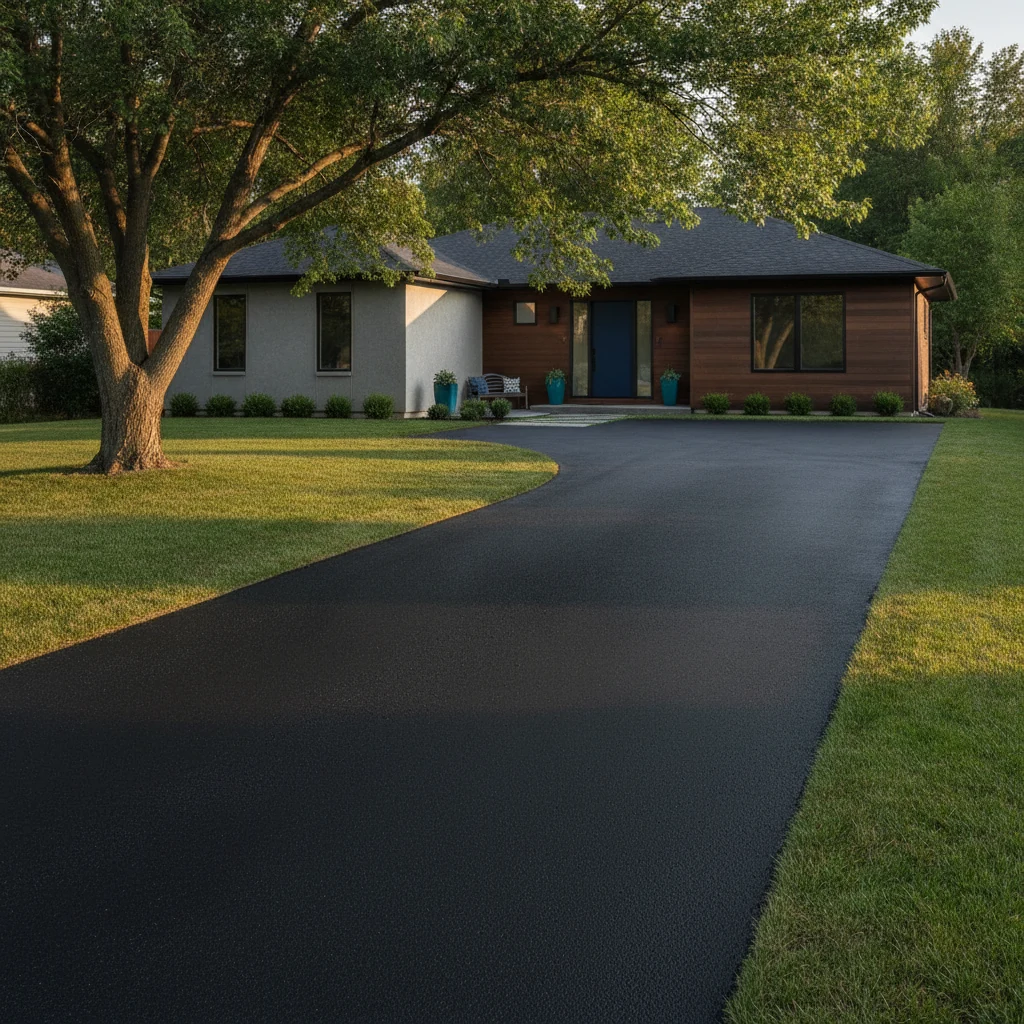
Sealcoating a standard two-car asphalt driveway runs about $250 to $600 if you hire it out, or roughly $45 to $130 in materials if you do it yourself. That is cheap enough that most homeowners just say yes on a contractor's word. But the price was never the hard part. The hard question is whether that money buys you anything — and on a meaningful share of driveways, it buys nothing, or actively shortens the life of the surface it was supposed to protect.
Here is the part the cost guides skip: sealcoat does not do what most people think it does, and there are three specific situations where sealing is money set on fire. Run the math before you run the squeegee.
What sealcoating actually costs in 2026
Professional sealcoating lands at roughly $0.50 to $1.50 per square foot applied, materials and labor included. On a typical 600-square-foot driveway that is about $250 to $600; on a larger 1,000-square-foot drive, closer to $575 to $1,150. The wide spread comes from prep — a crew that cleans, fills cracks, and edges before coating costs more than one that sprays and leaves.
Doing it yourself collapses the number to materials. A five-gallon pail of sealer covers about 250 to 400 square feet and runs $18 to $65 depending on type, so a 600-square-foot driveway needs two to three pails — $45 to $130 all in. The catch is that DIY sealer is thinner and less durable than commercial-grade product, and a bad squeegee job (puddles, tire tracking, coating in the wrong weather) can look worse than doing nothing.
| Job | Cost (600 sq ft) | Cost per sq ft | What you're paying for |
|---|---|---|---|
| DIY, materials only | $45 – $130 | ~$0.08 – $0.22 | Sealer + your Saturday |
| Pro, basic spray | $180 – $350 | ~$0.30 – $0.60 | Coating, minimal prep |
| Pro, clean + crack-fill + coat | $400 – $600 | ~$0.65 – $1.00 | Prep that makes the coat last |
Ranges reflect 2025–2026 U.S. contractor and retail pricing (HomeAdvisor/Angi, Fixr, HomeGuide, and asphalt-supply retailers). Regional labor and driveway condition move the final number.
What sealcoat does — and the thing it doesn't
This is where the "is it worth it" question is actually decided. Sealcoat is a thin surface film. It slows the two things that age asphalt from the top down: UV oxidation (sun turning the binder brittle and gray) and raveling (loose aggregate working free). It also resists gas and oil staining and gives that clean matte-black look. The Federal Highway Administration treats surface sealing as legitimate preventive maintenance for exactly these reasons.
What sealcoat does not do is fix anything structural. It does not bridge cracks, it does not add strength, and it does nothing for the base underneath. Asphalt driveways fail from the bottom up — water gets through cracks into the sub-base, freezes, heaves, and the surface breaks apart. The treatment that actually prevents that is crack sealing — routing and hot-pour filling the cracks so water stays out — not the black film on top. Skip the crack filling and repair and coat over open cracks, and you have painted a failing driveway. It will still fail; it will just look good for one season while it does.
So the honest version of "sealcoating extends the life of your driveway" is this: crack sealing plus surface sealing on a driveway with a sound base extends life. Sealcoat alone, or sealcoat over a cracked or failing surface, does not. Any cost-vs-savings math that skips this distinction is selling you something.
The cost-vs-savings math, run honestly
Amortize the recurring spend. Reseal frequency depends on the product and how hard the driveway lives: budget asphalt-emulsion sealer wears in one to three years, especially where a snowplow scrapes it; acrylic sealer holds three to five. Call it a coat every three years. That is roughly $30 a year maintained DIY, or $100 to $150 a year maintained by a contractor with real prep.
What that spend protects against is a resurface or full replacement — a $1,200 to $4,200 job on a 600-square-foot driveway, depending on whether you overlay or tear out. On a driveway with a sound base, in a climate that punishes asphalt, disciplined maintenance can push that big job from year 12–15 out toward year 20–25. Deferring a ~$3,000 replacement by roughly a decade, for $30–150 a year, is a real and favorable trade.
But notice everything that trade depends on, because this is where it flips:
- Climate. In a mild, low-freeze region, unsealed asphalt already lasts 20-plus years. Sealing there is mostly cosmetic — you are paying to keep it black, not to keep it whole. In a freeze-thaw or high-UV climate, the protective value is real.
- You do the crack sealing too. Sealcoat without crack maintenance is not buying you the deferral above. The two are a package or neither works.
- You're keeping the house. If you sell within a year or two, a single fresh coat for curb appeal at closing is worth it; a multi-decade maintenance program is not your expense to make.
This is the same logic as our cost-per-year comparison across driveway materials: the sticker price is the least useful number. What matters is dollars per year of sound driveway you actually get — and for sealcoating, that number is only good when the conditions above hold.
Three times sealcoating is a waste of money
1. On brand-new asphalt. Fresh asphalt needs to cure. Sealing it inside the first 6 to 12 months traps the light oils still gassing off, leaving a soft surface that scuffs and tracks. New driveways should go through a full season bare. Sealing early isn't just wasted money — it makes the surface worse.
2. On a driveway you seal every year. More is not better. Piling on a fresh coat annually builds a thick sealer layer that cannot flex with the asphalt underneath, so it cracks, peels, and flakes off in sheets — taking your money and the clean look with it. Every two to three years is the window; annual sealing is a common, expensive mistake.
3. On pavement that has already failed. If you see interconnected alligator cracking, potholes, or spots that sink underfoot, the base is gone. Sealcoat is a cosmetic film over a structural problem; the cracks will telegraph back through within a season or two. Money spent sealing an alligatored driveway is money you'll spend again on the replacement you actually needed. Check the surface first — our asphalt driveway cost breakdown covers what a fresh installation runs when sealing is no longer the answer.
One more thing: skip the coal tar
Two sealer chemistries dominate the shelf. Coal-tar sealers are durable and cheap but carry high levels of PAHs — polycyclic aromatic hydrocarbons, a class of known carcinogens that wash into stormwater and track indoors as dust. They are now banned in Washington, Minnesota, Maine, New York, Maryland, and Virginia, plus a growing list of counties and cities. Asphalt-emulsion (water-based, ~$28–$42 a pail) and acrylic (~$42–$58 a pail, three-to-five-year life) sealers are the safer, increasingly standard choice. If a contractor is quoting coal tar, ask why — and check your state.
So, is it worth it?
Seal it if the base is sound, you'll fill the cracks too, you're staying in the house, and your winters are hard — that combination turns $30 to $150 a year into a decade of deferred replacement. Skip it if the asphalt is new, if you already seal every year, if the surface is alligatored, or if you're listing the house. And whatever you do, price the full driveway job with our cost calculator before you decide — sealing is only the right move when the number it protects is a number worth protecting.