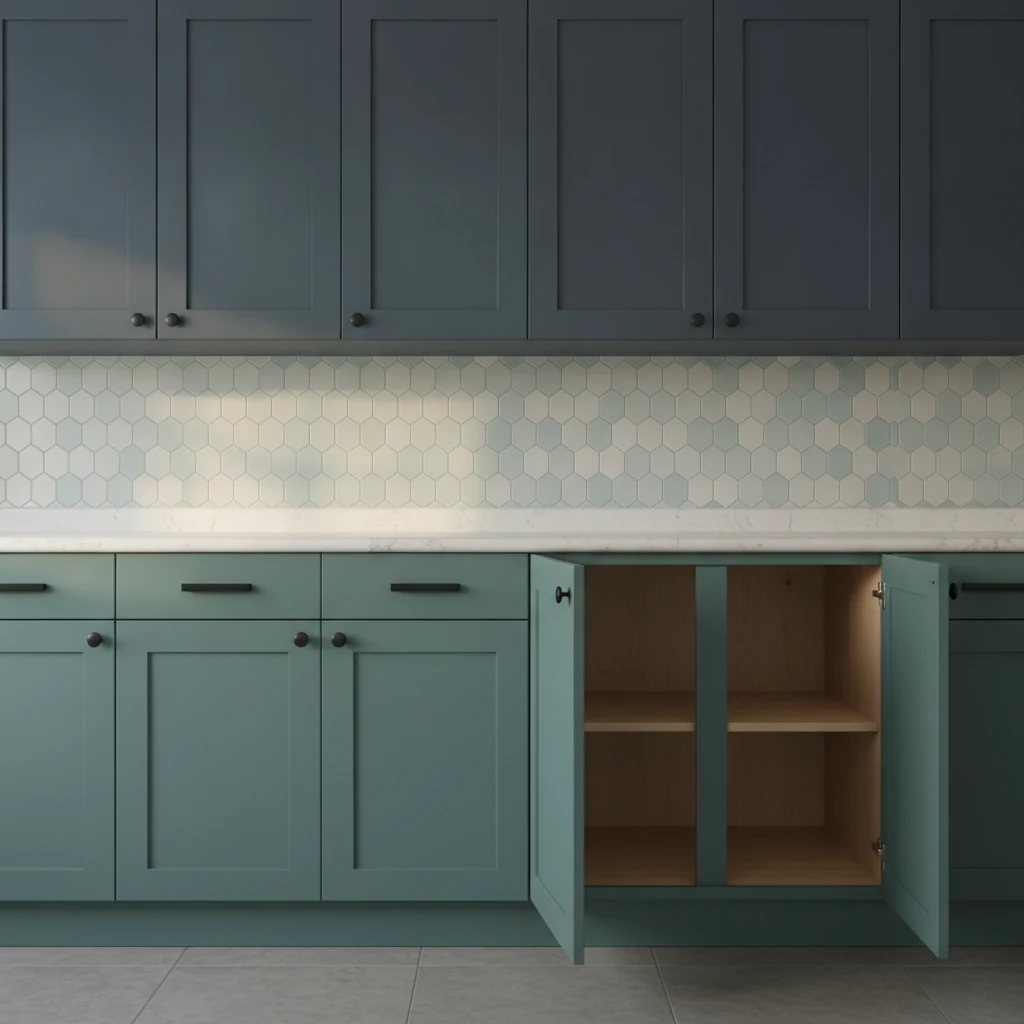
You can get two bids for the exact same kitchen and see one at $4,000 and another at $22,000 — and both can be honest. Cabinets are the single biggest line item in a kitchen remodel, usually 30% to 50% of the whole budget, and they're priced in a way most homeowners never see explained: by the linear foot, across three quality tiers that don't overlap in price. Once you know the pricing model, wildly different quotes stop looking like one contractor ripping you off and start looking like what they are — estimates for three different products.
Here's how cabinet pricing actually works, why the same room produces a $15,000 spread, and how to normalize competing quotes so you're comparing apples to apples.
Cabinets are priced by the linear foot — here's the number that matters
Cabinet estimates are built on linear feet: the length of wall your base and upper cabinets run along, measured in feet. A standard 10×12 kitchen typically has about 25 linear feet of cabinetry (base plus upper counted together in the common shorthand). Contractors multiply that footage by a per-foot rate that depends almost entirely on one thing — the cabinet tier. That single multiplier is where the whole spread comes from:
| Cabinet tier | Installed cost / linear foot | ~25 linear ft kitchen |
|---|---|---|
| Stock (off-the-shelf sizes) | $100–$300 | $2,500–$7,500 |
| Semi-custom (stock sizes, more finishes/mods) | $150–$650 | $3,750–$16,250 |
| Custom (built to your exact kitchen) | $500–$1,200+ | $12,500–$30,000+ |
2026 US installed ranges (material + fabrication + install), verified via search grounding across multiple cost aggregators. Ranges are wide because layout complexity, door style, and finish move the per-foot rate substantially within each tier.
Look at the right-hand column. A stock kitchen and a custom kitchen of identical size can legitimately differ by $15,000 or more. If one contractor quoted stock and another quoted custom — or you described "nice cabinets" and each interpreted it differently — you're not comparing two prices for one thing. You're comparing two different things.
How to measure your run (do this before you read a single quote)
You can estimate your own linear footage in five minutes with a tape measure:
- Measure the length, in feet, of every wall that has (or will have) cabinets along it — base cabinets and wall cabinets are usually counted together in the rough estimate.
- Add an island's cabinet run if you have one.
- Don't subtract for the sink or range — the standard shorthand counts the full run.
Most kitchens land between 20 and 30 linear feet. Knowing your number turns a scary lump-sum bid into simple division: a $10,000 quote on a 25-foot kitchen is $400 per foot — solidly in semi-custom territory. Now you can tell what tier you're actually being sold. For the full project picture — cabinets alongside countertops, appliances, and labor — run the room through our kitchen remodel cost calculator first, then use these tiers to sanity-check the cabinet line.
The three tiers, decoded
Stock cabinets come in fixed sizes (widths jump in 3-inch increments) and a limited set of door styles and finishes. They're in stock or ship in days, and they're the value play — a clean, durable kitchen if your layout fits standard boxes. This is where big-box store lines live.
Semi-custom starts from stock sizes but lets you modify: more door styles, more finishes, some depth and width changes, extras like pull-outs and soft-close. It's the most popular tier because it covers most kitchens without full-custom pricing — but it's also the widest price band, which is exactly why two semi-custom quotes can look so far apart.
Custom cabinets are built to your kitchen's exact dimensions, any style, any material, any storage solution. You pay for the flexibility — and for odd layouts, tall ceilings, or specialty storage, it may be the only tier that fits. If your walls aren't square or your ceilings are 10 feet, a custom bid isn't padding; it's the real cost.
"Installed" vs. "cabinet only" — the other reason quotes diverge
Two bids can quote the same tier and still disagree because one includes installation and the other doesn't. Installation labor typically runs 20% to 30% of the cabinet total, or roughly $50 to $150 per linear foot — meaning $1,250 to $3,750 in labor alone on a 25-foot kitchen. Always confirm whether a number is cabinets-only (boxes and doors delivered to your driveway) or fully installed. A "cheaper" cabinet-only quote can end up costing more once you add an installer. This is the same trap behind most confusing bids, and it's worth reading our guide on how to compare contractor quotes before you sign anything.
Before you price new cabinets: do you even need them?
New cabinets are the default assumption, but they're often the most expensive way to solve the actual problem. If your boxes are structurally sound and you like the layout, two cheaper routes fix a dated kitchen for a fraction of replacement:
| Route | Typical whole-kitchen cost | What changes | Best when |
|---|---|---|---|
| Paint (professional) | $1,500–$6,000 | Color only — same doors, boxes, layout | Boxes and doors are fine; you just hate the color |
| Reface | $4,000–$10,000 | New doors, drawer fronts & veneer; boxes and layout stay | Boxes are solid, layout works, you want a real refresh |
| Replace (mid-range) | $8,000–$20,000 | All-new boxes, doors, and layout freedom | Boxes failing, changing the layout, or going high-end |
2026 US ranges, verified via search grounding. Professional painting estimates vary widely by source and kitchen size; DIY materials can run $200–$600. Refacing typically saves roughly 30%–50% versus a full replacement.
The deciding factor isn't budget — it's box condition and whether the layout changes. Painting and refacing both keep your existing boxes and footprint, so they're off the table the moment you want to move the sink, add an island, or if the boxes are water-damaged or particleboard that's crumbling. If any of that is true, you're replacing — and you're back to the linear-foot math above. Choosing the wrong route here is a classic entry on our list of kitchen remodel regrets: refacing cabinets you were about to reconfigure, or replacing boxes that only needed paint.
How to normalize two quotes
Put competing bids on the same footing before you judge price:
- Divide by your linear footage. Convert every bid to a per-foot number. That instantly reveals which tier each contractor is quoting.
- Confirm installed vs. cabinet-only. Add ~25% to any cabinet-only number to compare it against an installed one.
- Match the tier to your kitchen. If your layout fits standard sizes, a custom bid is upsell; if your kitchen is oddly shaped, a stock bid may not physically work.
- Check what's bundled. Countertops, hardware, crown molding, and haul-away are sometimes inside the cabinet line and sometimes separate.
Do those four things and a $4,000-vs-$22,000 mystery usually resolves into a clear, defensible choice. And because cabinets are the same 30%–50% slice of most kitchens, decisions elsewhere follow the same logic — countertop material, for instance, is another place where the "expensive" option isn't always the one you think.
Frequently asked questions
How much are kitchen cabinets per linear foot?
Installed, stock cabinets run about $100–$300 per linear foot, semi-custom $150–$650, and custom $500–$1,200 or more. Multiply your kitchen's linear footage (usually 20–30 feet) by the tier's rate to estimate the cabinet line.
Why are two cabinet quotes so different for the same kitchen?
Almost always because they're quoting different tiers (stock vs. semi-custom vs. custom) or because one is installed and the other is cabinet-only. Convert each bid to a per-linear-foot number to see which is which — the difference is the product, not usually the contractor.
What percentage of a kitchen remodel is cabinets?
Typically 30% to 50% of the total budget, making cabinets the largest single line item in most kitchen remodels. That's why the tier you choose moves your whole project cost more than any other decision.
Is it cheaper to reface or replace kitchen cabinets?
Refacing is cheaper — roughly 30%–50% less than replacement — because it keeps your existing boxes and layout and only swaps doors, fronts, and veneer. It only makes sense if the boxes are sound and you're not changing the layout; otherwise replacement is the honest cost.
Next step: price your kitchen with cabinets, countertops, and labor broken out, then measure your linear footage and use the tier table above to check every bid you get. Once you can convert a quote to dollars per foot, you can't be sold the wrong tier by accident.