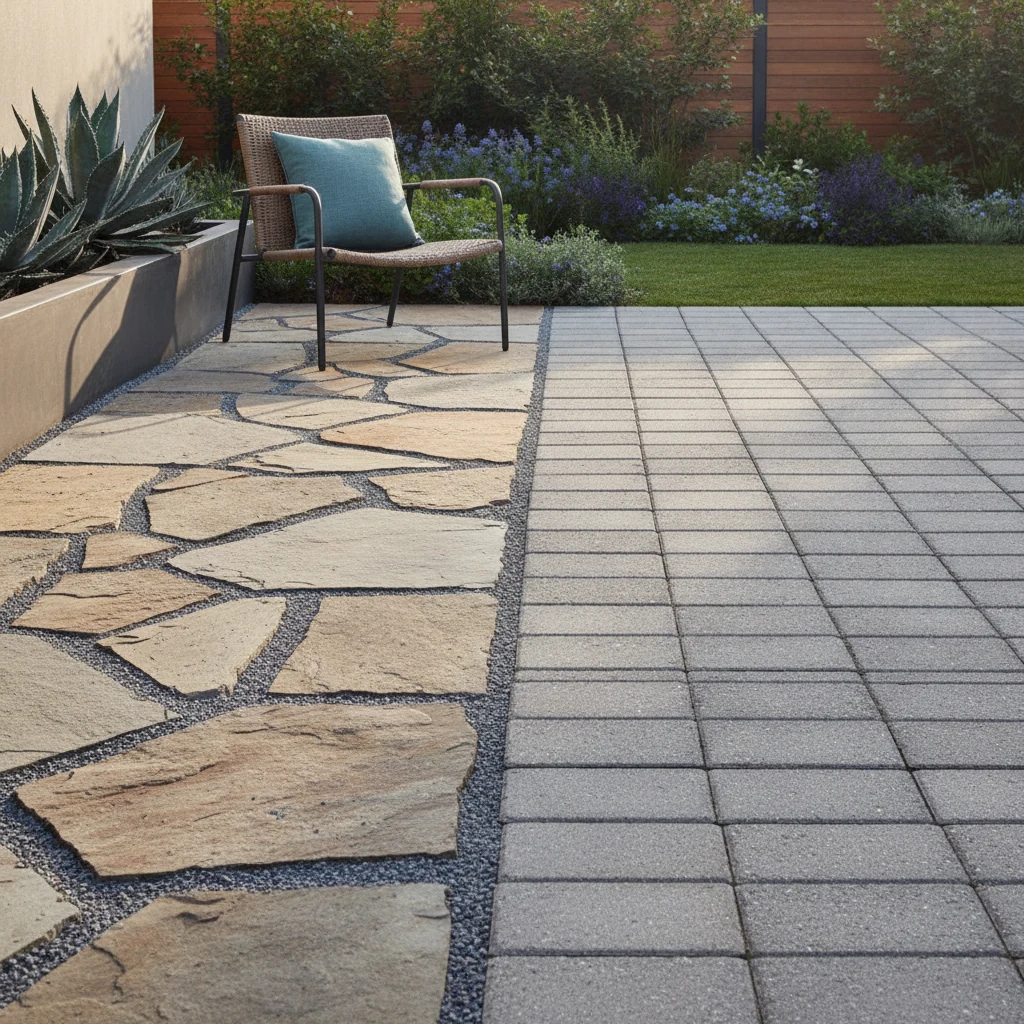
The cheapest patio to build is almost never the cheapest patio to own — and the material most homeowners pick as their "affordable upgrade," stamped concrete, is the single worst value on the list once you do the math that matters. Sticker price ranks patio materials one way. Cost per year — what you actually pay to have that surface underfoot over its life — ranks them differently, and one material flips positions entirely.
Here are 2026 installed costs for the six patio surfaces people actually build, the honest cost-per-year math that reshuffles them, and how to price your own patio before a contractor's number anchors you.
Price your own patio first
National ranges are a starting point, not a quote — your square footage, region, and site conditions move the number more than the material does. Run your dimensions through our patio cost calculator, which prices concrete, pavers, stamped concrete, natural stone, and gravel side by side for your state and shows total cost, cost per square foot, and cost per year for each. The concrete calculator breaks out plain vs. stamped finishes if that's the decision you're weighing. Get your real number, then use the comparison below to decide which surface earns its price.
Installed cost per square foot, 2026
These are installed ranges — material plus labor — for a standard patio on reasonably flat ground with decent drainage. The 300 sq ft column is a common real-world patio (roughly 15×20). Your region and site prep move these; more on that below.
| Material | Installed / sq ft | 300 sq ft patio | Typical lifespan |
|---|---|---|---|
| Loose gravel / pea gravel | $2–$5 | $600–$1,500 | 10–15 yrs |
| Poured concrete | $6–$12 | $1,800–$3,600 | 25–30 yrs |
| Concrete pavers | $8–$18 | $2,400–$5,400 | 30–50 yrs |
| Stamped concrete | $10–$20 | $3,000–$6,000 | 20–25 yrs |
| Brick pavers | $10–$20 | $3,000–$6,000 | 35–50 yrs |
| Natural stone (flagstone / travertine) | $25–$50 | $7,500–$15,000 | 50+ yrs |
2026 US installed ranges; figures match the material data behind our patio calculator and were cross-checked against current contractor pricing via search grounding. Freeze-thaw climates, sloped or clay-heavy sites, and tricky access raise every row.
On sticker price alone the ladder is simple: gravel is cheapest, natural stone is roughly four times a poured slab, and everything else stacks in between. Most cost guides stop here. That's exactly where the decision goes wrong, because a patio isn't a one-year purchase — you live on it for decades, and the surfaces age nothing alike.
The number that actually decides it: cost per year
Divide the installed cost by the years you'll realistically get, and the ranking rearranges. Using the midpoint of each range on that same 300 sq ft patio:
| Material | Midpoint install | Lifespan | Cost / year | Upfront rank | Per-year rank |
|---|---|---|---|---|---|
| Loose gravel | $1,050 | 12 yrs | ~$88 | 1 | 1 |
| Poured concrete | $2,700 | 28 yrs | ~$96 | 2 | 2 |
| Brick pavers | $4,500 | 35 yrs | ~$129 | 4 (tie) | 3 |
| Concrete pavers | $3,900 | 30 yrs | ~$130 | 3 | 4 |
| Stamped concrete | $4,500 | 22 yrs | ~$205 | 4 (tie) | 5 |
| Natural stone | $11,250 | 50 yrs | ~$225 | 6 | 6 |
Cost per year = installed cost ÷ expected lifespan, the same method our patio calculator uses to flag its "best value" material. Excludes maintenance, which widens — not narrows — the gaps below.
Two things jump out. First, poured concrete is the sweet spot: it costs about $96 a year to own — within a rounding error of loose gravel — but gives you a permanent, solid surface instead of stone that migrates and needs topping up. Second, and this is the one that saves people real money: stamped concrete is the only material that ranks worse on cost-per-year than it does on sticker price.
Why stamped concrete is the value trap
Stamped concrete is sold as the affordable way to get a high-end look — pavers' style at concrete's price. The price half of that pitch is roughly true: at $10–$20 per square foot it overlaps directly with real pavers. The durability half is where it falls apart.
Stamped concrete is still a single poured slab. It cracks like one — especially through freeze-thaw cycles — and when it cracks, you can't fix it invisibly. Patching compounds and color hardeners never quite match the original stamp, so the repair shows. Its realistic life is 20–25 years, the shortest of any solid surface here. So you pay paver money (~$4,500 on our example patio) for a surface that lasts a third less time than the pavers it's imitating and fails in a way you can't spot-repair. That's how a material tied for fourth-cheapest to build lands second-most-expensive to own, at ~$205 a year.
Real pavers — brick or concrete — cost the same or less upfront, last 30–50 years, and repair by lifting and swapping a single unit. On our example patio they run about $129–$130 a year versus stamped concrete's $205. If you're drawn to stamped concrete for the look, price actual pavers before you sign; the case for the imitation is weaker than it appears. Our deeper pavers vs. concrete cost breakdown runs the same lifespan-and-repair logic in detail.
What natural stone's premium actually costs you
Natural stone looks unaffordable on the sticker: at $25–$50 per square foot it's the priciest row by a wide margin, roughly $11,000+ on our example patio. But it lasts 50 years or more, and that long life amortizes the spend. On cost-per-year it lands at ~$225 — still the most expensive to own, but only about 10% more per year than stamped concrete, which costs a third as much to build.
Put plainly: the gap between stone and stamped concrete is enormous on the invoice and small on the ledger. If flagstone or travertine is the look you actually want and you'll stay in the house long enough to live on it, the premium is far more defensible than the price tag suggests — and you never repay it in the crack-and-patch cycle that catches stamped concrete.
The hidden cost driver that beats material choice
Here's the part no material table captures: the surface you pick is often not the biggest line on the quote. Two identical-size patios can differ by thousands, and the spread usually traces to what's under and around the patio, not on top of it:
- Base prep and drainage. A standard estimate assumes flat ground that drains. Clay soil, a slope, or a low spot means excavation, grading, and a deeper compacted base — and that foundational work is where budgets blow up. It's also non-negotiable: skimp on the base and any surface fails early.
- Demolition. Tearing out an old concrete slab typically adds about $2–$5 per square foot before your new patio starts.
- Site access. If a crew can't get machinery to the backyard and has to move base material and pavers by hand, labor climbs fast.
- Pattern and edging. Herringbone paver layouts, curved borders, and cut stone all add labor over a running-bond field or a plain pour.
This is why a per-square-foot average can be off by a wide margin for your specific yard, and why pricing your own project beats trusting a national number. The same lifespan-versus-sticker logic drives our cheapest driveway options ranked by cost per year — a patio surface and a driveway surface are bought the same wrong way, on the price of year one.
So which patio should you build?
- Budget-first, permanent surface: poured concrete. Near-gravel cost per year, no loose material, decades of life. A broom or exposed-aggregate finish avoids the crack-prone thinness of a decorative pour.
- Cheapest possible, casual look: loose gravel — genuinely low cost to own, with the asterisk that it migrates, isn't great under furniture, and needs topping up every few years.
- Best long-term value with a premium look: concrete or brick pavers. Same-or-less than stamped concrete upfront, far longer life, invisible repairs, strong resale.
- You want the high-end look and you're staying: natural stone. The priciest to own, but the per-year premium over stamped concrete is small and you skip the crack-and-patch failure mode entirely.
- Reconsider: stamped concrete, unless you specifically want it and have priced real pavers first. It's the one surface here that costs more to own than its sticker rank implies.
Frequently asked questions
What is the cheapest patio material?
Loose gravel is cheapest to install at $2–$5 per square foot. But poured concrete is nearly as cheap to own — about $96 a year versus gravel's $88 on a 300 sq ft patio — because concrete lasts 25–30 years while gravel needs topping up every few years. If you want a solid, permanent surface for close to the lowest cost per year, concrete usually wins.
Is stamped concrete cheaper than pavers?
Upfront, barely — both run about $10–$20 per square foot, so they overlap. Over time, no: stamped concrete lasts 20–25 years and cracks like a slab you can't spot-repair, while pavers last 30–50 years and repair one unit at a time. On cost per year, real pavers (~$129) beat stamped concrete (~$205) clearly. Stamped concrete's value case is weaker than its marketing.
Does a paver patio really last longer than concrete?
Yes. A poured slab is designed to crack at control joints and ages as one monolith; pavers flex at their joints, so they ride out freeze-thaw and minor soil movement without the field failing. Individual pavers can chip or settle, but you lift and replace them — the surface as a whole lasts 30–50+ years versus 22–30 for concrete.
Is a natural stone patio worth the money?
If you want the flagstone or travertine look and plan to stay, usually yes. It's the most expensive to build by a wide margin, but its 50+ year life brings cost per year to roughly $225 — only about 10% above stamped concrete — and it never enters the crack-and-patch cycle. For a short-term hold, the upfront premium is harder to recover.
Next step: run your patio's square footage through the calculator to see all six materials priced side by side for your state — total, per square foot, and per year — then pick the surface that's actually cheapest over the years you'll own it, not just the day it's poured.