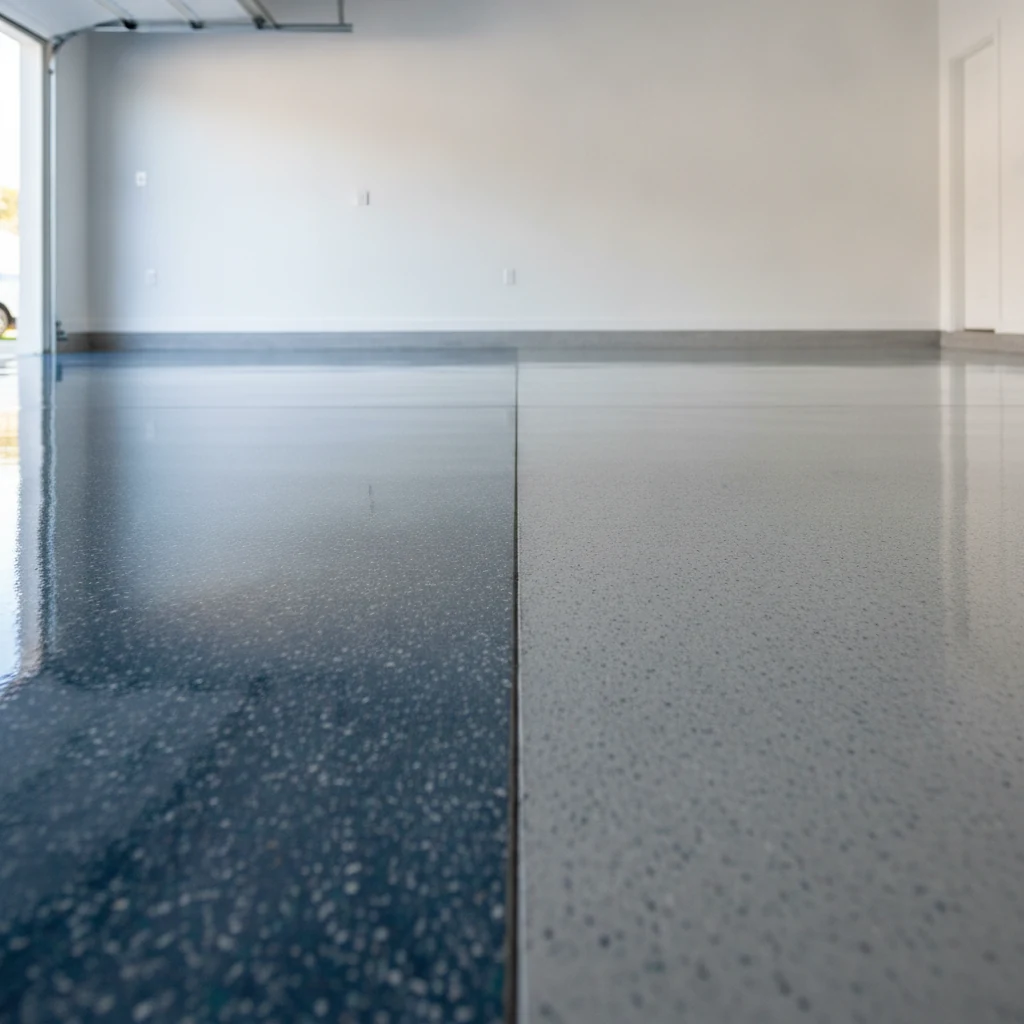
The sticker price is the wrong number to compare. A professionally installed epoxy garage floor can cost roughly half what polyaspartic does — and still end up the more expensive choice by year twelve. But not always. Whether the premium coating is worth it comes down to one calculation almost no installer will walk you through: cost per year of service, not cost per square foot. Run that math and the "obvious" cheaper option flips in about a third of real garages.
Here is the honest version — including the three specific situations where the cheaper coating genuinely wins, and the one option that looks cheapest of all but quietly costs the most.
There are three tiers, not two
"Epoxy vs polyaspartic" is the wrong framing. The real market has three price tiers, and the mistake most homeowners make is comparing the top of one against the bottom of another:
- DIY epoxy kit — roughly $1.00–$2.50 per square foot in materials, about $450–$1,100 for a standard two-car garage (400–550 sq ft). The big-box water-based kits you paint on yourself.
- Professional epoxy — $3–$7 per square foot installed. Solid-color runs $3–$5; a decorative flake system $4–$7; add a urethane or polyaspartic topcoat and you push toward $5–$7+. That's $1,500–$5,000 for a two-car garage, with a mid-range flake floor typically landing $2,500–$3,500.
- Professional polyaspartic — $5–$12 per square foot, most commonly a polyurea base coat with a polyaspartic topcoat. Franchised systems (Penntek, Garage Force, and similar) usually quote $7–$9 per square foot. Figure $2,000–$7,000 for a two-car garage.
Notice the overlap. A high-end epoxy system with a good topcoat and an entry-level polyaspartic floor land in the same $5–$7 band and last about the same time. In that overlap zone, price isn't the deciding factor at all — cure time and UV resistance are. (Figures here track 2026 pricing from contractor aggregators like HomeGuide and Homewyse.)
| Coating tier | Cost / sq ft | 2-car garage | Typical lifespan | UV-stable? | Park on it |
|---|---|---|---|---|---|
| DIY epoxy kit | $1.00–$2.50 | $450–$1,100 | 2–5 yrs* | No | ~7 days |
| Pro epoxy (basic) | $3–$5 | $1,500–$2,800 | 5–10 yrs | No | ~7 days |
| Pro epoxy + topcoat | $5–$7 | $2,500–$3,800 | 10–15 yrs | Partial | ~7 days |
| Polyaspartic | $5–$12 | $2,000–$7,000 | 15–20+ yrs | Yes | ~24 hrs |
*DIY lifespan assumes typical prep. Well-prepped DIY floors last longer; poorly prepped ones fail far sooner — see below.
The cost-per-year math (the honest version)
Take a real 500-square-foot two-car garage and run both coatings over their service life.
Basic professional epoxy: about $2,000 installed, with a 5–10 year life. Call it 8 years — that's roughly $250 a year. But if the garage gets any daylight, epoxy ambers and yellows, and to keep it looking right you'll likely want a mid-life recoat (another $1–$2 per square foot, so $500–$1,000). Fold that in and you're closer to $310 a year.
Polyaspartic: about $3,500 installed, 15–20 year life, no yellowing, no scheduled recoat. Over 18 years that's roughly $195 a year.
So on a per-year basis, polyaspartic actually comes out cheaper — if you stay long enough to amortize it. That "if" is the whole argument. Under about eight years of ownership, epoxy's lower upfront cost wins outright, because you never live long enough with the floor to pay the recoat penalty that makes it look expensive on paper.
Two honest caveats before you treat that $195-vs-$310 as gospel:
- Cost-per-year ignores the time value of money. The $1,500 you don't spend upfront on polyaspartic is real money you keep — and could invest — today, versus a recoat you might avoid a decade from now. Use cost-per-year as a tie-breaker, not a trump card.
- "Epoxy" isn't one product. A pro epoxy system with a urethane or aliphatic topcoat can last 10–15 years and closes most of the lifespan gap. If you compare the best polyaspartic against the cheapest epoxy, of course polyaspartic wins. Compare like systems.
This is the same lens we use on the driveway side of the site — the coating that costs more upfront often wins once you divide by years of service, exactly like the logic in our breakdown of the cheapest driveway options by cost per year.
Where the cheaper coating actually wins
Three garages where a quality professional epoxy is the smarter money, full stop:
- You'll move within about 5–7 years. You never reach the recoat, and you never live with the yellowing long enough for it to matter. You'd be pre-paying for durability the next owner collects. Buy the cheaper floor.
- Low-traffic, low-light garage. No windows, no west-facing open door, no direct sun means epoxy's biggest weakness — UV yellowing — never shows up. Light use means polyaspartic's abrasion and impact edge barely earns its keep. In a dim, gently used garage the two floors will look about the same in year eight.
- A firm upfront budget. If the honest choice is a solid pro epoxy floor now versus stretching the budget for polyaspartic later, the epoxy wins — because the real alternative is a DIY kit or bare concrete, and a professionally installed epoxy floor beats both by a wide margin.
Where polyaspartic earns its premium
And the flip side — situations where the premium pays for itself:
- Sun exposure. Windows, a glass door, or a west-facing garage you leave open: epoxy ambers, polyaspartic is 100% UV-stable and holds its color for decades.
- Heavy use or a workshop. Polyaspartic is more flexible and abrasion-resistant, and it tolerates heat better — so it resists the "hot-tire pickup" that softens and peels epoxy where warm tires sit.
- You need the garage back fast. Polyaspartic can be walked on in 2–4 hours and parked on in about 24. Epoxy wants 24–72 hours before foot traffic and up to a full 7 days to cure before you park a car on it — return it to service early and you can permanently mar the finish.
- Cold-climate or off-season installs. Polyaspartic goes down at temperatures as low as ~40°F (some systems far lower); epoxy generally wants 60°F+ to cure properly, which rules out a lot of the year in northern garages.
- You're staying put 15+ years. The recoat and the re-yellowing you skip are the entire cost argument. Over that horizon, polyaspartic is the cheaper floor per year, comfortably.
The real trap isn't epoxy — it's the DIY kit
At $450–$1,100 for a two-car garage, the DIY epoxy kit looks irresistible next to a $2,000+ pro quote. It's also where most garage-floor money gets wasted.
DIY kits commonly fail within a couple of years, and the cause is almost never the product — it's surface prep. Coating over concrete that wasn't ground or acid-etched, or over a slab with too much moisture, leaves the epoxy nothing to grip. The symptoms are predictable: hot-tire pickup, peeling, and delamination in sheets. And the redo is worse than the first job, because now you have to grind off a failed coating before you can start over. The "cheap" floor can end up costing more than doing it once, properly.
If you DIY, understand that prep is 80% of the job and the coating is 20%. A well-prepped budget floor outlasts a beautifully colored one applied over dusty, sealed concrete every single time.
One thing you should not DIY: polyaspartic. Its fast cure — the same property that lets pros finish in a day — makes it unforgiving of a first-timer's pace. You can't stop, reposition, or fix a run. It's a professional product, and the fast-setting chemistry is exactly why.
How to actually price your floor
Before you call a single installer, measure your slab (length × width for the square footage) and run your real numbers through the garage floor coating cost calculator so you walk into quotes knowing roughly what your square footage should cost at each tier.
Then get three quotes and read them the way you'd read any contractor bid — line by line, on the same spec. This matters more with coatings than almost any other project, because the same word can describe wildly different jobs. A $6/sq ft "polyaspartic" quote with one thin coat and no grinding is not the same product as a $9/sq ft quote with a diamond-grind, a base coat, broadcast flake, and a topcoat. Make every bidder quote the same prep, the same number of coats, and the same warranty, or you're comparing prices for different floors. And remember that a coating's true cost includes upkeep over its life — the same reason a driveway's real price includes periodic resealing, not just the day it was poured.
The verdict
The answer isn't "polyaspartic is better." It's this: if you're staying 10+ years, or your garage sees real sun or hard use, pay for polyaspartic — the recoat and the yellowing you avoid make it genuinely cheaper per year. If you're moving soon, your garage is dim and lightly used, or your budget is fixed, a quality professional epoxy floor is the smarter money and you'll never notice the difference. And whichever you choose, spend on the preparation, not the label. A well-prepped epoxy floor will outlast a badly-prepped polyaspartic one — every time.
Frequently asked questions
Can you put polyaspartic over an existing epoxy floor?
Sometimes — if the epoxy is fully bonded, sound, and mechanically abraded first. But adhesion depends entirely on the condition of what's underneath, so most professionals grind back to bare concrete rather than gamble on a coating whose failure would take the new one down with it.
Is polyaspartic really a "one-day" floor?
Yes — its fast cure genuinely allows same-day installation and return to service within about 24 hours. But don't let the speed become the selling point. Prep quality determines whether the floor lasts 5 years or 20, and grinding a slab properly takes the same time regardless of what you're coating it with.
Does epoxy always yellow?
Only with UV exposure. A fully enclosed garage with no windows and a closed door may never yellow noticeably. A urethane or aliphatic topcoat also resists ambering. It's the combination of standard epoxy plus sunlight that causes the classic yellow cast.
How much does a recoat cost versus a full replacement?
If the base coat is still sound, a refresh recoat runs roughly $1–$2 per square foot — a fraction of a new install. But if the original coating has failed or delaminated, there's no shortcut: it has to be ground off and redone at close to full new-floor cost. That gap is exactly why prep quality on the first install matters so much.