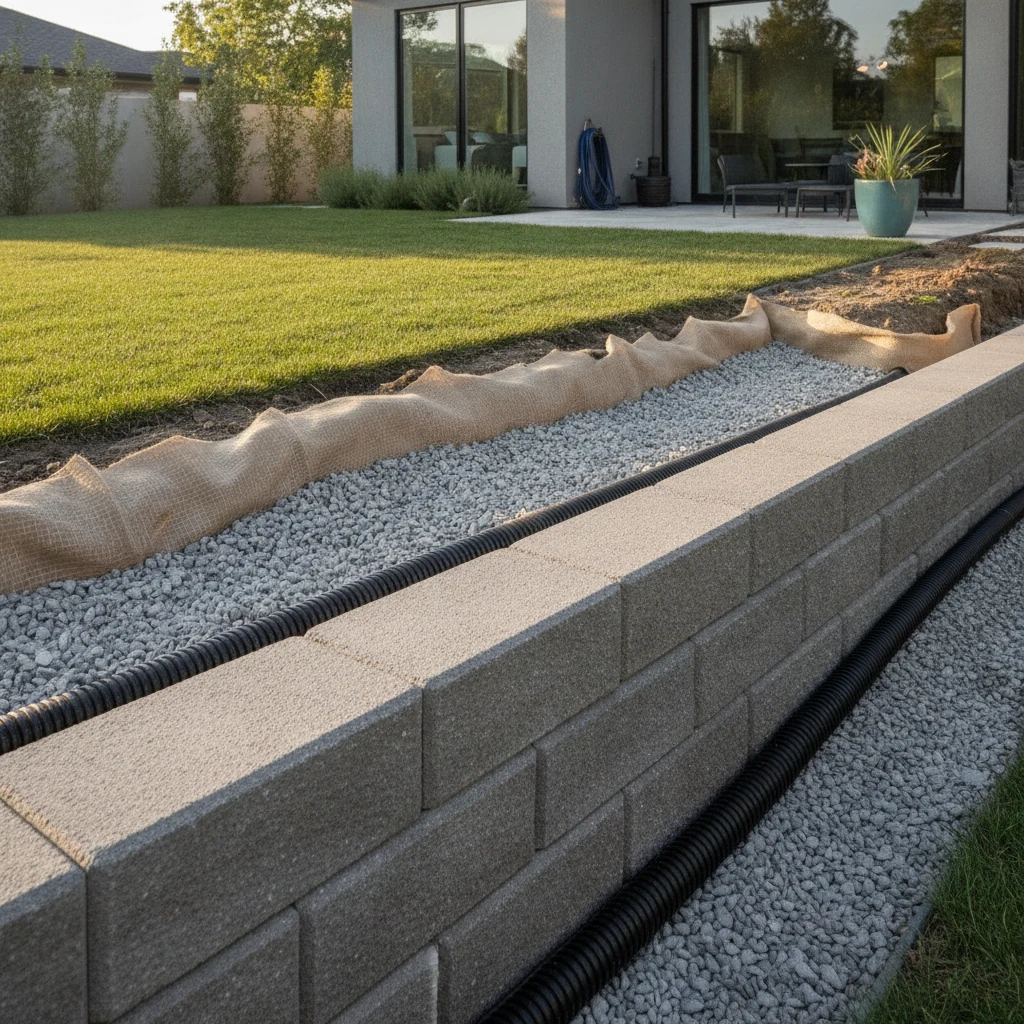
On a typical 4-foot backyard retaining wall, the drainage system costs about $10–$30 per linear foot — roughly 10–15% of the build. It is also the single most commonly skipped or under-budgeted step, and when it is skipped it is the reason walls lean, bulge, and blow out. The uncomfortable math: a wall that fails from trapped water usually costs more to rebuild than it cost to build the first time, because you pay to demolish and haul away the old one before you can start over. Drainage is the cheapest insurance in the entire project. Here is what it actually buys, what happens without it, and how to make sure it is in your quote.
What "drainage" actually is on a retaining wall
"Add drainage" is not one thing — it is a small system working behind the wall face where you never see it. On a professionally built wall it has four parts:
- Granular backfill — a zone of angular gravel or crushed stone (typically 12 inches deep) packed directly behind the blocks so water drops straight down instead of soaking into the soil and pushing on the wall.
- A perforated drain pipe (drain tile) — a 3–4" pipe laid at the base of the gravel, pitched to daylight or a drywell, that carries collected water away from the wall.
- Geotextile filter fabric — a membrane between the gravel and the native soil that keeps fine dirt from clogging the gravel and pipe over time.
- Weep holes — gaps or vents through the wall face that let any remaining water escape to the front.
All in, that system runs about $10–$30 per linear foot depending on wall height and site access, per 2025–26 national contractor cost surveys. On a standard 4-foot wall that lands in the 10–15% range of total cost — but be careful with the percentage: on a short 2-foot garden wall the same drainage work can be a third of the (small) total, and on a tall engineered wall it is a smaller slice of a much bigger number. Think in dollars per foot first, not as a flat percentage.
Why walls without drainage fail — and why it isn't only about drainage
When water can't escape, saturated soil behind the wall does two destructive things. First, hydrostatic pressure: water-logged soil behaves like a heavy fluid and can push on the wall with double or triple the load it was designed for, which shows up as bulging, cracking, and forward lean. Second, in cold climates, frost heave: trapped water expands about 9% when it freezes, and repeated freeze-thaw cycles pry the wall apart and shift its footing.
Soil type changes how bad this gets. Clay soils hold water and swell, so they punish a missing drain far harder than sandy, granular soils that shed water on their own. That is exactly why the gravel backfill matters — it replaces the water-hungry native soil right where the pressure builds.
One honest caveat, because your contractor should be thinking about all of it: drainage is the most-skipped failure driver, not the only one. A wall can still fail with perfect drainage if the base isn't compacted, if a segmental block wall over ~3 feet has no geogrid soil reinforcement, or if the footing isn't embedded deep enough below grade. Drainage is the cheapest of these make-or-break steps to get right and the one most often value-engineered out of a bid — which is why it deserves top billing, not sole billing.
The part nobody quotes you: a failed wall costs more than the original
Repair pricing scales with how far gone the wall is. Sealing minor cracks runs roughly $150–$500; correcting drainage or minor settling, $500–$1,200; straightening a leaning or bulging wall, $1,200–$5,000+. A full tear-down and rebuild commonly lands at $6,000–$14,000.
To compare fairly, price the same wall both ways. Take a 50-foot-long, 4-foot-high segmental-block wall — 200 square feet of wall face. At about $35 per square foot installed with proper drainage, that's roughly $7,000, of which drainage was maybe $600–$1,200. Now assume it was built dry and fails in a few years. The rebuild isn't just $7,000 again:
- Demolition and removal comes first — about $10–$20 per linear foot for timber or small block, and meaningfully more for poured concrete or large SRW units that need a hydraulic breaker and an excavator.
- Restricted access — machinery that rolled onto a bare lot the first time now has to work around an established yard, fences, and finished grading.
- Collateral damage — landscaping, a patio, or hardscape installed above or below the wall since the original build often has to come out and go back.
- Disposal fees — heavy, wet soil and broken concrete are billed by weight at the tipping station, not by the foot.
Stack those on top of a fresh build and the rebuild reliably exceeds the original. You are paying twice for the wall and once for the cleanup — to save a few hundred dollars of gravel and pipe the first time.
The cost-per-year lens: the cheapest wall is rarely the cheapest
Upfront price is the wrong number to optimize. Divide installed cost by realistic service life and the ranking changes. These are typical installed ranges (per square foot of wall face) and life expectancies when built and drained correctly:
| Material | Installed cost / sq ft | Service life | Rough cost per year* |
|---|---|---|---|
| Pressure-treated timber | $15–$30 | 10–25 yrs | Highest — rots regardless of drainage |
| Gabion (rock-filled cages) | $10–$55 | 30–80 yrs | Low |
| Segmental block (SRW) | $20–$55 | 50–100 yrs | Low |
| Poured / CIP concrete | $25–$60 | 50–100+ yrs | Low |
| Natural stone / boulder | $25–$70 | 75–150+ yrs | Lowest |
*Directional, for a wall that is properly drained and reinforced. Life expectancies collapse toward the low end — or below it — when drainage is skipped.
The catch worth stating plainly: the 40-year (or longer) lifespans belong to block, concrete, and stone. Timber tops out around 25 years no matter how well you drain it, because the failure mode is organic rot, not water pressure. So if your goal is a wall that outlives the mortgage, drainage protects a masonry or concrete wall's decades — it can't rescue a wood wall from its own chemistry. Run your own numbers on the retaining wall cost calculator before you commit to a material.
When drainage — and an engineer — stop being optional
Above a certain height, drainage design isn't a preference, it's code. Most U.S. jurisdictions require a permit and an engineered design for walls taller than 4 feet, measured from the bottom of the footing to the top of the wall (not just the part you see above ground), a threshold rooted in the International Building Code. Two things trip people up:
- Local codes are often stricter. Plenty of municipalities set the trigger at 3 feet or even 2 feet. Check your local building department before you assume 4 feet applies.
- A "surcharge" lowers the bar to zero. If anything adds load to the soil behind the wall — a driveway, a pool, a parking area, or a steep slope above it — an engineered design is typically required at any height. That engineered design will specify the drainage, so it is baked in whether you like it or not.
The practical takeaway: on anything approaching 4 feet, or with a load above it, budget for engineering and treat drainage as non-negotiable. On lower garden walls you have more latitude — but the cost of adding drainage is so small relative to the wall that skipping it rarely makes sense.
How to make sure drainage is actually in your bid
Drainage is invisible once the wall is backfilled, which makes it the easiest line to quietly drop from a lowball quote. When you compare contractor quotes, look for these specifics — a bid that omits them is not cheaper, it's incomplete:
- A stated depth of gravel/crushed-stone backfill behind the wall (e.g., "12 inches of ¾" clean stone").
- A perforated drain pipe at the base, with where it drains to (daylight, drywell, or storm connection).
- Filter fabric between stone and native soil.
- For SRW walls over ~3 feet, geogrid reinforcement layers and base compaction spelled out.
If two bids are hundreds apart, this is usually where the difference hides. The same discipline applies to any hardscape that holds back soil or water — the drainage-first mindset carries over to a paver or stone patio and to pavers-vs-concrete decisions, where base prep and runoff quietly decide how long the surface lasts.
Frequently asked questions
Can I add drainage to an existing retaining wall?
Sometimes, but it's expensive relative to doing it during construction. Retrofitting usually means excavating the backfill to install gravel and a drain pipe, or coring weep holes and adding a French drain at the base — often $1,000+ on a wall where the same work cost a few hundred dollars if done upfront. It's still far cheaper than a rebuild if the wall is showing early signs of pressure.
How do I tell if my wall has a drainage problem before it fails?
Watch for a forward lean or bulge in the wall face, stair-step cracking, blocks separating at the joints, soil or water seeping through the face after rain, or standing water and soggy ground at the top. Any of these means water is building up behind the wall — get it looked at before it moves from a $500–$1,200 correction to a four-figure rebuild.
Do short garden walls under 3 feet really need all of this?
They need less, but not nothing. A low wall carries far lower soil pressure, so a simpler gravel-backfill-and-weep-hole approach is often enough and engineering usually isn't required. But because the drainage cost is tiny at that scale, skipping it entirely to save a hundred dollars is a poor trade — clay soil and freeze-thaw can still shift even a short wall.
The bottom line: drainage is the highest-return dollar in a retaining wall budget — small enough to disappear from a quote, decisive enough to determine whether the wall lasts decades or fails in a few years. Price it as part of the wall, not an upgrade. Then estimate your full retaining wall cost with drainage, reinforcement, and material factored in, so the number you plan around is the one that actually holds up the hill.