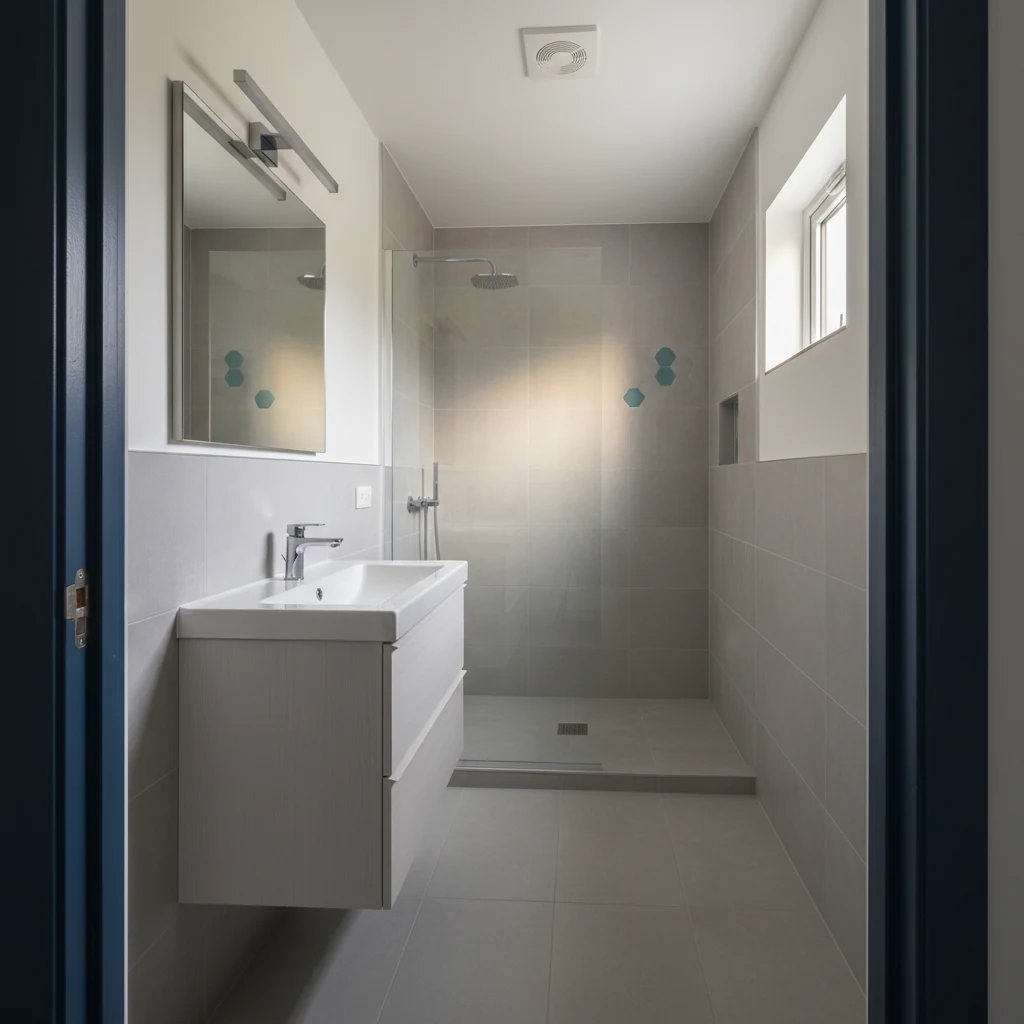
A small bathroom remodel costs $6,000 to $25,000 in 2026 — and on a per-square-foot basis, it almost always costs more than a master bathroom remodel of equivalent finish quality. Mid-range gut renovations in a 5x7 (35 sq ft) bath run roughly $350 to $700 per square foot. A 100-sq-ft master bath at the same finish level runs $250 to $400 per square foot. That gap is not a quirk of contractor pricing. It is the predictable result of four fixed costs that show up no matter how small the room is.
Most cost articles bury this. They quote a range, point to the bathroom calculator, and move on. The actually-useful question is: why does halving the floor area not halve the price? Once you know which line items don't scale, you can predict where your budget will go and which scope cuts will actually save money (and which won't).
The Headline Numbers
Here is the per-square-foot picture in 2026, by size and scope. These are installed-cost ranges drawn from current industry pricing and the 2024 Remodeling Cost vs. Value Report.
| Scope | Small (35-40 sq ft) | Mid (60-80 sq ft) | Master (100-150 sq ft) |
|---|---|---|---|
| Cosmetic refresh | $170-$300 / sq ft | $130-$230 / sq ft | $100-$180 / sq ft |
| Mid-range remodel | $400-$700 / sq ft | $300-$500 / sq ft | $250-$400 / sq ft |
| Gut renovation (high-end finishes) | $600-$900 / sq ft | $450-$700 / sq ft | $350-$600 / sq ft |
The 2024 Cost vs. Value Report puts a national-average mid-range bathroom remodel at $25,251 — and that figure is benchmarked against a 5x7 bathroom. Divide it out: $721 per square foot. The same report puts an upscale bathroom remodel at $78,840, also benchmarked at a small footprint. Those numbers feel high because they are spread over very little floor area.
Move the same scope of work into a 100-square-foot master bath and the per-square-foot number drops by roughly 30 to 50 percent, even though the total project cost rises. That is the inversion in one sentence: total cost grows with size, but per-square-foot cost shrinks.
The Four Fixed Costs That Don't Scale
Bathroom remodels carry four cost buckets that show up at full price regardless of whether the room is 35 square feet or 135 square feet. In a small bath, those fixed costs are spread over so little area that they overwhelm everything else.
1. Fixtures: The Toilet, Vanity, and Shower Are One Each
A small bathroom and a master bathroom both need exactly one toilet, one sink (the vast majority of master baths still use a single primary vanity), one tub or shower assembly, and the rough plumbing to feed them. Doubling the floor area does not double the fixture count.
| Fixture line item | Typical installed cost |
|---|---|
| Toilet (mid-range, installed) | $300 - $600 |
| Vanity, 24"-36" with top and faucet | $700 - $2,200 |
| Shower valve rough-in replacement | $225 - $575 |
| Tub-to-shower conversion (no plumbing relocation) | $3,500 - $8,000 |
| Drain line relocation (per fixture) | $900 - $1,500 |
A reasonable fixture package on a mid-range remodel runs $4,000 to $7,000 before any tile or finishes hit the floor. In a 35-sq-ft bath, that's $115-$200 per square foot just on fixtures. In a 125-sq-ft master, it's $32-$56. Same fixtures, very different per-sq-ft impact.
2. Code-Triggered Electrical and Ventilation
Once the walls are open, current code applies. The National Electrical Code requires GFCI protection on all 125-volt receptacles in bathrooms (NEC 210.8(A)(1)) and a dedicated 20-amp branch circuit feeding them. The International Residential Code requires mechanical ventilation in any bathroom without an openable window adequate to the floor area — a minimum 50 CFM intermittent or 20 CFM continuous exhaust fan, ducted to the exterior (IRC M1507.4, with R303.3 setting the broader habitability requirement).
The cost of meeting code:
- GFCI circuit + receptacles: $250-$500 if the existing circuit needs replacement (common in homes built before the mid-1990s when GFCI mandates were narrower).
- Dedicated bath circuit: $400-$900 if a new run from the panel is needed.
- Vanity light and switch: $200-$500 for fixture and install.
- Exhaust fan with timer or humidity sensor, ducted to exterior: $300-$700 installed.
- Permit fee, electrical and mechanical combined: $200-$800 depending on municipality.
That's $1,350-$3,400 of fixed code-driven cost that lands the moment you pull a permit. None of it grows or shrinks with floor area. In a small bath, it accounts for 10-20 percent of the entire project budget.
3. Tile Waste Cuts Worse in Small Rooms
Tile installation labor runs $5-$15 per square foot nationally in 2026 for standard formats, plus material. The total tile bill in a bathroom is not just the floor — it's the floor, the shower walls (commonly 60-80 sq ft of vertical tile in a walk-in shower), often a wainscot, and increasingly the full wall around the vanity. A 35-sq-ft bath may need 90-110 total square feet of tile installed; a 125-sq-ft master may need 200-240. Tile coverage scales with roughly the cube root of the floor footprint, not linearly.
And small rooms cut worse. Standard waste assumptions are 10 percent on rectangular floor layouts, 15 percent on diagonals, and 20 percent or more when tile must be cut around alcoves, vanities, and small awkward corners. A small bath has more corners per square foot than a large one. Combine higher waste percentages with smaller fields, and the effective material cost-per-installed-foot is meaningfully higher.
Add the practical reality of tradesman minimums: a tile installer typically charges a one- or two-day minimum, even if the actual work would only fill half a day. In a master bath that's invisible (the work fills the time). In a small bath it shows up as effective hourly rate inflation.
4. Permit, Design, and Mobilization Are Per-Job, Not Per-Foot
Building permits, design review, and general-contractor mobilization (the daily overhead of running the job — site protection, dumpster, port-a-john if outside, project management hours) all run on a per-job basis. A typical permit bundle in a U.S. municipality runs $200-$800. A general contractor will load roughly $1,500-$3,000 of fixed mobilization and PM into the bid before line items even start. Those numbers are roughly the same on a $20,000 bathroom and a $50,000 bathroom.
None of this is hidden — it is what the industry has been quietly charging for decades. It only becomes visible when you compute per-square-foot.
The Per-Sq-Ft Math, Worked Out
Take a real mid-range remodel target: replace tub with walk-in shower, new toilet, new vanity, new tile floor and shower walls, new lighting, new exhaust fan, new paint. Same finish quality across two sizes.
| Line item | 5x7 (35 sq ft) | 10x12.5 (125 sq ft) |
|---|---|---|
| Demolition + disposal | $800 | $1,800 |
| Fixtures (toilet, vanity, shower) | $5,500 | $5,500 |
| Electrical (GFCI, circuit, lighting, fan) | $1,800 | $2,400 |
| Plumbing (rough-in updates, no relocation) | $1,500 | $1,800 |
| Tile material + labor | $4,500 | $10,500 |
| Drywall, paint, trim | $1,200 | $3,200 |
| Permits + GC mobilization + PM | $3,000 | $3,500 |
| Total | $18,300 | $28,700 |
| Per square foot | $523 | $230 |
The master bath costs 57 percent more in absolute dollars but 56 percent less per square foot. That is the inversion, fully visible. Of the small bath's $18,300 budget, roughly $11,800 — almost 65 percent — sits in fixtures, electrical, plumbing, permits, and mobilization that didn't grow with size. The master bath's $28,700 spreads that same $11,800 across 3.5× the area.
What This Means for Your Project
Five practical implications, in roughly decreasing usefulness:
- Don't budget per square foot for a small bath. If a contractor or a calculator quotes you "$200 per square foot" for a small bath remodel, that's a cosmetic refresh price — not a full remodel. Real mid-range gut renovation prices in a 35-sq-ft bathroom land at $400-$700 per square foot. Plan on the total being $15,000-$25,000, not $7,000.
- Cutting scope on fixtures saves more than cutting tile. If you need to cut $3,000 from a small-bath budget, choosing a $400 vanity instead of a $1,800 one moves the needle more than going from large-format porcelain to ceramic subway. Fixtures are a fixed cost item that doesn't shrink with the room — but you do have substantial choice within each fixture.
- "Just refresh, don't gut" is the right call more often than people think. If your plumbing layout works, your floor isn't damaged, and your tile isn't broken, a refresh — new paint, new mirror, new vanity top, new toilet seat, new lighting — at $3,000-$8,000 can buy 5-8 years of "this room feels new" without paying the fixed-cost overhead twice. Composite bathroom remodel case studies show that the most expensive regret is gutting when refreshing would have done.
- Combining bathrooms during a whole-house remodel saves real money. If you're remodeling two bathrooms at once, the GC mobilization, design hours, and permit overhead are shared. The marginal cost of the second bathroom is 10-20 percent lower than doing them sequentially. This is the only legitimate "remodel-more-to-save-more" argument in residential construction.
- Watch for "fixed cost stacking" on tiny powder rooms. A half bath at 20 square feet hits the same fixed-cost floor as a 35-sq-ft full bath (toilet, sink, GFCI, fan, permit) — but with even less floor area to absorb it. Powder-room gut renovations regularly run $8,000-$15,000 and produce $400-$750 per square foot bills. That's not because contractors are gouging; it's because the fixed-cost denominator is just very small.
Plan Your Number, Not Theirs
The most common bathroom-remodel budget mistake is anchoring on a national-average dollar figure (the $25,251 you'll see quoted everywhere) and assuming it's roughly your bathroom. It is roughly a 5x7 bathroom. If yours is bigger, the per-square-foot rate drops and the total rises more slowly than you'd expect. If yours is smaller, the total can land surprisingly close to that benchmark even at higher quality finishes — because the fixed-cost floor isn't moving.
Run your specific layout through the bathroom remodel cost calculator with your real square footage, your fixture choices, and your local labor rates. The calculator works in line items, not averages — so the four fixed costs land where they actually land in your project, not where a national benchmark suggests they should.
For the related decisions that drive total cost: tank vs. tankless water heater matters if you're upgrading the bathroom's hot water source while the walls are open; ROI thinking from the basement guide applies to bathrooms too, especially for second-bath additions; and composite kitchen remodel case studies show the same fixed-cost pattern in a different room.