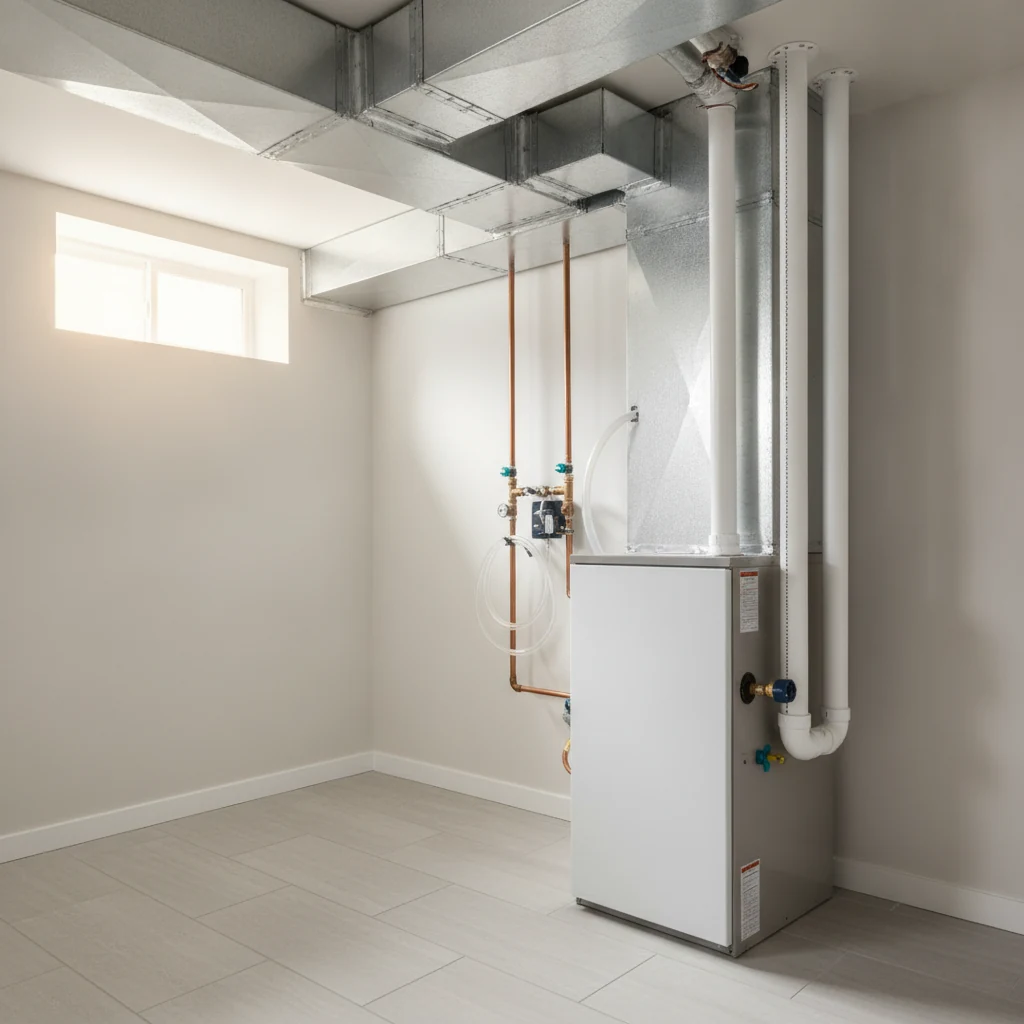
A furnace replacement runs $3,500 to $7,500 installed for a standard gas system, with the national average landing around $4,800 to $6,300. But here is the number almost no quote breaks out for you: the furnace itself — the appliance the whole job is named after — is usually the smallest line on the bill. A standard 80% efficiency gas furnace costs the contractor roughly $500 to $1,800 as a piece of equipment. On a $5,500 job, that is about a fifth of what you pay.
Everything else — labor, ductwork, venting, permits, disposal, a correctly sized load calculation — is the other four-fifths. Once you understand that split, nearly everything confusing about furnace pricing snaps into focus: why two quotes for the "same" furnace differ by thousands, why the cheapest bid is often the most expensive mistake, and why "just buy a smaller unit" almost never lowers the price.
What Furnace Replacement Actually Costs in 2026
Here is the realistic range for a professionally installed forced-air furnace, before we take the bill apart:
| Scenario | Typical installed cost |
|---|---|
| Straightforward like-for-like swap (standard 80% AFUE gas) | $3,500 – $5,500 |
| National average, all jobs | $4,800 – $6,300 |
| High-efficiency (90–98% AFUE) with new venting | $6,000 – $9,000 |
| Complex job (duct changes, tight access, upsizing) | $8,000 – $11,000+ |
Ranges reflect 2026 U.S. contractor pricing for residential forced-air furnace replacement.
Notice how wide that is — a $2,500 spread on a "simple" swap and far more once the job gets complicated. That spread is not the furnace. It is the work around the furnace.
Why the Furnace Is the Cheapest Part of the Job
Break a typical $5,500 replacement into its real components and the appliance shrinks fast:
| Line item | Share of a typical bill |
|---|---|
| The furnace unit (equipment) | ~20–30% |
| Installation labor, permits, disposal | ~40–60% |
| Ductwork, venting & connections | ~15–30% |
Labor and non-equipment costs account for roughly 40–60% of a furnace replacement bill.
The reason is labor. A furnace swap is a full day for a two-person crew: disconnecting and hauling out the old unit, setting the new one, reconnecting gas, electrical, and the flue, wiring the thermostat and safety controls, then commissioning and testing the system. Skilled HVAC labor is not cheap — technicians bill $75 to $150 an hour, and the trade's median wage was $61,010 as of May 2025, according to the U.S. Bureau of Labor Statistics. That labor cost barely moves whether you install a $600 builder-grade unit or a $2,500 premium one.
This is exactly the pattern we found when we took apart paver driveway pricing: the material everyone fixates on is the small part, and labor is the line that actually decides the total. Furnaces work the same way. The single most useful thing you can do before signing a quote is run your own heating cost estimate so you know roughly what the job should land at — then read the bid against it.
The Four Line Items That Actually Move Your Quote
If the furnace is not what makes two quotes differ by $3,000, what is? Four things, almost every time.
1. Ductwork changes
Your existing ducts are the most expensive variable in the whole job. A clean swap onto healthy ductwork adds nothing. But if the ducts are undersized, leaky, or need to be re-routed, costs climb quickly — a full duct replacement for a typical home runs $3,500 to $12,000 on its own. Most jobs need only modifications, but even those can add several hundred to a couple thousand dollars. A contractor who inspects your ducts before quoting is protecting you; one who ignores them is setting up a change order later.
2. Efficiency and the venting it requires
Standard 80% AFUE furnaces vent through your existing metal flue. High-efficiency condensing furnaces (90–98% AFUE) do not — they produce cool, acidic exhaust that has to run through new PVC venting, which typically adds $300 to $700 and a condensate drain. That is part of why a high-efficiency unit costs more to install than its price tag alone suggests.
3. Correct sizing (the step cheap bids skip)
An oversized furnace short-cycles, wears out faster, and heats unevenly; an undersized one runs constantly and never quite keeps up. A proper Manual J load calculation — the industry standard for sizing — costs about $150 to $450 and is the difference between a system that lasts 20 years and one you fight with. Bargain quotes often skip it and simply match whatever size was there before, which may have been wrong to begin with.
4. Permits, disposal, and access
Pulling a permit and having the install inspected is not optional in most jurisdictions, and it protects you at resale. Hauling away the old unit, tight attic or crawlspace access, and code upgrades (a new disconnect, a drip leg, an updated flue) all add labor hours. None of it shows up as "furnace," but all of it shows up on the bill.
High-Efficiency vs. Standard: The Math Changed in 2026
For years the pitch for a high-efficiency furnace leaned on a federal tax credit. That lever is gone. The Energy Efficient Home Improvement Credit (Section 25C), which had offered up to $600 toward a qualifying high-efficiency furnace, expired for equipment placed in service after December 31, 2025, per the IRS. If a contractor's 2026 quote still bakes in a federal furnace credit, that is a red flag worth questioning.
Without the credit, high efficiency has to pay for itself on fuel savings alone. The upgrade from 80% to 96% AFUE means about 16% less gas burned for the same heat. Whether that recovers the extra $1,500–$3,000 in equipment and venting depends entirely on your climate and gas price — a cold Minnesota winter pays it back far faster than a mild Georgia one. If you are weighing fuel types rather than just efficiency, our breakdowns of heat pump vs. gas furnace cost and electric vs. gas heating run the numbers by state.
Rule of thumb: in a cold climate with average or high gas prices, high-efficiency usually wins over the life of the unit. In a mild climate, a standard 80% furnace is often the smarter buy now that the tax credit is off the table.
Repair or Replace? The Break-Even Math
If your furnace still works, the real question is not "what does a new one cost" but "is one more repair worth it." Two numbers decide it.
First, age. A gas furnace lasts 15 to 20 years. Past 15, its heat exchanger and blower are near the end regardless of any single repair, and efficiency has quietly drifted down for years. Our guide to how long furnaces last covers the warning signs in detail.
Second, the 50% rule: if a single repair costs 50% or more of a new furnace, replace instead of fixing. Minor repairs — igniters, flame sensors, a capacitor — run $150 to $450 and are almost always worth doing. It is the big-ticket failures that trip the rule:
- Cracked heat exchanger — a safety issue (carbon monoxide risk) and often $1,500+. On an older furnace, this is a replace, not a repair.
- Failed blower motor or control board — several hundred to over a thousand dollars. Worth it on a 6-year-old unit; rarely worth it on a 16-year-old one.
A sharper version many contractors use combines the two: multiply the furnace's age by the repair quote — if it clears roughly $5,000, replace. A 16-year-old furnace with a $400 repair scores 6,400: replace. A 6-year-old furnace with the same $400 repair scores 2,400: fix it and move on.
How to Keep Your Quote Honest
Because the furnace is the small part, the way to control the bill is to control the work around it. Before you sign:
- Get an itemized quote that separates equipment, labor, ductwork, venting, and permits. A single lump sum hides exactly the lines that vary.
- Ask whether a Manual J was done. "We'll match the old size" is not sizing.
- Confirm what the efficiency choice actually requires — a 96% unit that needs new PVC venting is a bigger job than the price tag implies.
- Get three bids. With labor as 40–60% of the cost, the spread between contractors is where your real savings live — not in shopping for a cheaper box.
The homeowners who overpay are the ones who compare furnaces. The ones who get it right compare installations. Start with a realistic target from our heating cost calculator, then judge every quote against where the money actually goes.
Frequently Asked Questions
Is it cheaper to replace just the furnace or the whole HVAC system?
Replacing only the furnace is cheaper up front. But if your air conditioner is also near the end of its life, pairing the two installs shares the labor day and often saves money versus two separate visits a year or two apart. The deciding factor is the AC's age, not the furnace's.
Why is my furnace quote so much higher than the "average" I saw online?
Almost always ductwork, venting, or access — not the furnace. National averages assume a clean like-for-like swap. If your quote is $9,000 and the average is $5,500, ask the contractor to itemize what the extra $3,500 is buying; it is usually duct modifications or a high-efficiency venting run.
Does a more expensive furnace last longer?
Not by itself. Lifespan is driven far more by correct sizing, good installation, and annual maintenance than by the price of the unit. A well-installed mid-range furnace routinely outlasts a premium one that was oversized and rushed.
Can I lower the cost by installing a smaller furnace?
Rarely, and it is risky. The equipment price difference between sizes is small, and an undersized furnace runs constantly and wears out early. Correct sizing — not minimum sizing — is what saves money over the life of the system.