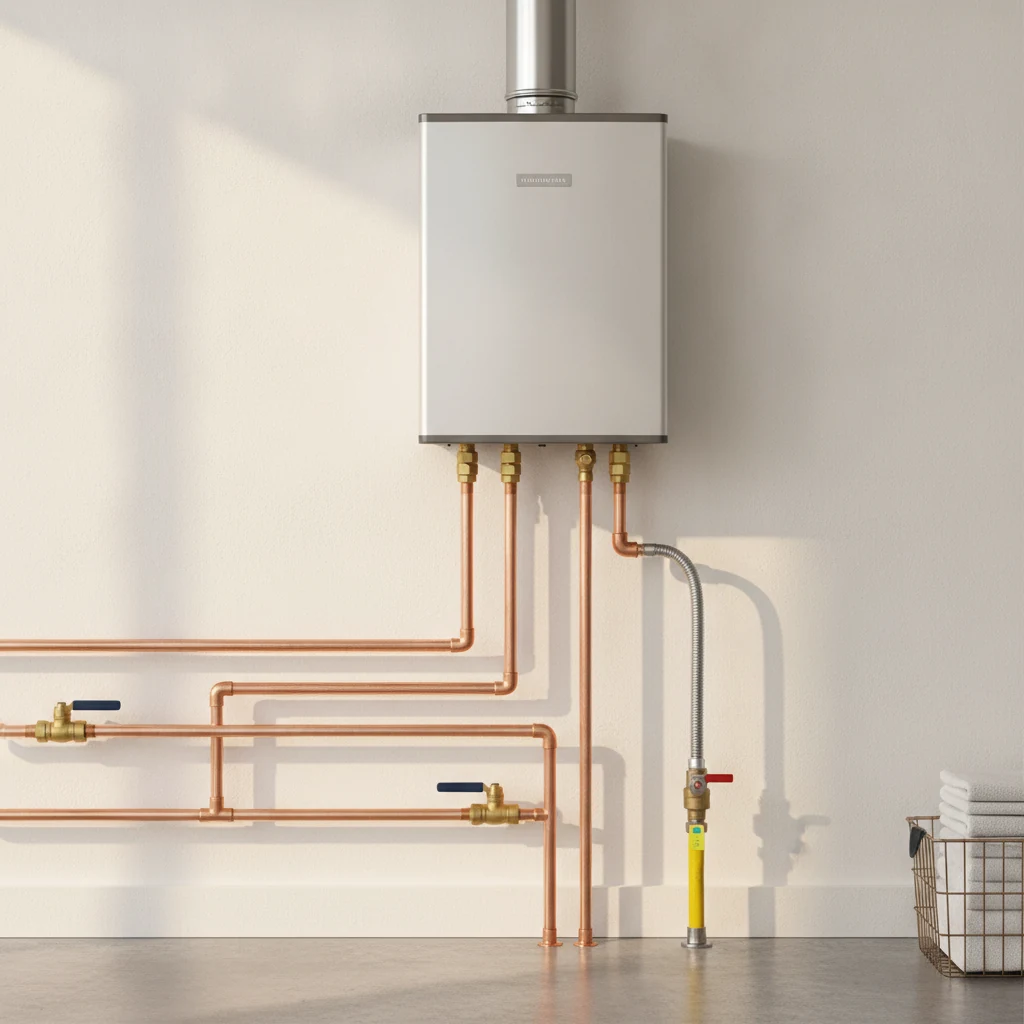
The labor to install a tankless water heater runs $1,500 to $3,500 on a like-for-like swap — and that single line item, not the unit, is what makes one quote $2,200 and the one next to it $5,600. A modern condensing unit costs roughly $900–$2,200 on its own. Everything between that number and your final bill is labor, gas-line work, venting, electrical, and permits — and how much of each you need depends almost entirely on what's already behind your wall.
That's why "price to install a tankless water heater" is the wrong question to type into a search bar and expect one number back. The honest answer is a range, and your position in that range is set before a plumber ever shows up — by your existing gas line size, your venting path, and whether there's a 120V outlet near the unit. This guide breaks the install cost into the line items a contractor actually quotes, shows where the labor hours go, compares big-box install programs against an independent plumber, and explains the 2026 change that quietly raised the real cost for everyone: the federal tax credit is gone.
What "Installation Cost" Actually Includes in 2026
When a plumber hands you a tankless quote, the unit is usually the smallest moving part. Here is the full installed cost broken into the components most contractors itemize separately:
| Line item | Low-end | Typical | High-end |
|---|---|---|---|
| Tankless unit (5–10 GPM, gas/propane condensing) | $900 | $1,400 | $2,200 |
| Plumber labor (4–10 hrs) | $600 | $1,100 | $2,500 |
| Gas line upsize / new run (3/4″, 15–40 ft) | $350 | $650 | $2,000 |
| Stainless category III venting + wall penetration | $100 | $350 | $600 |
| Electrical (120V outlet near unit, if missing) | $0 | $200 | $1,000 |
| Permit + inspection | $50 | $150 | $300 |
| Removal & disposal of old tank | $0 | $150 | $300 |
| Condensate drain (condensing units only) | $0 | $100 | $300 |
| Total installed cost | ~$2,200 | ~$4,000 | ~$5,600+ |
Source: 2026 contractor pricing surveys (HomeGuide, Angi, plumbing-cost aggregators) cross-checked against manufacturer-published install requirements (Rinnai, Navien, Rheem, Takagi).
The reason the same product produces a $2,200 install in one house and a $5,600 install next door comes down to three line items — gas line, venting, and electrical — that a tank-to-tank swap never triggers. Isolate the labor portion and the picture gets clearer.
The Labor Number, On Its Own
Strip out materials and the labor to install a tankless water heater is $600 to $2,500. A clean swap — replacing an existing tankless or tank with the gas, venting, and power already sized correctly — is 4 to 6 hours of work. A full retrofit that adds a gas line, runs new venting through finished space, and adds a circuit can stretch to a two-person, full-day job.
Plumber rates in 2026 run $45 to $200 per hour depending on region, licensing, and whether you're paying a journeyman or a master plumber. That spread is most of why the labor range is so wide:
- Like-for-like swap (4–6 hrs): roughly $600–$1,500 in labor. This is the cheapest path and the most common.
- Tank-to-tankless conversion (6–8 hrs): roughly $1,200–$2,000, because the gas line, venting, and mounting all change.
- Full retrofit with gas/electrical upgrades (8–12 hrs): $2,000–$2,500+, often quoted as a flat project price rather than hourly.
The phrase to listen for in a quote is "like-for-like." If your installer can reuse the existing gas line, vent path, and electrical, you're in the bottom third of every range on this page. If any of those three has to change, you're not.
The Four Upcharges That Inflate a Tankless Quote
Almost every tankless install that comes in over $4,000 got there through some combination of these four items. Knowing them in advance is the difference between reading a quote and being surprised by one.
1. Gas line upsizing ($350–$2,000)
This is the big one. A gas storage tank needs only about 40,000 BTU/hr, so older homes typically have a 1/2″ line. A tankless unit demands 150,000–199,000 BTU/hr at peak, which usually requires a 3/4″ — sometimes 1″ — line depending on length and what else shares the trunk. If the line has to be re-run from the meter or propane regulator, you're at the top of the range. This is the single most common reason an online "$2,000 install" estimate turns into a $4,500 bill.
2. Venting ($100–$600)
Gas tankless units need sealed stainless category III venting, not the old galvanized flue. A short side-wall vent that exits within a few feet of the unit is the cheap case. A vertical run through finished space, or a reroute around joists, pushes venting past $500 on its own.
3. Electrical ($0–$1,000)
Even a gas tankless needs a 120V outlet for its electronic ignition and controls. If there's already an outlet within reach, this is $0. If an electrician has to run a new circuit, budget $200–$1,000. (Electric tankless units are a different and much larger electrical story — see below.)
4. Permits and inspection ($50–$300)
Gas and venting work legally requires a permit in nearly every jurisdiction. A reputable installer pulls it and bakes the inspection into the schedule. A quote that omits permits isn't cheaper — it's incomplete, and it can stall a future home sale when the work shows up as unpermitted.
Electric Tankless: A Different Install Cost Entirely
If you're pricing an electric tankless instead of gas, the unit is usually cheaper but the install can be more expensive — because the cost shifts from gas-line work to electrical-panel work. A whole-house electric tankless commonly needs 100–150 amps of dedicated capacity, one or more 240V double-pole circuits, and heavy 6- or 8-gauge copper wire.
If your existing panel can't carry that load — and many 100- or 150-amp panels in older homes can't — you're looking at a service upgrade. A new dedicated circuit runs $250–$900; a full panel upgrade runs $850–$4,000. The math frequently flips the conventional wisdom: the "cheaper" electric unit ends up costing as much as or more than gas once the panel work is priced in. In homes without natural gas service, that calculus is exactly why many owners land on propane or a heat pump water heater instead.
Big-Box Install Program vs. an Independent Plumber
Both Home Depot and Lowe's sell tankless installation, fulfilled through vetted local subcontractors. Their pricing is competitive on straightforward jobs, but the scope and the way upcharges are handled differ from hiring a plumber directly:
| Path | Typical 2026 pricing | What to know |
|---|---|---|
| Home Depot installed | ~$2,400–$5,400 all-in (unit, labor, permits, old-unit removal) | Single bundled price; gas-line, venting, or access work usually billed as change orders after the in-home assessment. |
| Lowe's installed | ~$823–$3,083 for the install service (unit priced separately) | Service-only number looks low because the unit isn't in it; add the unit to compare apples to apples. |
| Independent licensed plumber | ~$2,200–$5,600 all-in | One accountable contact, more flexible pricing on upcharge items, easier to negotiate scope. |
Source: Home Depot and Lowe's published 2026 installation pricing; independent-plumber figures from contractor surveys. Big-box "from" prices assume a simple swap and exclude most retrofit work.
The practical takeaway: a big-box program is fine for a clean like-for-like swap where the headline price is the real price. The moment your job needs a gas line or venting, the change-order pricing through a retailer is often less flexible than what an independent plumber will quote — and harder to negotiate, because the salesperson and the installer aren't the same person. Get one quote from each and compare line items, not headline numbers.
How to Read a Tankless Install Quote
A complete quote lets you see exactly which of the cost drivers above apply to your house. Before you sign, confirm each of these is spelled out:
- Is the gas line being upsized? If the quote is silent on gas line work for a tank-to-tankless conversion, ask directly — it's the line item most likely to become a surprise.
- What venting is included? Stainless category III vent kit and wall penetration should be named, with footage.
- Is a permit pulled? "Owner pulls permit" on a gas job is a red flag — it shifts liability and inspection scheduling onto you.
- Is old-unit removal and disposal in the price? It's cheap ($0–$300) but frequently left off the "from" price.
- Flat project price or hourly? For retrofits, a flat price protects you from hours overruns; for a clean swap, hourly is usually cheaper.
Rule of thumb: if a tankless quote is more than ~60% unit cost, something expensive (gas line, venting, or panel work) is in it. Make the installer name what.
The 2026 Change Nobody Mentions: The Tax Credit Is Gone
Through 2025, a high-efficiency gas or propane tankless water heater (UEF ≥ 0.95) qualified for the federal Section 25C Energy Efficient Home Improvement Credit — 30% of the cost including installation, capped at $600 for water heaters. A lot of cost guides still quote that credit. It no longer applies.
The One Big Beautiful Bill Act, signed in July 2025, accelerated the credit's termination. Per IRS guidance, the 25C credit "will not be allowed for any property placed in service after December 31, 2025." A tankless water heater installed in 2026 is not eligible. (If yours was installed and operational on or before December 31, 2025, you can still claim it on your 2025 return using IRS Form 5695.)
Practically, this raises the effective 2026 cost of a high-efficiency install by up to $600 versus what the same project would have netted in 2025. It also weakens the case for paying the condensing-unit premium purely for the credit — the efficiency still pays off in fuel savings over the unit's 15–20 year life, but the federal subsidy that used to offset the upcharge is no longer there. Some state and utility rebates ($100–$500 for ENERGY STAR units) still exist and change quarterly, so check your utility's database before you buy — but don't budget around the federal credit.
The Bottom Line
Budget $2,200–$5,600 for an installed tankless water heater in 2026, with labor accounting for $600–$2,500 of that. The number lands low when your gas line, venting, and electrical are already sized for tankless, and high when any of the three has to change. Before you sign anything, get an itemized quote, confirm whether the gas line is being upsized, and compare a big-box bundled price against an independent plumber on a line-by-line basis rather than headline to headline. And budget without the federal tax credit — it expired for 2026 installations.
For a personalized estimate using your home's specs, fuel type, and local labor rates, run our free water heater cost calculator. It compares tankless, storage tank, and heat pump options side by side. If you're weighing fuel types first, our propane tankless water heater cost breakdown walks through the operating-cost math in detail.
Shopping for the unit?
Popular tankless water heaters on Amazon
The install is a plumber job, but the unit itself you can buy yourself — here are well-reviewed high-output (199k BTU) gas tankless models.
As an Amazon Associate, RemodelCostCalc earns from qualifying purchases. Prices and availability are shown on Amazon.